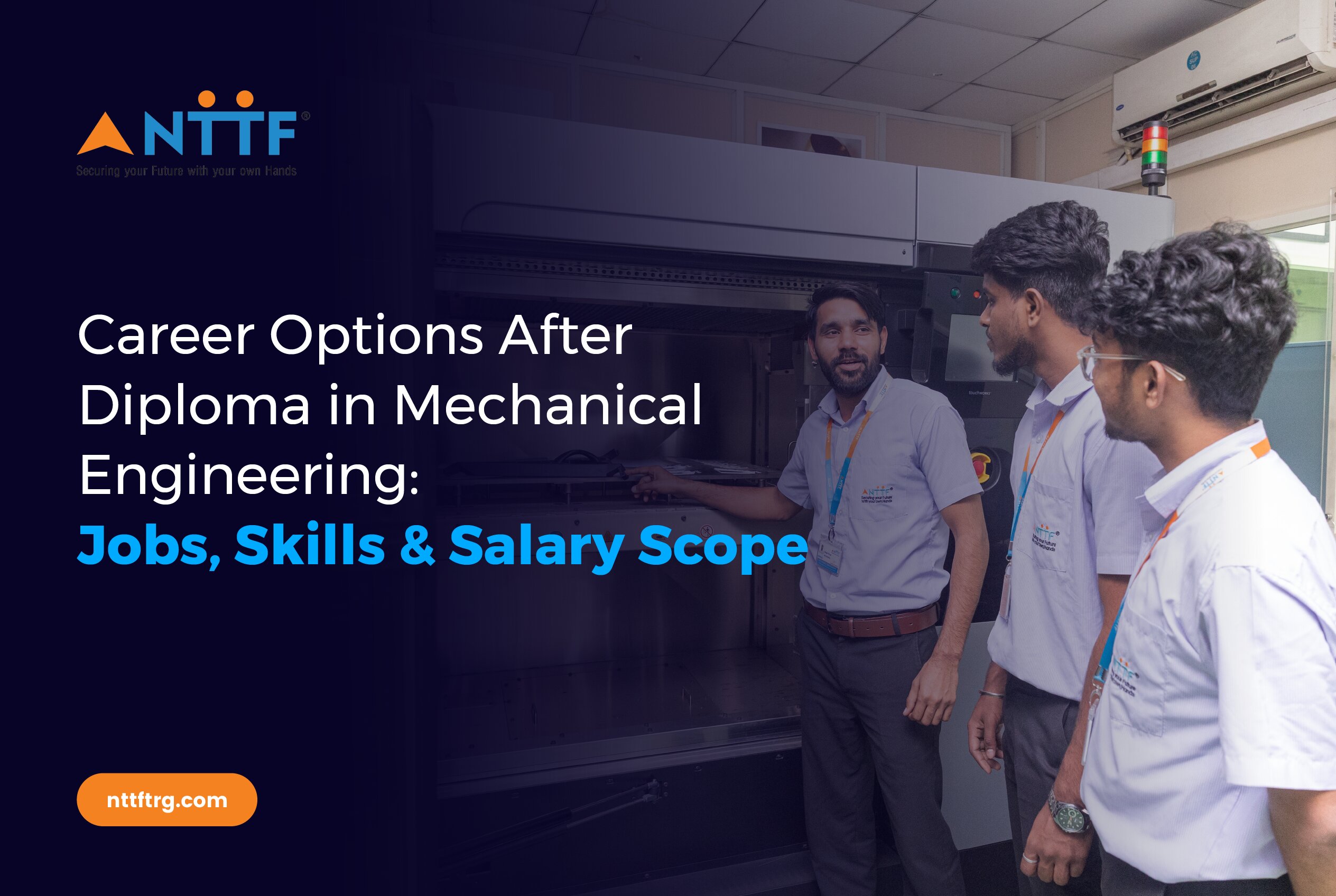
What happens after the completion of a Diploma in Mechanical Engineering?
A diploma in mechanical engineering is often perceived as a pathway of simply employment on the shop floor, but in reality, it opens long-term opportunities in manufacturing, design, automation, and even higher education.
Additionally, the mechanical diploma is among the most universal technical programs offered in India. In factories, tool rooms, design offices, and smart manufacturing units, graduates of mechanical diplomas are very important in ensuring that industries operate.
In this comprehensive blog, let’s find out details about job descriptions, skills, pay levels, post-diploma studies, the state of employment in these fields, and prospects in the field after obtaining a diploma in mechanical engineering.
What is a diploma in mechanical engineering?
A Diploma in Mechanical Engineering is a technical degree that is practice-based in nature and aims to develop solid skills in mechanical systems, manufacturing processes, machines, materials, and industrial practices. This diploma, unlike the completely theoretical ones, puts a lot of emphasis on practical training, workshops, labs, and practice.
Students get to know the design of machines and the way machines are made, assembled, run, and maintained. This makes diploma graduates very marketable in those sectors that are considered the core industries, which are concerned with skill, precision, and efficiency in production.
Why Choose a Mechanical Diploma?
Mechanical engineering is the backbone of industrial development. Choosing the career path of a mechanical diploma leads to many benefits; they are
- Early eligibility to enter the workforce after Class 10
- Heavy demand across production and manufacturing sectors
- Opportunities to work in both core engineering and emerging technologies
- Career clarity for higher studies and further specialization
- Stable and steady career growth with promotions based on experience
This diploma offers a strong and future-ready career base for students who love machines, hands-on work, and problem-solving.
Core Learning areas in a Mechanical Diploma
The all-rounded curriculum of a Diploma in Mechanical Engineering is well designed in such a way that it balances theory and practice. Key learning subjects include:
- Engineering Drawing and CAD
- Workshop Technology
- Manufacturing Processes
- Strength of Materials
- Thermal Engineering
- Fluid Mechanics
- Machine Design Basics
- CNC Machines and Automation
- Metrology and Quality Control
- Industrial Safety and Maintenance
These subjects make students ready for technical responsibilities and real production environments from day one.
Mechanical engineering Diploma: Career Opportunities
The variety of job roles that a Mechanical Diploma allows one to handle is one of the largest strengths of the product.
- Production Supervisor / Production Engineer: Production jobs are aimed at the organization of the manufacturing process, the usage of machines, the planning of workflow, and achieving production goals. A graduate with a diploma is usually a supervisor or junior engineer in production and eventually becomes a leader of a plant.
Industries: Motor vehicles, manufacturing, heavy engineering, consumer goods. - Maintenance Engineer: Maintenance engineers make sure that machines and equipment are operating effectively and with smaller downtime. This position will need good troubleshooting skills and experience.
Industries: Infrastructure projects, power plants, process industries, and factories. - Quality Control Engineer: Quality positions entail checking, testing, measurement, and observing standards. The knowledge of metrology possessed by diploma holders is highly appreciated here.
Industries: Aerospace suppliers, Automotive and Precision Manufacturing. - CNC Operator / CNC Programmer: CNC professionals are perennially in demand with increasing automation and precision manufacturing. Diploma graduates can also be employed as operators and eventually graduate to programming jobs.
Industries: Machine shops, Tool rooms and export manufacturing units. - Tool Designer Assistant / Tool Room Technician: The holder of a mechanical diploma can be important in tool rooms that are related to press tools, molds, jigs, and fixtures.
Industries: Tooling, plastic making, and sheet metal industries. - Design/ CAD Engineer: Diploma holders are able to be involved in the design support division, where they may help senior engineers in product and tooling design with training in engineering drawing and the use of CAD software.
Industries: design, manufacturing, OEMs
Salary Scope after completing Mechanical Diploma
Salary for a Diploma in Mechanical Engineering relies on industry, skills, and location.
- Entry-level: ₹1.8 – ₹3.0 LPA
- 2–5 years’ experience: ₹3.5 – ₹6.0 LPA
- Specialized roles (Tooling, CNC and automation): ₹6.0 – ₹9.0 LPA
With domain expertise, certifications, and consistent performance, diploma holders can develop high earning potential with better experience.
Scope of Government Jobs After Mechanical Diploma
A Mechanical Diploma also opens doors to stable government careers through public sector units and departments.
Common Government Recruiters:
- Indian Railways
- Public Works Department (PWD)
- State Electricity Boards
- Defense services and ordnance factories
- ISRO, DRDO (technical assistant roles)
Recruitment is generally done through competitive exams conducted by state boards, SSC, or PSU-specific tests.
Scope of Higher Studies After Mechanical Engineering Diploma
A diploma does not put a full stop on academic growth. It opens doors to multiple career progression paths.
PG Programs and Specialized Diploma
Students can pursue advanced programs in:
- Tool Engineering
- Digital Manufacturing
- Automation & Robotics
- Mechatronics
- Product Design
These programs improve career growth and enhance specialization.
Skills That Convert Mechanical Diploma Holders Job-Ready
It’s true that beyond technical knowledge, employers nowadays look for practical and professional skills.
Technical Skills
- Machine operation and maintenance
- CNC Machining
- CAD software proficiency
- Measurement and inspection techniques
- Process understanding
Professional Skills
- Problem-solving
- Team coordination
- Safety awareness
- Time management
- Continuous learning mindset
Strong skills often matter more than marks in mechanical careers.
New Developments in Careers in Mechanical Engineering.
There is a rapid development of the mechanical field in relation to technology.
Key Industry Trends:
Intelligent industry and Industry 4.0.
Automation and robotics
Additive manufacturing (3D printing).
Green cars and green production.
Simulation and Digital twins.
Mechanical diploma graduates who update their skills remain current and future proof.
The Rationale Behind Why a Mechanical Diploma is a Long-term Asset of a Career?
A Mechanical Diploma is not just a qualification; it is a career foundation. It allows students to:
- Enter the workforce early
- Gain hands-on industrial experience
- Grow through skills and specialization
- Shift into higher education or leadership roles
- Get comfortable with new technologies easily
Industries will always need skilled mechanical professionals who understand machines, materials, and manufacturing.
Why NTTF?
Choosing the right institute matters just as much as choosing the right course, and this is where NTTF stands apart. For decades, NTTF has built its reputation on one simple belief: technical education must lead to real careers, not just certificates.
At NTTF, the course is not just for the students. It’s more about collaborating on the border of creativity, engineering, manufacturing, and business, which is precisely how the development of products in the real world occurs. From the first day, students will be introduced to industry-quality tools, actual design issues, and work processes so that they will not leave school perplexed.
What Makes NTTF Different?
1) Industry-Integrated Learning
The curriculum developed by NTTF is planned in cooperation with the specialists of the industry, and students should be taught what companies do with CAD/CAE tools for design-for-manufacturing practices. It makes graduates remain up-to-date in rapidly developing products and engineering.
2) Hands-On, Not Theory-Heavy
Having high rates of practical training, 70% and workshops, labs, and live projects, students use more time to design, model, and test better products than memorize concepts.
3) Professional Faculty & Industry Advisors
NTTF students are taught by professionals that introduce years of experience in industry and design to the classroom and provide a link between the classroom and the real world of work.
4) Career Support and Strong Placement
With decades of trust built across manufacturing, automotive, product design, and R&D sectors, NTTF connects students with leading companies and career opportunities across India and beyond. NTTF has a 98% placement record.
5) Legacy of Excellence
NTTF has produced thousands of engineers and designers in more than 60 years that play a role in the manufacturing, innovation, and product development ecosystem in India.
A Diploma in Mechanical Engineering is a wise choice when a student would prefer to learn practically, be highly employable, and gain career growth in the long run. Diploma holders with the proper training, skills, and attitude can develop successful careers in manufacturing, design, automation, and government industries.
Mechanical skills will never be rendered useless in a machine-driven and technologically oriented world.