The automobile industry is no longer changing only under the bonnet. Electric vehicles are transforming how automobiles are designed, manufactured, tested, serviced, and powered..
This change creates a valuable opportunity for diploma engineers. Students with electrical, electronics, mechanical, mechatronics, automobile, and embedded systems backgrounds can enter different parts of the EV ecosystem. However, they must develop skills beyond their basic diploma syllabus.
A suitable EV engineering course can help students understand industry-specific technologies. A diploma in electronics engineering can also provide a strong foundation for battery management, embedded systems, and power electronics roles.
This guide explains the EV career opportunities available to diploma holders. It also covers required skills and relevant courses along with job roles and a practical learning roadmap. Let us learn more:
Why Electric Vehicles Are Creating New Technical Careers
Electric mobility is moving beyond early experimentation. Global electric car sales crossed 20 million units during 2025. Electric cars represented approximately one-quarter of all new cars sold worldwide that year.
India’s electric car market also expanded during 2025. Sales increased by approximately 75% to reach 165,000 vehicles. Electric cars represented nearly 4% of total car sales in the country.
Electric two-wheelers create another major technical market. India remained the world’s second-largest electric two-wheeler market during 2025, with sales reaching nearly 1.3 million units.
The EV sector now includes:
- Electric two-wheelers
- Electric three-wheelers
- Passenger cars
- Commercial vehicles
- Electric buses
- Battery manufacturing
- Charging infrastructure
- Vehicle testing facilities
- Software and embedded systems
- Maintenance and repair services
India’s PM E-DRIVE scheme supports electric vehicles, charging infrastructure, testing facilities, and domestic manufacturing. The broader scheme carries an outlay of ₹10,900 crore and has been extended until March 31, 2028. This expansion broadens the technical work available across the automobile industry.
A student no longer needs to become only a conventional automobile technician. The same student can build skills in battery diagnostics or charging equipment. Electronics students can work with control units and vehicle sensors.
How Electric Vehicles Differ From Conventional Vehicles
A petrol or diesel vehicle depends mainly on an internal combustion engine.
An electric vehicle uses an electric motor and a high-voltage battery pack. Electronic controllers manage energy flow, motor speed, battery temperature, charging, and safety.
| Conventional Vehicle System | Electric Vehicle Alternative |
| Internal combustion engine | Electric traction motor |
| Fuel tank | High-voltage battery pack |
| Fuel injection system | Power electronic controller |
| Exhaust system | Battery cooling system |
| Alternator | DC-DC converter |
| Mechanical transmission | Electric drivetrain |
| Engine control unit | Vehicle control unit |
| Fuel station | EV charging station |
The mechanical system does not disappear completely. Electric vehicles still require suspension, steering, braking, tyres, structural components, and thermal management. However, electrical and electronic systems become more important. This change explains why diploma engineers from several branches can enter EV careers.
Which Diploma Branches Are Suitable for EV Careers?
Students from different diploma specializations can contribute to the electric vehicle industry.
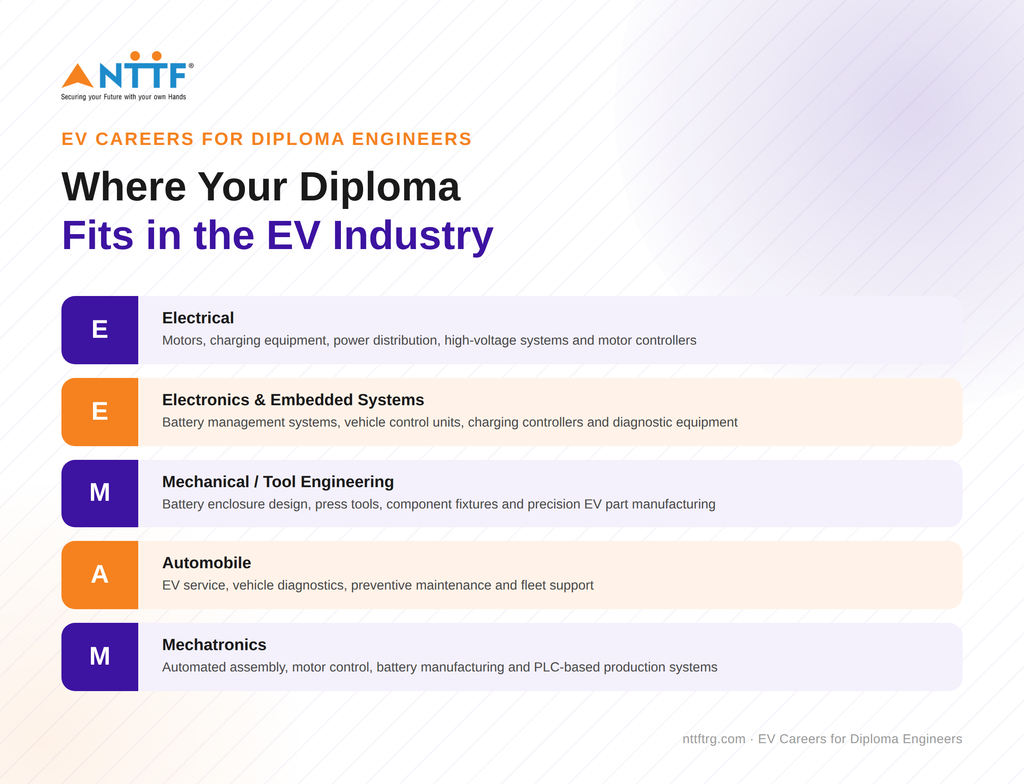
1. Diploma in Electrical Engineering
Electrical diploma students already study circuits, motors, power systems, wiring, and electrical machines.
These foundations support careers involving:
- Electric motors
- Charging equipment
- Power distribution
- Electrical testing
- High-voltage systems
- Motor controllers
- Wiring harnesses
- Maintenance
Additional EV safety training remains essential.
2. Diploma in Electronics Engineering
A diploma in electronics engineering provides a useful foundation for vehicle electronics.
Students may already understand:
- Electronic components
- Digital circuits
- Microcontrollers
- Sensors
- Printed circuit boards
- Testing instruments
- Embedded systems
- Basic programming
These subjects connect directly with battery management systems, vehicle control units, charging controllers, and diagnostic equipment.
NTTF’s Diploma in Electronics and Embedded Systems includes practical learning in electronics, measurements, microcontrollers, programming, circuit simulation, testing, and PCB design.
3. Diploma in Mechanical Engineering
Mechanical diploma students can work across vehicle structure, manufacturing, assembly, and thermal systems.
Suitable areas include:
- Chassis manufacturing
- Battery enclosure design
- Production engineering
- Component inspection
- Thermal management
- Vehicle assembly
- CAD modelling
- Quality control
Mechanical students should add electrical safety and basic EV electronics to their preparation.
4. Diploma in Automobile Engineering
Automobile diploma students understand vehicle systems, maintenance practices, and service operations.
They can prepare for:
- EV service
- Vehicle diagnostics
- Preventive maintenance
- Workshop operations
- Brake and suspension work
- Customer support
- Fleet maintenance
- Road testing
Their strongest transition requirement usually involves batteries, motors, and high-voltage safety.
5. Diploma in Mechatronics Engineering
Mechatronics combines mechanical systems with electronics and automation.
This combination fits several EV functions, including:
- Automated assembly
- Motor control
- Battery manufacturing
- Robotic production
- Sensor integration
- PLC-based systems
- Testing equipment
- Smart maintenance
NTTF’s Diploma in Mechatronics Engineering and Smart Factory includes automation, robotics, PLCs, and smart manufacturing technologies. Its learning model dedicates significant time to hands-on training.
6. Diploma in Tool Engineering
Electric vehicles still require thousands of manufactured parts.
Tool engineering students can contribute through:
- Press tools
- Mould design
- Battery casing production
- Component fixtures
- Jigs and gauges
- Sheet-metal tooling
- Plastic component manufacturing
- Production quality
An EV contains fewer moving powertrain components than a conventional vehicle. However, precision manufacturing remains critical.
12 Electric Vehicle Career Opportunities for Diploma Engineers
The exact job title depends on the employer and qualification requirements.
Some companies use titles such as technician or associate engineer. Others may use junior engineer, trainee, or service executive.
1. EV Service Technician
An EV service technician inspects and repairs electric vehicles.
The role may involve:
- Routine vehicle inspection
- Diagnostic scanning
- Electrical fault identification
- Low-voltage system repair
- Battery condition checks
- Motor inspection
- Software update support
- Service documentation
Technicians must follow strict safety procedures before accessing high-voltage components.
Skills Required
- Automobile fundamentals
- Electrical measurements
- Diagnostic tools
- Wiring diagrams
- Battery basics
- Customer communication
- Workshop safety
2. Battery Assembly Technician
Battery assembly technicians support the production of EV battery modules and packs.
Their responsibilities may include:
- Cell inspection
- Cell sorting
- Module assembly
- Electrical connections
- Insulation checks
- Torque verification
- Pack sealing
- Production documentation
Accuracy is critical because one incorrect connection can affect pack performance.
Skills Required
- Electrical safety
- Basic battery chemistry
- Measuring instruments
- Assembly procedures
- Quality documentation
- Attention to detail
3. Battery Testing Technician
Battery testing technicians evaluate battery cells, modules, and complete packs.
Testing may cover:
- Voltage
- Current
- Capacity
- Temperature
- Charging behaviour
- Discharging behaviour
- Insulation resistance
- Thermal performance
Technicians may also record test results and report unusual behaviour.
Skills Required
- Battery fundamentals
- Multimeters
- Data logging
- Test equipment
- Spreadsheet reporting
- Safety procedures
- Basic fault analysis
4. Battery Management System Technician
A battery management system monitors the condition of an EV battery.
It tracks parameters such as voltage, current, temperature, state of charge, and cell balance.
A BMS technician may support:
- Sensor testing
- Wiring inspection
- Communication checks
- Fault-code analysis
- Calibration
- PCB testing
- Battery data monitoring
- System validation
This role is particularly relevant for students completing a diploma in electronics engineering.
Skills Required
- Embedded systems
- Electronic circuits
- Microcontrollers
- Sensors
- Communication protocols
- PCB testing
- Battery fundamentals
5. Power Electronics Technician
Power electronics controls how electrical energy moves through an EV.
Important EV power electronics components include:
- Inverters
- DC-DC converters
- Onboard chargers
- Motor controllers
- Charging modules
- Power distribution units
A technician may assemble, test, inspect, or troubleshoot these systems.
NTTF’s Post Diploma in Power Electronics connects power conversion knowledge with applications across electric vehicles, renewable energy, and industrial machinery.
Skills Required
- Power semiconductor devices
- Circuit testing
- Oscilloscopes
- Soldering
- PCB inspection
- Electrical safety
- Fault diagnosis
6. Electric Motor Testing Technician
The electric motor converts battery power into vehicle movement.
Motor technicians may support:
- Motor assembly
- Winding inspection
- Insulation testing
- Vibration testing
- Speed measurement
- Torque testing
- Temperature monitoring
- Performance validation
Several EVs use brushless direct current motors or permanent magnet motors.
Skills Required
- Electrical machines
- Motor construction
- Testing instruments
- Mechanical measurements
- Vibration basics
- Technical documentation
7. EV Charging Infrastructure Technician
Charging infrastructure technicians install and maintain EV charging equipment.
The role may involve:
- Site inspection
- Charger installation
- Cable testing
- Earthing verification
- Network configuration
- Preventive maintenance
- Fault diagnosis
- User support
Charging stations combine electrical systems with communication and payment technologies.
Skills Required
- Electrical installation
- Earthing and protection
- Power distribution
- Network basics
- Safety standards
- Diagnostic tools
- Customer handling
8. Embedded Systems Technician
Embedded systems manage several functions inside an EV.
Controllers may operate the battery, motor, charging, braking, lighting, and thermal systems.
An embedded systems technician may support:
- Microcontroller programming
- Sensor integration
- PCB testing
- Firmware testing
- Communication testing
- Prototype assembly
- Fault-code analysis
- Technical documentation
Skills Required
- C or C++ programming
- Microcontrollers
- Electronic circuits
- Sensors
- CAN communication
- PCB fundamentals
- Debugging tools
9. EV Production Technician
Production technicians support the assembly of electric vehicles and components.
Their work may include:
- Component assembly
- Workstation operation
- Torque checks
- Process monitoring
- Material handling
- Equipment inspection
- Production reporting
- Safety compliance
The role requires consistency because manufacturing errors can affect vehicle reliability.
Skills Required
- Manufacturing processes
- Assembly procedures
- Technical drawings
- Workplace discipline
- Quality awareness
- Basic troubleshooting
10. EV Quality Inspection Technician
Quality technicians inspect vehicles, batteries, motors, chargers, and electronic systems.
Their responsibilities may cover:
- Incoming material inspection
- Process inspection
- Dimensional checks
- Electrical testing
- Visual inspection
- Defect reporting
- Root-cause support
- Final product validation
Skills Required
- Measuring instruments
- Technical specifications
- Inspection procedures
- Basic statistics
- Documentation
- Problem-solving
- Attention to detail
11. EV Field Service Technician
Field service technicians visit customer locations or fleet facilities.
They may inspect:
- Electric buses
- Delivery vehicles
- Charging stations
- Commercial fleets
- Battery systems
- Vehicle electronics
The role combines technical knowledge with independent problem-solving.
Skills Required
- Diagnostics
- Electrical troubleshooting
- Travel readiness
- Customer communication
- Service reporting
- Time management
- Safety awareness
12. EV Testing and Validation Technician
Testing technicians help determine whether an EV component performs safely under expected conditions.
Testing may cover:
- Range
- Charging time
- Motor efficiency
- Braking
- Temperature
- Water resistance
- Vibration
- Electrical safety
Testing facilities also require professionals who can operate equipment and record accurate results.
Skills Required
- Test procedures
- Data recording
- Measuring equipment
- Vehicle fundamentals
- Electrical systems
- Technical reporting
- Safety compliance
Career Areas and Suitable Diploma Backgrounds
| EV Career Area | Suitable Diploma Background |
| Battery assembly | Electrical, electronics, mechanical |
| Battery management systems | Electronics, embedded systems |
| Electric motor testing | Electrical, mechatronics |
| Power electronics | Electrical, electronics |
| EV service | Automobile, electrical, mechanical |
| Charging infrastructure | Electrical, electronics |
| Vehicle manufacturing | Mechanical, automobile, mechatronics |
| Embedded controllers | Electronics, embedded systems |
| Quality inspection | Mechanical, electrical, electronics |
| Tooling and fixtures | Tool engineering, mechanical |
| Automated production | Mechatronics, automation |
| Field maintenance | Automobile, electrical, electronics |
Students should review each job description before applying. A related diploma does not guarantee eligibility for every opening.
Important EV Technologies Diploma Students Should Understand
An effective EV engineering course should cover technologies that appear inside real electric vehicles.
1. Battery Technology
The battery is one of the most important EV systems.
Students should understand:
- Battery cells
- Modules and packs
- Voltage and capacity
- Charging cycles
- State of charge
- State of health
- Cell balancing
- Thermal management
- Battery safety
- Battery degradation
Advanced battery chemistry requires deeper study. Diploma freshers should first understand safe handling and basic operation.
2. Battery Management Systems
The BMS protects the battery and monitors its performance.
Students should understand:
- Cell voltage monitoring
- Temperature sensing
- Current measurement
- Overcharge protection
- Deep-discharge protection
- State-of-charge estimation
- Fault detection
- Data communication
Electronics and embedded systems students may find this area especially suitable.
3. Electric Motors
Electric vehicles use motors instead of internal combustion engines.
Students should learn:
- Motor construction
- Torque and speed
- Motor efficiency
- BLDC motors
- Permanent magnet motors
- Motor cooling
- Controller operation
- Motor testing
Motor knowledge is useful across assembly, testing, and maintenance roles.
4. Power Electronics
Power electronics controls electrical energy inside the vehicle.
Important topics include:
- Rectifiers
- Inverters
- DC-DC converters
- Switching devices
- Onboard chargers
- Motor drives
- Heat dissipation
- Circuit protection
Power electronics becomes particularly valuable for electrical and electronics diploma holders.
5. Charging Systems
Students should understand the basic differences between AC and DC charging.
An EV charging curriculum may cover:
- Charger types
- Charging levels
- Connectors
- Electrical protection
- Earthing
- Charging communication
- Load requirements
- Installation safety
- Preventive maintenance
- Fault diagnosis
6. Embedded Controllers
Electronic control units coordinate EV functions.
Useful topics include:
- Microcontrollers
- Sensors
- Actuators
- C programming
- Firmware basics
- CAN communication
- Diagnostic trouble codes
- Data acquisition
7. Thermal Management
Battery and motor performance can change with temperature.
Thermal management systems control heat through air cooling, liquid cooling, sensors, and control systems.
Mechanical and mechatronics students should understand these systems.
8. High-Voltage Safety
EV batteries can operate at dangerous voltage levels.
Students should never practise on high-voltage systems without proper supervision.
Essential safety concepts include:
- Personal protective equipment
- Isolation procedures
- Lockout and tagout
- Insulated tools
- Voltage verification
- Emergency response
- Safe battery handling
- Warning labels
Safety should remain part of every EV task.
What Should an EV Engineering Course Include?
Not every course carrying an EV title provides strong technical preparation. Students should review the syllabus before enrolling. A practical EV engineering course should include:
- Electrical Fundamentals: The course should review voltage, current, resistance, power, and electrical measurements.
- EV Architecture: Students should understand how the battery, motor, controller, charger, and vehicle control unit connect.
- Battery Systems: The syllabus should cover cells, modules, packs, charging, testing, and battery safety.
- Motors and Controllers: Students should learn motor types, control methods, torque, efficiency, and testing.
- Power Electronics: The curriculum should include inverters, converters, chargers, and semiconductor devices.
- Embedded Systems: Microcontrollers, sensors, communication protocols, and basic programming should receive practical coverage.
- Charging Infrastructure: Students should understand charger installation, protection systems, earthing, maintenance, and communication.
- Diagnostic Training: The course should offer exposure to multimeters, oscilloscopes, diagnostic scanners, and data loggers.
- Practical Projects: Students should build, test, or troubleshoot a working EV-related system.
- Industry Exposure: Internships, laboratory sessions, industrial visits, and expert sessions can improve career readiness.
A course based only on presentations may not prepare students for technical roles.
How a Diploma in Electronics Engineering Supports EV Careers
A diploma in electronics engineering can open several EV pathways.
Modern electric vehicles depend heavily on electronic control.
Electronics diploma students can contribute to:
- Battery management systems
- Vehicle control units
- Motor controllers
- Charging controllers
- Sensor systems
- PCB testing
- Embedded software testing
- Diagnostic equipment
Their existing knowledge of circuits and testing instruments provides a useful starting point.
Students should strengthen that foundation with:
- Battery technology
- Power electronics
- CAN communication
- Automotive sensors
- Embedded programming
- Electrical safety
- EV diagnostics
- Practical projects
NTTF’s Electronics and Embedded Systems diploma covers electronics assembly, testing, microcontrollers, programming, circuit simulation, and PCB development. These capabilities can support several emerging automotive electronics pathways.
Practical EV Projects for Diploma Students
Projects help students demonstrate applied knowledge during interviews.
1. Battery Voltage Monitoring System
Build a basic system that measures and displays battery voltage.
Skills demonstrated:
- Sensors
- Microcontrollers
- Display modules
- Basic programming
- Circuit assembly
2. Battery Temperature Alert
Create a system that triggers an alert when battery temperature crosses a safe limit.
Skills demonstrated:
- Temperature sensors
- Threshold programming
- Warning systems
- Circuit testing
3. Small BLDC Motor Controller
Develop a controlled motor demonstration using a suitable low-voltage setup.
Skills demonstrated:
- Motor fundamentals
- Controllers
- Wiring
- Speed control
- Electrical measurements
4. Solar-Assisted EV Charging Model
Build a small educational charging model using a solar panel and battery.
Skills demonstrated:
- Renewable energy
- Charge control
- Power conversion
- System integration
5. EV Charging Station Prototype
Create a low-voltage prototype demonstrating charging authorization and energy monitoring.
Skills demonstrated:
- Relays
- Microcontrollers
- Display systems
- Power measurement
- User authentication
6. Battery State-of-Charge Indicator
Design an indicator that displays approximate battery charge levels.
Skills demonstrated:
- Voltage sensing
- Calibration
- Programming
- User interface design
7. Regenerative Braking Demonstration
Build a small educational setup showing how motor energy can return to a battery.
Skills demonstrated:
- Motors
- Energy conversion
- Measurement
- Circuit design
8. EV Fault Monitoring Dashboard
Create a dashboard that displays simulated battery or motor fault conditions.
Skills demonstrated:
- Data monitoring
- Embedded systems
- Fault codes
- Interface design
Students should use safe, low-voltage components for academic projects.
High-voltage batteries require specialist supervision and safety equipment.
Skills Employers May Check During EV Placements
Technical employers may evaluate both theoretical knowledge and practical behaviour.
Technical Knowledge
Candidates may be asked about:
- Battery fundamentals
- Motor operation
- Charging systems
- Power electronics
- Electrical measurements
- Embedded controllers
- Vehicle architecture
- Safety procedures
Practical Ability
Recruiters may assess:
- Multimeter use
- Circuit inspection
- Wiring interpretation
- Component identification
- Fault diagnosis
- Measurement recording
- Tool handling
- Safety compliance
Soft Skills
Employers also observe:
- Communication
- Listening
- Teamwork
- Accountability
- Problem-solving
- Learning ability
- Workplace discipline
- Attention to detail
A technically capable candidate must still communicate faults clearly.
Common EV Interview Questions for Diploma Freshers
Students can prepare for questions such as:
- What is the basic difference between an EV and a conventional vehicle?
- What is a battery management system?
- Why does an EV require an inverter?
- What is the purpose of a DC-DC converter?
- How does an electric motor produce movement?
- What is regenerative braking?
- What is the difference between AC and DC charging?
- Why is battery temperature monitoring important?
- Which safety steps should precede EV maintenance?
- How would a multimeter help during diagnosis?
- What is the role of sensors inside an EV?
- Which project has prepared you for EV work?
- How would you troubleshoot a charging failure?
- Why do you want to enter the EV industry?
- How would you learn an unfamiliar diagnostic system?
Students should answer through simple explanations and practical examples.
Common Career Preparation Mistakes and Their Solutions
1. Completing Only a General Diploma
A general diploma provides a foundation but may not cover EV-specific systems.
Solution
Students should add an EV specialisation, practical project, or relevant internship.
2. Ignoring Electrical Safety
Mechanical students may focus only on vehicle components.
Solution
Every EV aspirant should learn high-voltage awareness and isolation procedures.
3. Learning Theory Without Using Tools
Videos cannot replace practical measurement and testing.
Solution
Students should practise with multimeters, oscilloscopes, circuits, and diagnostic equipment.
4. Building Projects Without Understanding Them
Copied projects create problems during technical interviews.
Solution
Students should understand every component and testing decision.
5. Focusing Only on Passenger Cars
The EV ecosystem includes two-wheelers, buses, commercial fleets, batteries, and chargers.
Solution
Students should examine the complete mobility ecosystem before choosing a career path.
6. Ignoring Embedded Systems
Modern EVs rely heavily on electronic control.
Solution
Students should learn basic microcontrollers, sensors, programming, and communication systems.
7. Applying to Every EV Role
Different roles require different diploma backgrounds.
Solution
Candidates should compare each job description with their actual skills.
8. Adding Unsupported Skills to the Resume
Listing advanced EV skills without practical understanding reduces credibility.
Solution
Students should mention their real exposure level and relevant projects.
A 90-Day EV Career Preparation Roadmap
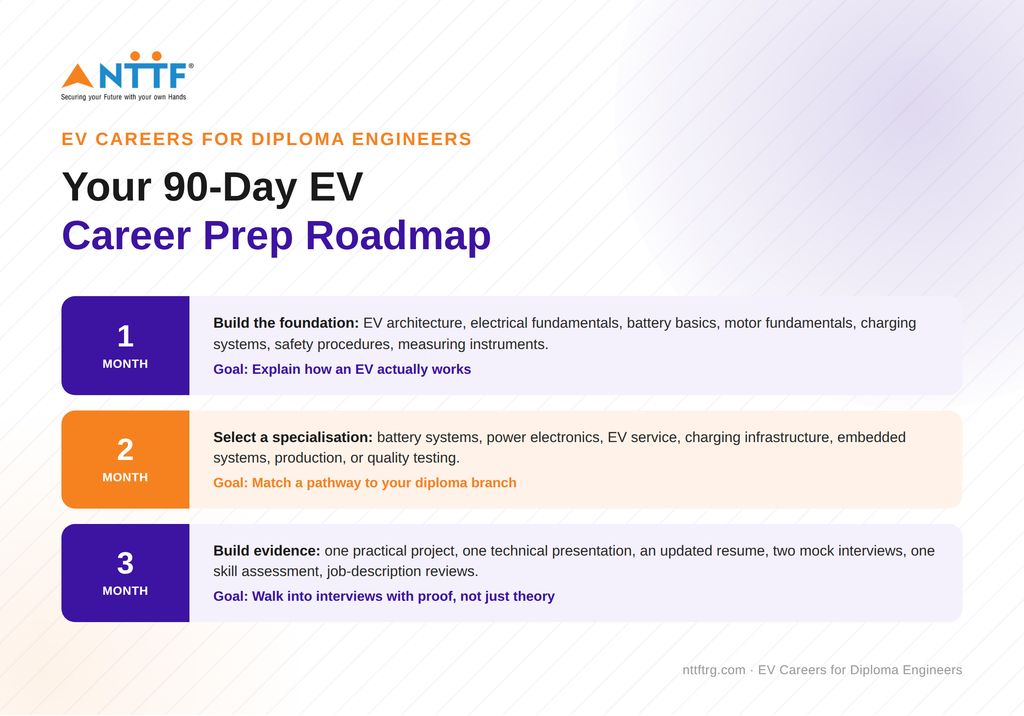
EV Career Readiness Checklist
Diploma students can use this checklist before applying:
- EV architecture can be explained clearly.
- Battery pack fundamentals are understood.
- Electric motor basics have been revised.
- Charging systems can be compared.
- High-voltage safety procedures are understood.
- A multimeter can be used correctly.
- One EV-related project is complete.
- The project contribution can be explained.
- The resume reflects relevant technical skills.
- Embedded systems basics have been reviewed.
- Workplace safety examples are prepared.
- Common EV interview questions have been practised.
- Target roles match the diploma specialisation.
- Job applications use verified sources.
- Further learning requirements have been identified.
Unchecked areas should become preparation priorities.
How NTTF Programs Can Support EV Career Preparation
EV careers require a combination of electronics, electrical systems, manufacturing, and practical problem-solving.
NTTF offers diploma programs in Electronics and Embedded Systems, Electrical and Electronics Systems, Mechatronics, Automation, and Tool Engineering. Its diploma learning model places significant emphasis on practical training.
Students interested in advanced power conversion can also explore NTTF’s Post Diploma in Power Electronics. The program connects power electronics with applications such as electric vehicles, renewable energy, and industrial systems.
Relevant NTTF pathways may include:
- Diploma in Electronics and Embedded Systems
- Diploma in Electrical and Electronics Systems
- Diploma in Mechatronics Engineering and Smart Factory
- Diploma in Automation and Robotics
- Post Diploma in Power Electronics
- Post Diploma in Embedded Systems and IoT
The right program depends on the student’s qualification and preferred EV career area.
Electronics students may focus on control systems and battery electronics. Electrical students may prefer motors, chargers, and power systems.
Conclusion
Electric vehicles are creating a new technical career ecosystem. The opportunity extends beyond vehicle manufacturing. It includes batteries, charging infrastructure, testing, electronics, software, maintenance, and production automation. Diploma engineers already possess many useful foundational skills.
Electrical students understand power systems and motors. Electronics students work with circuits and embedded controllers. Mechanical students understand manufacturing and vehicle components. However, the transition into EV careers requires focused preparation.
A practical EV engineering course can help students understand industry-specific systems. A diploma in electronics engineering can create a strong pathway into battery management, embedded controls, and power electronics. Students should not wait until placement season begins. They should build one relevant project and strengthen electrical safety. Practical exposure can then convert general diploma knowledge into job-ready EV capability.
Explore NTTF’s industry-aligned diploma and post-diploma programs to build the practical electronics, power systems, and automation skills required for emerging electric vehicle careers.