A student can study production for months but understand it faster after seeing a real factory in action. That is why industry visits matter in industrial training in diploma programmes. They connect classroom learning with machines and safety along with connecting quality and maintenance. Students choosing a diploma or ITI diploma course should therefore check how much real industry exposure the institute provides.
This guide explains why industry visits matter and what students should actually observe during them. It also provides a practical framework for turning one factory visit into useful career learning.
An Industry Visit Is Not a Field Trip
This distinction matters. A field trip can be interesting. An industry visit should be useful. Students should return with a clearer understanding of:
- How production actually happens
- Which machines are used
- How different departments interact
- What technicians do every day
- How safety is maintained
- How quality is checked
- Which skills employers expect
- Where their classroom subjects appear in real work
- Which job roles may suit them
The visit becomes valuable when students start connecting what they see with what they already study. A mechanical diploma student may recognise:
- CNC machines
- Hydraulic systems
- Pneumatic systems
- Bearings
- Motors
- Manufacturing processes
- Engineering drawings
An electrical student may notice:
- Motors
- Control panels
- Switchgear
- Sensors
- PLC systems
- Electrical safety equipment
A mechatronics student may see all these technologies working together. That connection is where classroom knowledge begins feeling real.
Why Industry Visits Matter During a Diploma
Diploma programs are expected to prepare students for technical environments. That requires more than passing examinations. Students need to understand how workplaces actually operate. A factory introduces something textbooks cannot fully reproduce; it introduces to context.
A textbook may explain preventive maintenance. A factory shows why one missed maintenance activity can stop an entire production line. A classroom may explain quality control. A factory shows how one incorrect dimension can affect hundreds of products. A laboratory may teach machine operation. An industrial visit shows how several machines are arranged into one production flow. This context makes technical learning easier to remember. It also changes the questions students begin asking.
Instead of asking:
What is this machine?
They begin asking:
Why is this machine being used at this stage?
That is a much stronger technical question.
Industrial Training in Diploma: Where Industry Visits Fit
Industrial training in diploma education can take several forms.
Students may receive practical exposure through:
- Workshops
- Laboratories
- Industry visits
- Internships
- Apprenticeships
- Live projects
- Skill demonstrations
- Industrial assignments
Each one serves a different purpose.
- A laboratory provides a controlled environment.
- An internship provides longer workplace exposure.
- An industry visit sits between the two.
It gives students access to a real workplace without immediately expecting them to perform a technical job. That makes industry visits especially useful during the earlier stages of diploma education.
Students can observe first. They can understand the environment. They can then prepare better for internships and placements later.
Key Industry Visit Benefits
1. Industry Visits Connect Theory With Actual Machines
A student may understand a concept on paper but still struggle to recognise it inside a factory.
Industry visits reduce that gap. Consider hydraulics. A diagram may show:
- Pump
- Valve
- Cylinder
- Reservoir
A student may understand how these components connect. During a factory visit the same hydraulic system may be attached to a press. Now the student can observe:
- Where the hydraulic unit is installed
- How the cylinder creates movement
- Why the machine needs high force
- How operators control it
- Which safety measures surround it
- How maintenance technicians access the system
The concept is no longer abstract. The student has seen where it belongs. This applies across many diploma subjects.
| Classroom Topic | What Students May See in Industry |
| CNC programming | CNC machining centres |
| Hydraulics | Hydraulic presses and lifting systems |
| Pneumatics | Clamping and sorting systems |
| PLC | Automated machine control |
| Electrical machines | Motors and drives |
| Engineering drawing | Manufacturing drawings |
| Quality control | Inspection and measurement |
| Welding | Fabrication processes |
| Production planning | Shop-floor workflow |
| Safety | PPE and machine guarding |
This connection helps students understand why they are learning each subject.
2. Students Understand How Production Actually Works
Factories do not operate as separate textbook chapters because everything is connected. A delay in one operation can affect the next stage while a quality problem can send a component back for rework. A machine breakdown can also affect production targets. Students begin seeing these relationships during industry visits.
Consider a manufacturing line where raw material enters one section and is cut before the component moves to machining. It then goes to inspection followed by assembly and final testing. The product is eventually packaged and dispatched. A student who only studies one machine may miss this larger flow. Industry visits help students see the entire system which is important because many technical jobs require employees to understand what happens before and after their own task.
3. Students See What Automation Looks Like in Practice
Automation sounds impressive in a classroom. A factory shows what it actually means. Students may observe:
- Sensors detecting products
- PLCs controlling sequences
- Pneumatic cylinders moving components
- Robots handling materials
- Conveyors connecting processes
- Motors running machines
- HMIs displaying production information
- Automatic inspection systems
- Safety interlocks stopping equipment
This can completely change how students understand automation. A PLC is no longer only a device used for ladder logic exercises. It becomes the controller coordinating several real operations. A sensor is no longer only an electrical component. It may be the device that prevents the next production step from starting incorrectly. This is one reason industry exposure can strengthen industrial training in diploma programmes. Students start understanding how technologies work together.
4. Students Learn Why Safety Is Part of Technical Skill
Safety rules can feel repetitive in a classroom. Industry makes their importance obvious. Factories contain:
- Moving machinery
- Electrical equipment
- Pressurised systems
- Heat
- Sharp tools
- Heavy materials
- Chemicals
- Moving vehicles
- Elevated work areas
Students may observe:
- Personal protective equipment
- Machine guards
- Emergency stops
- Warning signs
- Restricted zones
- Lockout procedures
- Fire safety systems
- Safety markings
- Emergency exits
The important lesson is simple.
Safety is not separate from technical competence.
A skilled technician has to know how to repair a machine.
A professional technician also knows how to make that repair safely.
Industry visits allow students to see this behaviour before they enter the workplace themselves.
5. Students Understand Quality Beyond Marks and Grades
Students are used to being evaluated through examinations but industry introduces another kind of evaluation called tolerance. A component may look correct and still fail inspection because one dimension falls outside the permitted range.
Students may observe tools such as:
- Vernier calipers
- Micrometers
- Gauges
- Coordinate measuring machines
- Testing instruments
- Inspection fixtures
They may also see documentation used to record quality results. This introduces an important idea because in industry the question is not only whether the component was made. It is whether the component was made according to the required specification. That difference prepares students for production and quality roles.
6. Industry Visits Show What Maintenance Teams Actually Do
Machine maintenance is often invisible when everything works correctly. An industry visit can expose students to how important maintenance is. Factories depend on equipment availability. A machine that remains stopped for too long can affect:
- Production schedules
- Delivery deadlines
- Labour utilisation
- Product cost
- Customer commitments
Students may learn about:
- Preventive maintenance
- Breakdown maintenance
- Machine inspection
- Lubrication
- Spare parts
- Fault diagnosis
- Maintenance schedules
- Equipment records
This gives technical students a clearer picture of maintenance careers. It also explains why troubleshooting skills matter so much.
7. Students Discover Job Roles They Did Not Know Existed
A student may enter a diploma with only one career idea. For example:
Mechanical diploma means machine operator.
Industry visits can expand that view.
A manufacturing company may employ:
- Production technicians
- Maintenance technicians
- Quality inspectors
- CNC operators
- CNC programmers
- Tool room technicians
- Automation technicians
- Electrical technicians
- Service technicians
- Safety personnel
- Production supervisors
- Quality engineers
- Maintenance planners
Students begin understanding how many different roles exist within one industrial environment. This can influence which skills they choose to strengthen during the remaining semesters.
8. Students Understand What Employers Expect
Job descriptions can feel vague until students see people performing the work. Industry exposure helps identify the skills that matter beyond certificates.
Employers may value:
- Technical knowledge
- Practical ability
- Punctuality
- Safety awareness
- Problem-solving
- Communication
- Teamwork
- Documentation
- Discipline
- Willingness to learn
Students also notice that a technician rarely works alone. Production employees speak with maintenance teams while maintenance teams coordinate with operators. Quality teams work closely with production and supervisors communicate with several departments. Technical ability therefore remains essential but communication and teamwork determine how effectively that ability is used.
9. Industry Visits Can Make Classroom Learning More Focused
Students often ask: Why do I need to learn this? Industry can answer that question. A student may not initially understand why engineering drawing matters. Then they see technicians using drawings during production. PLC logic may feel abstract. Then they watch an automated machine respond to sensors. Quality control may appear repetitive. Then they see an entire batch stopped because a dimension fails inspection.
Once students understand the application they often return to the classroom with better questions. This can make future learning more purposeful.
10. Industry Visits Prepare Students for Internships
An internship is very different from entering a factory for the first time. Students are expected to behave professionally and understand basic workplace rules. Industry visits provide an earlier introduction. Students become familiar with:
- Factory layouts
- PPE requirements
- Production areas
- Workplace behaviour
- Safety instructions
- Department structures
- Machine environments
- Technical terminology
This familiarity can reduce the initial adjustment period during an internship. The student is no longer seeing an industrial environment for the first time.
Industry Visit vs Internship: What Is the Difference?
Students sometimes use the two terms interchangeably.
They serve different purposes.
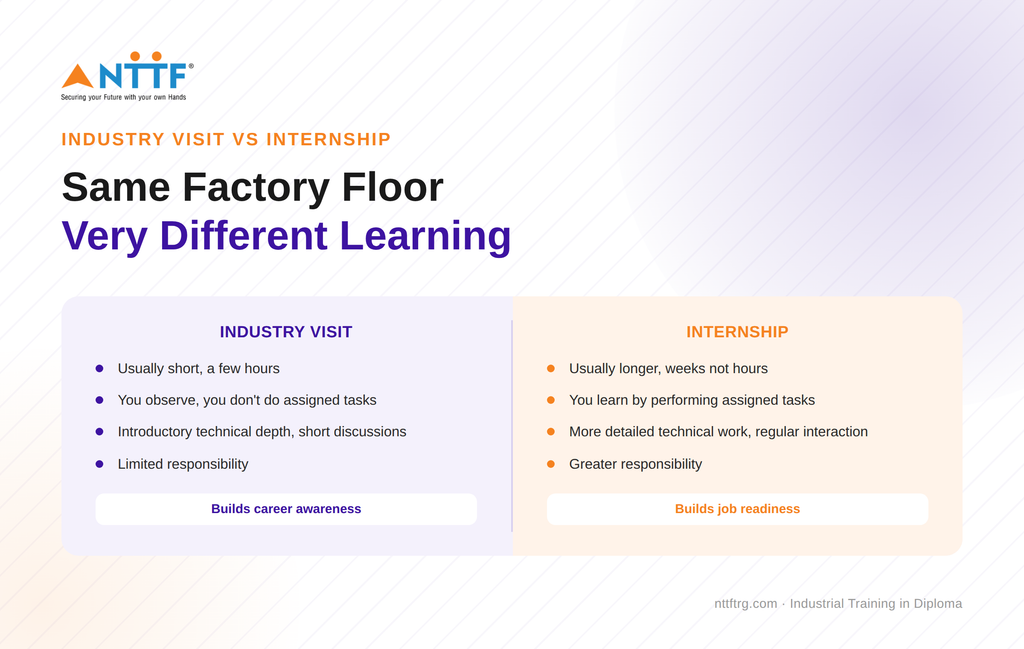
Industry visits help students understand the environment.
Internships help students begin working within it.
Both can strengthen industrial training in diploma education when planned properly.
For a wider look at why internships matter, read Why Internships Are Essential for Your Future Career.
ITI Diploma Course vs Diploma: Why Industry Exposure Matters in Both
Students often compare diploma programmes with an ITI diploma course or other skill-based technical programmes. The exact qualification structure can differ but the practical question remains similar:
How much real industry exposure does the student receive? Technical education should connect training with actual workplaces. This matters whether a student is learning:
- Fitting
- Electrical work
- Machining
- Welding
- Mechanical maintenance
- Electronics
- Automation
- Tool making
A student may perform a practical exercise perfectly inside the institute.
Industry introduces additional variables.
Production pressure exists.
Machine conditions vary.
Quality standards matter.
Teams need to coordinate.
Safety procedures cannot be ignored.
Exposure to these conditions helps students understand the difference between training and employment.
What Students Should Observe During an Industry Visit
A good industry visit should have a purpose. Students can use the following framework.
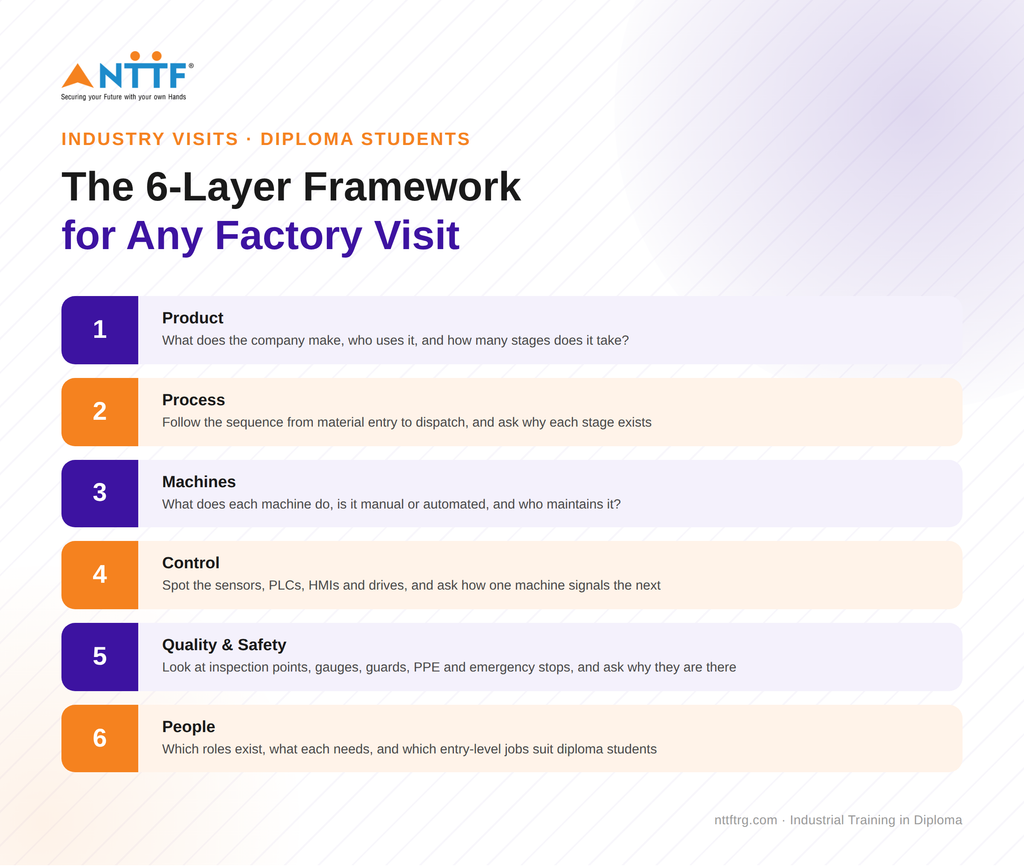
Layer 1: Product
Start with the final output.
Ask:
- What does the company manufacture?
- Who uses the product?
- Which raw materials are required?
- How long does production take?
- How many stages are involved?
Understanding the product makes the rest of the factory easier to follow.
Layer 2: Process
Follow the production sequence.
Observe:
- Material entry
- Machining
- Assembly
- Inspection
- Packaging
- Dispatch
Try to understand why each stage exists.
Layer 3: Machines
Identify major equipment.
Ask:
- What does this machine do?
- Is it manual or automated?
- Which technical principles does it use?
- What type of maintenance does it need?
- Which technician operates or repairs it?
Layer 4: Control
Look for automation.
Observe:
- Sensors
- PLCs
- HMIs
- Control panels
- Motors
- Drives
- Pneumatic systems
- Robots
Ask how one machine communicates with the next.
Layer 5: Quality and Safety
Look beyond production speed.
Observe:
- Inspection checkpoints
- Measurement tools
- Machine guards
- PPE
- Safety signs
- Emergency stops
- Restricted areas
Ask why each measure exists.
Layer 6: People
Finally observe the workforce.
Ask:
- Which roles are present?
- What qualification does each role require?
- Which skills are used most frequently?
- How do teams communicate?
- Which entry-level roles are available to diploma students?
This final layer turns an industry visit into career research.
Questions Diploma Students Should Ask During an Industry Visit
Students do not need to ask dozens of questions.
They need useful ones.
Here are some worth preparing before the visit:
- What are the main stages of production?
- Which machines are most important to this process?
- Which machines require the most maintenance?
- How much of the production line is automated?
- Which PLC or control systems are commonly used?
- What are the most frequent machine faults?
- How is preventive maintenance planned?
- Which quality checks happen during production?
- Which safety practices are mandatory?
- What skills do entry-level technicians need?
- Which diploma branches are commonly recruited?
- Do fresh diploma graduates receive additional training?
- Which technical skills should students strengthen before placement?
- What mistakes do new technicians commonly make?
- What can students learn now that will make their first job easier?
One good answer can sometimes influence an entire career decision.
What Students Should Do Before an Industry Visit
A useful visit starts before reaching the factory.
- Research the Company
Know:
- What it manufactures
- Which industry it belongs to
- Where its products are used
This prevents students from spending the first half of the visit simply understanding what the company does.
- Revise Relevant Concepts
If the company uses CNC machines then revise basic machining concepts. If it is an automation facility then revise sensors and PLC basics. This makes it easier to recognise what is being demonstrated.
- Prepare Questions
Write down five to ten questions. Do not depend on remembering them during the visit.
- Carry a Notebook
Record:
- Machine names
- Processes
- New technical terms
- Questions
- Career observations
Students should follow company rules regarding photographs or recording.
What Students Should Do After the Visit
The learning should not end at the factory gate. A simple post-visit exercise can make the experience more useful.
Write Down Three Things You Understood Better
For example:
- How CNC machining fits into production
- How maintenance teams respond to failures
- How PLCs control pneumatic movement
Write Down Three Skills You Need to Improve
For example:
- Reading engineering drawings
- PLC programming
- Measurement using precision tools
Identify Two Job Roles
Choose two roles you observed and research:
- Required qualification
- Skills
- Responsibilities
- Career progression
Identify One Next Action
This is the most important step.
Maybe the student decides to:
- Practise CNC programming
- Improve electrical troubleshooting
- Learn PLC basics
- Strengthen communication
- Apply for an internship
- Speak with a faculty member about a career path
The visit becomes valuable when observation changes behaviour.
How Institutes Can Make Industry Visits More Useful
Sending students to a factory is not enough. The visit needs structure. A stronger approach can include three stages.
- Before the Visit
Faculty can explain:
- Company background
- Products
- Relevant subjects
- Key processes
- Expected learning outcomes
Students can prepare questions.
- During the Visit
Students should observe selected areas rather than simply walking through the facility.
Faculty can encourage them to connect the visit with subjects already studied.
- After the Visit
Students can complete:
- Visit reports
- Process diagrams
- Technical presentations
- Group discussions
- Career reflections
This converts observation into learning.
How Industry Visits Improve Placement Readiness
Placements often test more than technical definitions. Interviewers may ask: Have you seen this process in a real factory? Industry visits give students something concrete to discuss.
A student can explain:
- What they observed
- Which machines were used
- How quality was controlled
- Which automation systems were present
- What they learned about maintenance
This can make technical conversations more meaningful. The student is no longer answering only from a textbook. They are connecting theory with something they have actually seen. Industry visits do not guarantee placement. They can however improve awareness and confidence when students use the experience properly.
Common Mistakes Students Make During Industry Visits
- Treating the Visit Like a Holiday: The factory may be new and exciting. The purpose is still learning. Students should observe actively instead of simply following the group.
- Focusing Only on Big Machines: Large machines attract attention. Small systems may teach more. A sensor or control valve can reveal how the entire machine sequence works.
- Asking Only About Salary: Career questions matter but salary should not be the only concern. Ask what skills the role requires first.
- Taking Notes Without Understanding the Process: Writing down every machine name creates information. Understanding how those machines connect creates knowledge.
- Ignoring Safety: Safety behaviour itself is something worth studying. Observe how experienced workers move around equipment.
- Forgetting the Visit After Returning: This is the biggest missed opportunity. Students should identify at least one skill they want to improve after every industry visit.
A Practical Checklist for Evaluating Industrial Exposure in a Diploma
Students comparing institutes can use this checklist before admission.
Ask:
- Does the programme include regular industry visits?
- Which companies have students visited?
- Are visits connected with the diploma branch?
- Does the institute provide internships?
- Are industrial projects included?
- Do students interact with working technicians?
- Is practical training connected with industry requirements?
- Are visit reports or presentations required?
- Does the institute provide placement preparation?
- Are companies invited for technical sessions?
Industry exposure should not be treated as a one-time event printed in a brochure. It should form part of the larger learning process.
So How Important Are Industry Visits for Diploma Students?
Think about what a diploma is supposed to achieve. The student should leave with technical knowledge. But they should also understand where that knowledge is used. Industry visits create that bridge. They show students:
- Where machines fit into production
- How automation controls movement
- Why maintenance matters
- How quality is measured
- Why safety rules exist
- Which jobs are available
- What employers expect
The visit may last only a few hours. The career clarity it creates can last much longer. This is why industrial training in diploma program should include meaningful industry exposure rather than relying only on laboratory practice.
Final Verdict
A classroom can teach how a machine works. An industry visit shows why that machine matters. That difference is important. Diploma students need technical knowledge but they also need context. They should understand how production and maintenance interact. Quality and safety are equally important. They should also see how automation changes the role of a modern technician.
Industry visits provide an early opportunity to connect these pieces. Students considering a diploma or ITI diploma course should therefore ask more than: “Which subjects will I study?” They should also ask: “How often will I see these skills being used in real industry?”
A useful industry visit should leave a student with three things:
- One process they understand better.
- One career they want to explore.
- One skill they know they need to improve.
If the visit achieves that then it has done much more than take students outside the classroom. It has shown them where the classroom is supposed to lead.
If you are comparing technical programmes, look closely at how they connect training with real workplaces. The quality of industry exposure can tell you a lot about how seriously practical learning is treated.
Want a diploma that connects classroom learning with real industrial skills? Explore NTTF’s Diploma in Mechatronics Engineering and Smart Factory to learn mechanics, electronics and automation through practical training. Build skills for modern manufacturing environments and prepare yourself for industry-focused technical careers.