Pick up almost anything within arm’s reach right now.
A phone case. A car dashboard vent. The cap on a water bottle. A metal bracket holding up a shelf.
None of these exist by accident.
Before a single unit rolled off a production line, an engineer designed the tool that gave it shape. Press die. Injection mould. The invisible ancestor of almost everything manufactured around you.
This is the world a post diploma in tool design curriculum prepares you for.
Not operating machines someone else designed. Designing the tool that makes the machine work.
Here’s what that journey looks like.
Diploma Training vs. Tool Design Specialisation
A diploma is full technical training, not just theory. You already come out of it able to:
- Read a drawing accurately
- Understand tolerances
- Recognise how a machine shapes a component
- Apply the discipline precision engineering demands
Real, practical skills. That part isn’t in question.
What a diploma doesn’t do is take you deep into one specific, high-demand area: designing press tools and moulds, rather than working around tools someone else designed.
That’s why so many diploma holders go looking for structured mould design training afterward, not because they’re missing basics, but because they want to specialise further into design specifically.
Quick way to think about it:
A diploma trains you broadly across manufacturing.
A post diploma takes that same trained engineer and sharpens the focus onto one advanced skill.
Tool design is that focus. You move from working with finished parts and processes to designing the tool that produces them, backward from the part, forward into the tool.
That shift is exactly what a well-built tool design course syllabus is engineered to create.
Semester One vs. Semester Two: What Changes
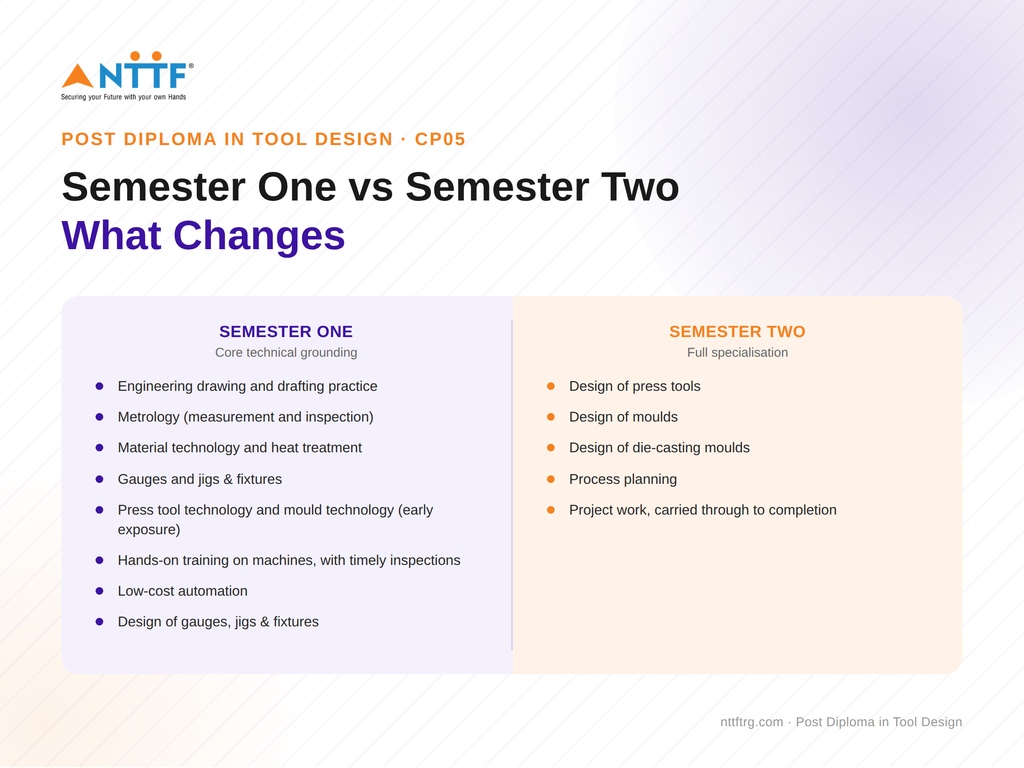
The short version:
Semester one sharpens and consolidates what a diploma already built, with a specific lens toward tool and mould work, and closes with an early design pass on gauges, jigs and fixtures alongside a first look at automation.
Semester two is where the post diploma in tool design curriculum turns fully specialised. By the end, a student hasn’t just studied tool design, they’ve designed tools, moulds, and die-casting tooling, and carried a project through to completion.
Why the sequence matters:
Skip semester one and you jump into design work without the tool-specific grounding to back it up.
Skip semester two and you stay at general technical training and never get to the specialised design work itself.
A properly built tool design course syllabus doesn’t let either gap happen.
The Craft of Advanced Mould Design
Looks simple from the outside: carve a cavity, pour material in, wait, pop out a part.
It isn’t.
Molten plastic:
- Flows unevenly, not like water into a glass
- Shrinks as it cools
- Warps or cracks if the mould geometry hasn’t planned for this in advance
An advanced mould design course component trains students to think several steps ahead of the material, before it even enters the mould.
Die-casting mould design raises the difficulty further, since molten metal brings its own thermal and mechanical complications plastic never deals with. A genuine, advanced mould design course covering die-casting depth is hard to find outside a dedicated post diploma program.
How this gets taught:
- Not through lectures alone
- Repetition in a lab, not repetition in a notebook
- CAD/CAM practice built into the training methodology, used for 2D and 3D modelling the way a sculptor treats clay
- Shape, test, adjust, repeat, until the design survives real manufacturing constraints
Most programs built this way spend most of the learning time hands-on rather than in a classroom. That’s the whole point of proper mould design training: building it into instinct, not just notes, across two full semesters instead of a few workshops.
What You Actually Walk Away With
Strip away the semester numbers and subject names. What’s left is a specific, employable skill set. The post diploma tool design skills a graduate typically carries out include:
- Designing press tools for sheet metal components
- Designing moulds for plastic components
- Designing gauges, jigs, and fixtures
- Modeling of components, with exposure to 2D and 3D CAD/CAM practice
- Process planning that connects design intent to actual manufacturing execution
Why this range matters:
- Not boxed into one manufacturing niche
- Can move between automotive sheet metal, plastics, and die-casting
- Recruiters actively look for candidates listing post diploma tool design skills, not generic diploma-level training
Will This Skill Set Still Matter in Ten Years?
Fair question, with automation and AI-driven design tools reshaping manufacturing.
Honest answer:
- Automation is changing how tools get drafted and simulated
- It hasn’t removed the need for someone who understands material behaviour, tolerance stacking, and how a mould fill
- Software speeds up iteration. It doesn’t replace judgment in a design review
Software can generate a hundred variations of a mould cavity in minutes. It still can’t tell you which one survives a hundred thousand production cycles without failing. That call comes from training, not from a tool.
Is This the Right Next Step for You?
This program builds on technical training you already have, not on a blank slate. It’s designed for diploma holders, requiring a three-year diploma in:
- Mechanical Engineering
- Tool Engineering
- Production Engineering
- Manufacturing Engineering
- Automobile Engineering
If you already have that, here’s the real choice:
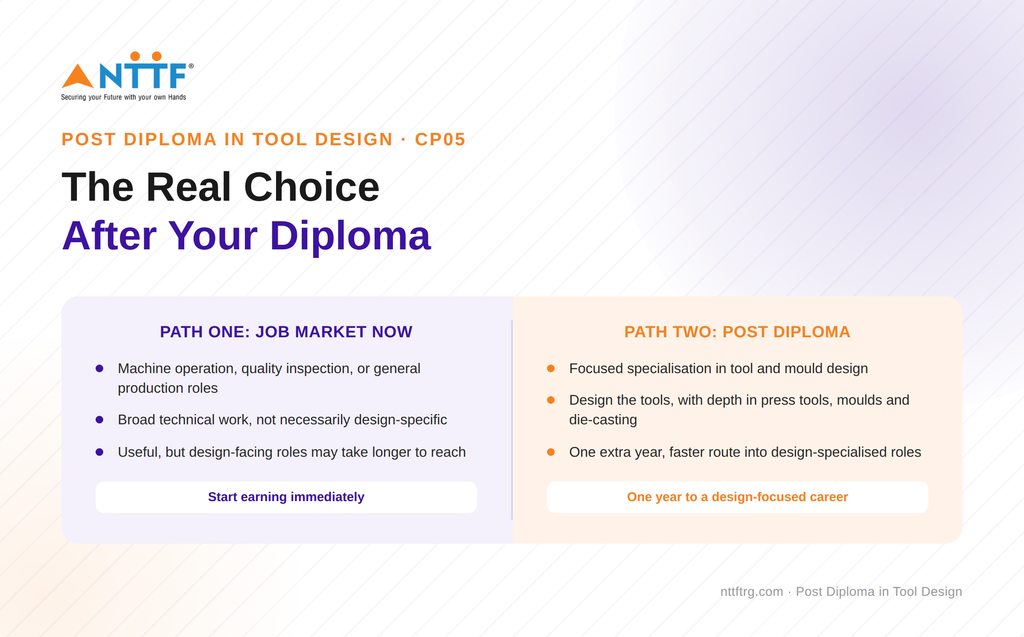
For many students, that one extra year is what shifts an entire career trajectory, from execution-focused work to design-focused work, along with the salary and responsibility that tends to follow.
Where the Tools Lead
- Tool Designer, specialising in press tools, moulds, jigs and fixtures
- Die-Casting Tool Design Specialist
- CAD Designer within mechanical industries
Not niche openings. Every sector that manufactures something physical needs this: automotive, consumer electronics, industrial equipment, packaging. As long as factories keep making things, someone must design what makes those things possible. For a closer look at what these roles involve day to day, see Top Career Opportunities After Completing a Post-Diploma in Tool Design.
And the skills travel. A press tool for an automotive bracket and a mould for a packaging component draw on the same underlying discipline. That portability is part of why this remains one of the more resilient specializations a diploma holder can choose.
A Quick Snapshot
If you’re skimming for the essentials, here’s the whole program in one table:
| What | Details |
| Duration | 1 year, 2 semesters |
| Program type | Post Diploma |
| Eligibility | 3-year diploma in Mechanical, Tool, Production, Manufacturing, or Automobile Engineering |
| Core focus | Press tool design, mould design, die-casting mould design, gauges & fixtures, CAD/CAM modelling |
| Career outcomes | Tool Designer, Die-Casting Tool Design Specialist, CAD Designer |
| Training style | Majority hands-on, lab and project-based |
Everything covered above, the post diploma in tool design curriculum, the semester-wise tool design course syllabus, the hands-on Mould design training, and the resulting post diploma tool design skills, comes down to this single table. It’s a short list. But it’s the difference between operating a machine someone else designed and being the person who designs it.
If you’re standing at that post-diploma decision point right now, NTTF’s Post Diploma in Tool Design (CP05) is built around exactly this journey, with over 70% of training delivered hands-on, backed by 98%+ placement and NCVET recognition, with campuses across Karnataka, Jharkhand, Maharashtra, Tamil Nadu, Andhra Pradesh, and Kerala. Full curriculum, eligibility details, and campus information are available on the program page.