
Factories today run on automation, and the professionals who keep that automation running are trained specifically for it. If you’re a diploma holder wondering how to move from theory into a specialised, high-demand career, a PLC SCADA training program is one of the most direct paths into Industry 4.0 roles. This blog breaks down exactly what a PLC SCADA course covers, the skills you’ll walk away with, where this training comes from, and the job roles realistically open to you in 2027
What Is PLC & SCADA, and Why Does It Matter in 2027
PLC (Programmable Logic Controller) is the hardware and software that controls machinery on a factory floor, everything from a conveyor belt to a robotic arm. SCADA (Supervisory Control and Data Acquisition) is the system that lets engineers monitor and manage those processes in real time from a central dashboard.
Together, PLC and SCADA form the backbone of modern manufacturing. As Indian industry adopts Industry 4.0 technologies at scale, from automotive plants to process industries, the demand for professionals who can design, program, and troubleshoot these systems has grown sharply. Manufacturers are under pressure to cut downtime, reduce manual error, and run leaner production lines, and none of that happens without people who understand both the hardware and the software controlling it. That’s exactly the gap a good PLC training institute is built to fill.
Where PLC & SCADA Training Actually Sits
Before getting into curriculum detail, it’s worth being clear on where this training lives, since not every technical program covers it to the same depth. PLC and SCADA fundamentals appear briefly inside some broader diploma programs, but dedicated, job-ready depth comes from a specific post-diploma specialisation.
At NTTF, that program is the Post Diploma in Industrial Automation (CP19), a one-year, two-semester course built specifically around PLC programming, SCADA, robotics, and process control. It’s open to diploma holders in Electrical, Electronics, Mechatronics, or Instrumentation, or B.Sc. Electronics graduates, with no upper age limit.
If you’re earlier in the pipeline and haven’t done a diploma yet, PLC and SCADA basics also show up inside the Diploma in Mechatronics Engineering and Smart Factory, alongside robotics and general Industry 4.0 concepts. That diploma gives you first exposure to how these systems work; CP19 is where that exposure becomes a genuine specialisation, with the depth employers screen for.
What You’ll Learn in a PLC & SCADA Training Course
A well-structured PLC SCADA course doesn’t just teach you to write ladder logic. It builds you into a complete automation technician. Based on the CP19 curriculum, here’s what the course covers:
| Subject Area | What It Covers |
| PLC and Plant Network | Ladder logic programming, hardware architecture, plant-wide network integration |
| SCADA | Data acquisition, real-time visualization, supervisory control systems |
| Process Control Instrumentation | Sensors, transmitters, control loops, calibration |
| Electrical Technology | Power systems, wiring, troubleshooting electrical faults |
| Pneumatics and Hydraulics | Actuator systems used in automated production lines |
| Industrial Robotics | Programming and operating robotic arms in production environments |
| Automated Production Systems | End-to-end automation of manufacturing workflows |
| Industrial Equipment Maintenance | Preventive and corrective maintenance of automation hardware |
| DCS Practical Project | Applied, hands-on automation project work |
This structure is typical of a one-year, two-semester PLC SCADA training program aimed at diploma holders who want to specialise rather than start over. Each subject builds on the last: electrical and instrumentation fundamentals come first, PLC and SCADA systems layer on top, and the final DCS project forces you to bring all of it together on a real automation problem rather than a simulated one.
How the Training Is Delivered
The single biggest differentiator between a good PLC training institute and an average one is the practical-to-theory ratio. Look for programs where:
- Hands-on training makes up most learning hours. Institutes that run 75%+ practical training ensure you’re troubleshooting real PLCs and SCADA systems, not just reading about them.
- You work with actual industrial hardware. Variable frequency drives, PC-based data acquisition systems, and real robotics cells matter more than simulation software alone.
- Projects are industry relevant. A strong SCADA training course ends with you designing and implementing an automation project, not just passing a written exam.
- Software exposure is current. You should be working with the same PLC and SCADA software platforms used on live factory floors today.
- Faculty have industry, not just academic, backgrounds. Instructors who’ve commissioned automation systems bring troubleshooting instincts that a purely theoretical background can’t.
This combination of theory and applied practice is what separates a PLC programming course that produces job-ready technicians from one that produces certificate holders.
Skills Gained from a PLC & SCADA Course
By the end of a structured program, you should be able to walk into an industrial setting and contribute from day one. The core skills include:
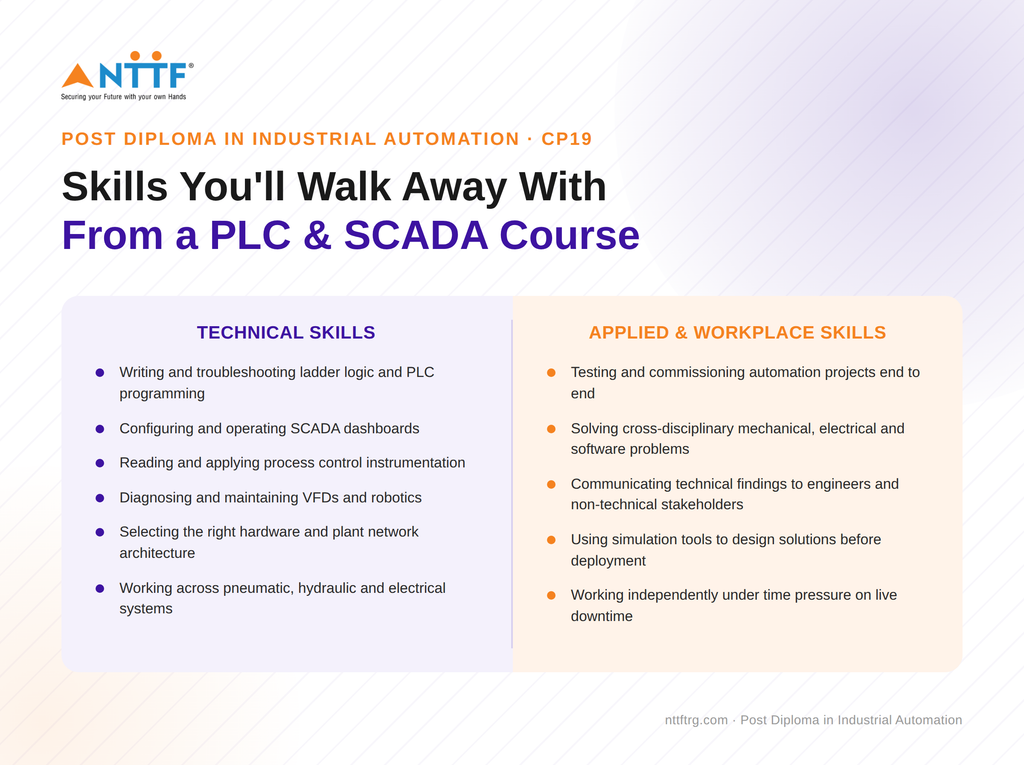
This blend is what makes graduates of a strong PLC SCADA training program genuinely different from someone who has only completed a short online certification. Employers aren’t just looking for someone who understands the theory, they want someone who has already solved real automation problems on real machines.
Job Roles You Can Target in 2027
India’s industrial automation market continues to expand as manufacturers across automotive, electronics, process industries, and heavy engineering adopt Industry 4.0 practices. Here are the roles a industrial plc programming typically prepares you for:
| Job Role | What the Role Involves |
| PLC Programmer | Writing, testing, and maintaining ladder logic for automated systems |
| Automation Engineer | Designing and implementing automation solutions across a production line |
| SCADA Engineer | Building and managing supervisory control and data visualization systems |
| Industrial Robotics Technician | Programming, operating, and maintaining robotic systems on the factory floor |
| Process Control Engineer | Managing instrumentation and control loops for continuous processes |
| Industrial Equipment Maintenance Technician | Troubleshooting and servicing PLCs, drives, and automation hardware |
These roles span sectors including automotive OEMs, aerospace, electronics manufacturing, and heavy industry, all of which are actively hiring automation specialists as production lines get smarter. Because the skill set is hardware-and-software hybrid by design, it also transfers well: someone trained on one manufacturer’s PLC platform can usually pick up another with relatively little retraining, which keeps career options open across employers rather than locking you into one company’s specific systems.
For a closer look at what these roles actually involve day to day, see Industrial PLC Programming Explained: A Career Skill Guide for Diploma Holders
Who Should Take This Course
A post-diploma in Industrial Automation course is designed for:
- Diploma holders in Electrical, Electronics, Mechatronics, or Instrumentation
- B.Sc. graduates in Electronics looking to specialise in a high-demand technical domain
- Working professionals in manufacturing who want to move into automation-specific roles
There’s typically no upper age limit for these programs, which makes them accessible whether you’re straight out of diploma or a few years into your career and ready to specialise.
Choosing the Right PLC Training Institute
Not all PLC SCADA course providers are built the same. Before enrolling, check for:
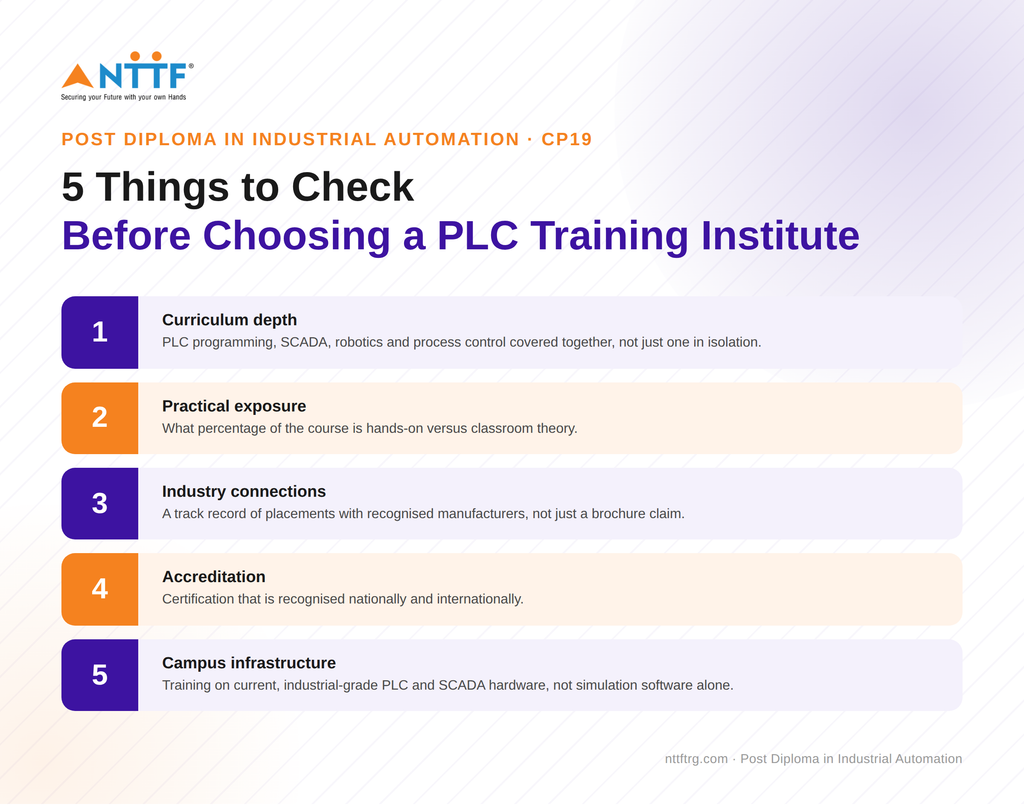
Any PLC training institutes you shortlist should be evaluated against these five points before you commit.
Building Your Career in Industrial Automation
Industrial automation isn’t a passing trend; it’s the direction the entire manufacturing sector is moving in. A well-structured PLC SCADA training program gives you the specific, applied skill set that recruiters in this space are actively looking for, and positions you for roles that simply didn’t exist a decade ago.
NTTF’s Post Diploma in Industrial Automation (CP19) is built around exactly this model: a one-year, hands-on PLC SCADA course covering PLC and plant networks, SCADA, industrial robotics, and process control instrumentation, with over 65% of learning time spent in the lab. It’s open to diploma holders in Electrical, Electronics, Mechatronics, or Instrumentation, as well as B.Sc. Electronics graduates, with no upper age limit for eligibility.
If you’re ready to move from diploma-level knowledge into specialist, job-ready expertise, this is the kind of program built to get you there.
Further reading: Industrial PLC Programming Explained: A Career Skill Guide for Diploma Holders and Robotics, PLC, and SCADA: Mastering Industrial Automation After Diploma