Getting a diploma should not be the final goal for students seeking a strong technical career.
Many diploma students want careers where their practical skills matter. Bosch often becomes a preferred employer because of its work across mobility, manufacturing, automation, software, and industrial technology.
However, wanting a Bosch job and becoming ready for one are completely different challenges. Preparation begins long before the placement interview. Workshop assignments, machine practice, technical projects, aptitude tests, and communication sessions gradually build the confidence required for industry.
This student spotlight explains the practical NTTF-to-Bosch pathway. It also shows how students can prepare for Bosch careers for diploma holders without depending only on placement season.
TL;DR
The NTTF placement journey requires more than good examination marks.
Students should:
- Build strong technical fundamentals
- Take workshop training seriously
- Complete one relevant technical project
- Practice aptitude and reasoning questions
- Prepare for practical technical interviews
- Improve workplace communication
- Research the company before placement day
- Apply through campus and direct career channels
- Review the eligibility criteria for every Bosch opening
NTTF states that approximately 65% of its diploma learning experience focuses on hands-on training. Its placement model also connects technical education with employment outcomes.
Why Students Choose NTTF After School
Many students do not want a course based only on classroom theory. They want to understand how machines, tools, production systems, and industrial processes work in real environments. This requirement makes practical training an important part of their decision.
NTTF offers diploma programs across technical areas such as:
- Tool engineering and digital manufacturing
- Mechatronics and smart factory systems
- Electronics and embedded systems
- Computer engineering
- Automation and robotics
- Manufacturing technology
NTTF’s Tool Engineering and Digital Manufacturing diploma covers areas such as CAD, CAM, CNC, tool design, and product development. The Mechatronics program includes automation, robotics, PLCs, and smart factory technologies.
These subjects can support diploma student placements across manufacturing, automotive, electronics, maintenance, quality, and automation roles. The course alone does not secure the job. Students still need to convert every subject into a demonstrable workplace skill.
Why Bosch Becomes a Target Company for Diploma Students
Bosch is associated with engineering, manufacturing, mobility, industrial technology, and connected solutions.
The company offers career opportunities across several technical fields. Its career portal includes direct employment and structured early-career programs.
A Bosch role may appeal to diploma students because it offers exposure to disciplined engineering processes. It can also provide an opportunity to learn inside an established industrial environment. However, students searching for Bosch careers for diploma holders must understand one important point. Every Bosch opportunity has separate eligibility requirements.
Some graduate programs require engineering degrees. Diploma holders should therefore review apprenticeships, technician positions, manufacturing roles, quality roles, maintenance openings, and direct employment opportunities individually. Students should never assume that every trainee program accepts diploma qualifications.
How NTTF Prepares Students for the Placement Process
The most valuable part of a diploma is not one subject or examination. The complete training environment gradually changes how students approach technical problems.
1. Practical Training Makes Technical Concepts Clear
A textbook can explain machining, automation, or electrical systems. A workshop reveals what happens when measurements are inaccurate or procedures are ignored.
Practical sessions help students understand:
- Machine operation
- Engineering measurements
- Technical drawings
- Component inspection
- Tool handling
- Production procedures
- Basic troubleshooting
- Workplace safety
Repeated practice makes technical interview questions easier to answer. Students can connect theoretical concepts with situations they have already observed. This hands-on model remains one of the strongest elements supporting NTTF placement preparation.
2 Workshop Discipline Improves Professional Habits
Industrial employers do not evaluate technical knowledge alone. They also observe punctuality, safety awareness, documentation, and process discipline. Workshop sessions teach students to:
- Arrive prepared
- Follow operating procedures
- Maintain tools correctly
- Record measurements
- Report errors honestly
- Keep the workspace organized
- Complete tasks within deadlines
These habits may appear basic, but they influence production quality and workplace safety.
3. Projects Help Students Demonstrate Their Skills
A diploma project can become an important part of interview preparation. A strong project gives the interviewer something specific to discuss. It also shows how a student applies classroom knowledge.
A useful project should explain:
- The problem being addressed
- The proposed technical solution
- The student’s exact responsibility
- The tools or software used
- The difficulties encountered
- The testing process
- The final result
Students should avoid memorizing an impressive project description they cannot explain. Interviewers may ask why a component was selected or how a failure was corrected. Honest technical understanding usually creates a stronger impression than complicated terminology.
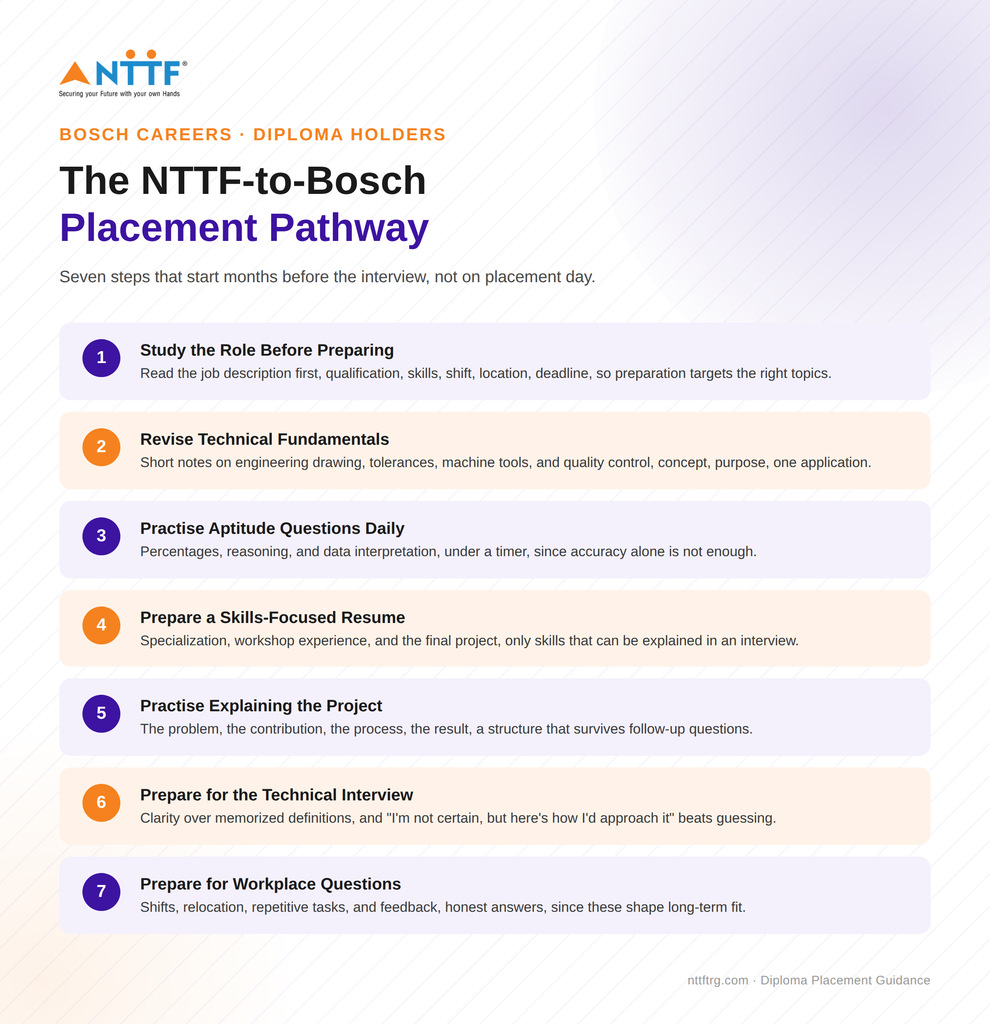
The NTTF-to-Bosch Placement Pathway
The placement process does not begin on the interview date. It starts several months earlier through technical revision and consistent practice.
Step 1: Study the Role Before Preparing
Generic preparation wastes time.
A maintenance role may focus on machines, preventive maintenance, and fault diagnosis. A quality role may require measurement knowledge and inspection awareness.
Production positions may test process understanding. Automation roles may require PLC, sensor, or electrical knowledge.
Students should first review the job description and identify:
- Required qualification
- Relevant technical subjects
- Expected practical skills
- Shift requirements
- Work location
- Experience requirements
- Application deadline
This step prevents students from preparing unrelated topics.
Step 2: Revise Technical Fundamentals
Diploma interviews often test concepts taught during the course.
The questions may appear simple, but the interviewer expects clear answers.
Technical revision should cover:
- Engineering drawing
- Manufacturing processes
- Tolerances and fits
- Basic electrical concepts
- Machine tools
- Quality control
- Measuring instruments
- Safety procedures
- Preventive maintenance
- Relevant course specializations
Students can create short notes instead of reading complete textbooks again.
Each note should explain the concept, its practical purpose, and one application.
Step 3: Practise Aptitude Questions Daily
Technical ability does not replace aptitude preparation.
Bosch’s published internship selection process states that applications may be screened before shortlisted candidates attend a written test. The exact process can differ across programs and openings.
Preparation may include:
- Percentages
- Ratios
- Time and work
- Basic algebra
- Data interpretation
- Logical reasoning
- Mechanical reasoning
- English comprehension
Students should practise under time limits because solving accurately may not be enough.
The test also requires speed and concentration.
Step 4: Prepare a Skills-Focused Resume
A resume does not need to contain every activity completed during the diploma.
It should focus on information relevant to the role.
The final resume should include:
- Diploma specialization
- Academic performance
- Technical skills
- Workshop experience
- Software knowledge
- Industrial training
- Final project
- Certifications
- Contact details
Students should use clear language and avoid skill ratings such as “expert” without evidence.
Every technical skill listed on the resume can become a possible interview question.
Step 5: Practise Explaining the Project
A project explanation should follow a simple structure.
The problem
Students should explain the practical problem that motivated the project.
The contribution
They should describe the components or tasks they personally handled.
The process
They should explain how the project was designed, built, tested, or improved.
The result
They should share what worked and what still required improvement.
This structure helps students answer follow-up questions naturally.
Step 6: Prepare for the Technical Interview
Technical interviews often focus on clarity rather than memorized definitions.
Students should practise answering questions such as:
- How does this machine or system work?
- Which measuring instrument would be suitable?
- What causes this production defect?
- How should this failure be troubleshooted?
- Which safety step comes first?
- What was learned during industrial training?
- Why was this project selected?
- What could be improved in the design?
Students can also say, “I am not certain, but this is how I would approach it.”
A reasoned answer is better than an incorrect confident answer.
Step 7: Prepare for Workplace Questions
Technical employers also assess attitude and reliability.
Preparation should cover questions about:
- Working in shifts
- Relocating for the role
- Handling repetitive tasks
- Following safety rules
- Receiving supervisor feedback
- Working with production teams
- Learning unfamiliar equipment
- Managing mistakes
Students should answer honestly because these conditions affect long-term performance.
Note: This article presents a general placement pathway based on NTTF training and publicly available Bosch recruitment information. Individual eligibility, selection stages, and job roles may differ between campuses and openings.
Skills That Can Strengthen Bosch Careers for Diploma Students
The required skills depend on the department and job description.
The following table provides a practical preparation guide.
| Career Area | Skills to Develop | Useful Evidence |
| Production | Manufacturing processes, safety, machine basics | Workshop assignments |
| Quality | Inspection, tolerances, measuring instruments | Quality project or lab work |
| Maintenance | Troubleshooting, preventive maintenance, electrical basics | Maintenance checklist |
| Tool Engineering | CAD, CAM, CNC, tool design | Design portfolio |
| Automation | PLCs, sensors, control systems | Working automation project |
| Electronics | Circuit basics, testing, embedded systems | Functional prototype |
| Digital Manufacturing | CNC, production data, CAD/CAM workflows | Simulation or manufacturing project |
| IT Support | Networking, operating systems, troubleshooting | Lab project or certification |
Students should prioritize depth over collecting unrelated certificates. One project explained properly can carry more value than several certificates with limited practical understanding.
What the Bosch Selection Process May Include
The selection stages vary between roles and locations.
A campus or direct hiring process may include:
- Resume screening
- Aptitude or written assessment
- Technical interview
- Practical skill evaluation
- Human resources discussion
- Document verification
- Medical or joining formalities
Bosch publicly states that its internship selection process can involve institute coordination and resume screening. It further includes shortlisting and a written test. Direct employment applications can also be submitted through the company’s career portal.
Students should rely on the specific job posting for confirmed stages.
How Students Can Improve Their NTTF Placement Chances
- Start Preparing Before the Final Semester
Placement preparation should begin before companies announce openings.
Early preparation leaves enough time to correct weak technical areas. - Maintain Consistent Academic Performance
Marks do not represent every professional skill.
However, some employers use academic scores during initial shortlisting.
Students should avoid preventable backlogs and incomplete coursework. - Take Industrial Training Seriously
Industrial exposure helps students understand workplace expectations.
Students should observe machines, reporting systems, safety processes, and team coordination. - Build One Strong Technical Project
The project should solve a real problem or demonstrate a useful concept.
Students should record design decisions and testing results throughout development. - Practise Technical Communication
Knowing the answer and explaining it are separate abilities.
Students should practise describing machines, processes, and projects in simple language. - Follow Official Career Channels
Students should use both campus placement support and official company portals.
Bosch maintains a direct employment page that connects applicants with current vacancies.
Unofficial job messages should be verified before personal documents are shared. - Apply According to Eligibility
One rejection does not mean a student lacks ability.
The qualification may simply not match that particular opening.
Students should continue reviewing apprentice, technician, manufacturing, and direct employment roles that accept their specialization.
Common Placement Mistakes and Their Solutions
- Preparing Only Before the Interview
Last-minute revision rarely develops practical confidence.
Solution– Create a weekly preparation plan several months before placement season. Divide time between technical concepts and interview communication. - Memorizing Project Answers
Memorized descriptions often collapse after one follow-up question.
Solution– Understand every important component and decision. Practise explaining project limitations honestly. - Adding Unfamiliar Skills to the Resume
Students sometimes list software or machines they have barely used.
Solution– Include only skills that can be explained or demonstrated. Mention beginner-level exposure honestly where necessary. - Ignoring Basic Technical Questions
Students often prepare advanced topics but forget core diploma concepts.
Solution– Revise basic definitions through practical applications. Interviewers frequently use foundational questions to evaluate clarity. - Depending Only on Campus Placement
Campus opportunities are valuable but may not cover every suitable role.
Solution– Monitor official career portals and apprenticeship notifications. Continue developing skills after completing the diploma. - Giving Generic Interview Answers
Answers such as “Bosch is a good company” do not show preparation.
Solution– Research the company’s work and connect the role with relevant diploma skills.
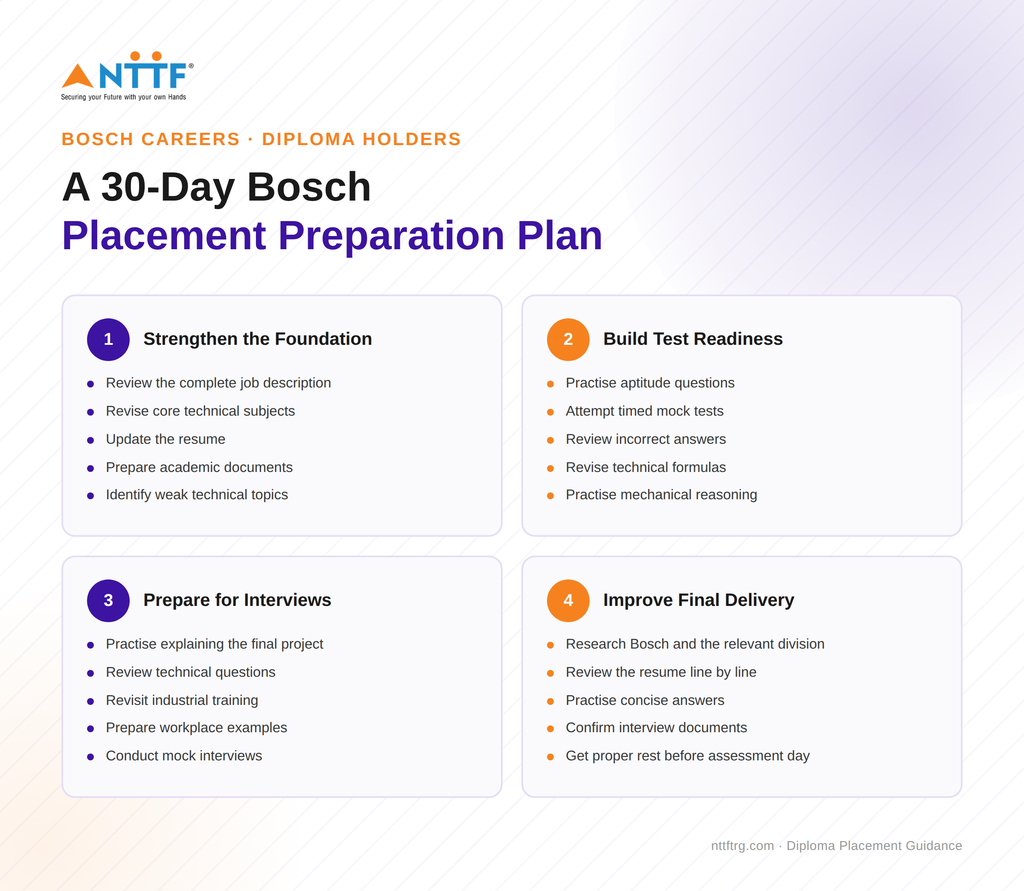
A 30-Day Bosch Placement Preparation Plan
Final Placement Checklist
Students can use this checklist before applying for Bosch careers for diploma holders:
- The stated qualification criteria are met.
- The resume reflects the job requirements.
- Every listed technical skill can be explained.
- The final project is clearly understood.
- Core diploma subjects have been revised.
- Aptitude questions have been practised.
- Industrial training experience can be described.
- Workplace safety basics are understood.
- The stated role conditions are acceptable.
- The application source has been verified.
- Questions for the interviewer are prepared.
- All required documents are organized.
Conclusion
An NTTF diploma can create a strong foundation, but consistent preparation completes the journey.
NTTF helps students develop practical exposure and technical discipline. The placement process requires them to convert that training into clear answers, relevant projects, and professional confidence.
The most important lesson is simple.
Diploma student placements do not depend only on examination marks. Employers also look for practical understanding, learning ability, and workplace readiness.
The NTTF placement pathway can help students move toward respected technical employers. However, each student must take ownership of preparation and skill development.
A Bosch opportunity may begin with a placement drive or an online application. The stronger journey begins much earlier inside classrooms and workshops.
Explore NTTF diploma programs and begin building the practical skills required for industry-focused career opportunities.
Further reading
How Our Diploma Courses Prepare Students for Real-World Success ·
What Students Expect from Diploma Programs