Look around you. The scooter you rode this morning, the plastic cap on your water bottle, the metal hinge on your door. Somebody designed the parts. Somebody built the tools that made those parts. And somebody made sure every single piece came out the same, thousands of times a day.
That somebody is usually a mechanical engineer.
If you are a student thinking about a Diploma in Mechanical Engineering, you have probably heard it called a “solid” or “evergreen” choice. But what does the job actually look like on a Tuesday afternoon? Is it all drawings and desks, or grease and machines? This guide walks you through a real working day, the skills you will use, and how the right mechanical engineering course can get you there.
What does a mechanical engineer actually do?
In simple words, a mechanical engineer turns ideas into physical things that work.
That covers a lot of ground. Some engineers design new products. Some build the tools, moulds and dies used to mass-produce those products. Others run machines, check quality, fix breakdowns, or plan how a factory floor should run.
At the diploma level, the work is very hands-on. You are the person who knows how a part is made, not just how it looks on screen. That practical knowledge is exactly what factories hire for.
A typical day in the life of a mechanical engineer
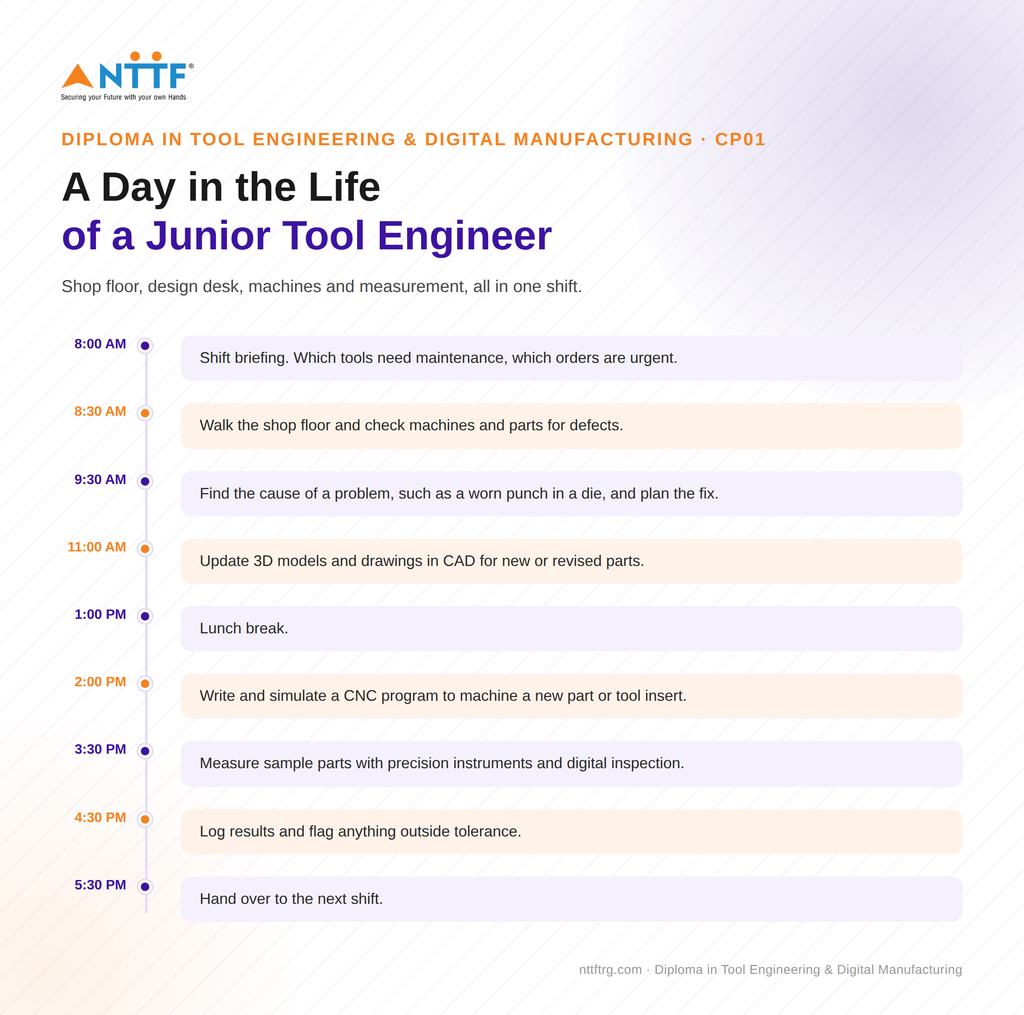
Here is what a regular working day looks like for a junior tool engineer in a manufacturing plant.
Morning: the shop floor
Most days start on the floor. Machines run in shifts, so problems don’t wait for office hours. A small defect repeated across 10,000 parts means rejections and an unhappy customer. Spotting the cause fast is a core part of the job.
Midday: the design desk
Next comes computer work. Engineers model parts, draw tools, and check how everything fits in CAD software. A small design change on screen can save hours of rework on the floor.
Afternoon: machines and measurement
This is where design meets reality. You program a CNC machine, cut the part, and measure it to the micron. If a dimension is off, you work out whether the cause is the design, the tool, or the machine setting.
End of day: records and handover
Everything gets logged so the next shift doesn’t start from zero. It is how factories avoid repeating the same mistake.
No two days are identical. Some are spent on tool trials, others on a breakdown that stops a line. That variety keeps the work interesting for years.
Where do mechanical engineers work?
Almost everywhere something gets made. Diploma holders with tooling and manufacturing skills are hired across:
- Automotive and auto components: brackets, gears, engine parts, body panels
- Aerospace: precision parts where tolerances are extremely tight
- Plastic moulding and packaging: bottle caps, containers, device housings
- Sheet metal and fabrication: enclosures, frames, structural parts
- Medical devices: components for equipment used in hospitals
- FMCG and consumer electronics: the moulds and tools behind everyday products
- Machine tool building: making the machines that make everything else
Not every role is on the floor, either. Many engineers grow into quality, purchase, supplier development, production planning, sales engineering or training roles once they know how things are made.
Skills you’ll use every day
| Skill | How it shows up at work |
| Engineering drawing and CAD | Reading and creating drawings, 3D modelling in tools like Fusion 360 |
| CNC programming and CAM | Telling a machine exactly how to cut a part |
| Tool and die knowledge | Understanding press tools, moulds, jigs and fixtures |
| Measurement and inspection | Checking parts are within tolerance |
| Problem solving | Finding why a part is failing, then fixing it |
| Teamwork and communication | Working with operators, supervisors and customers |
| Safety habits | Keeping yourself and your team safe around heavy machines |
The good news? None of these need you to be a topper. They need practice. Lots of it.
How a Diploma in Mechanical Engineering gets you there
Here is the honest truth about this career. Companies care less about how much theory you memorised and more about whether you can work on a machine from day one. That is why the kind of mechanical engineering course you pick matters as much as the subject itself.
NTTF’s Diploma in Tool Engineering & Digital Manufacturing (CP01) is built around that idea. It is a three-year Diploma in Mechanical Engineering that trains you to become a skilled tool and die maker, ready for modern, digital factories.
What makes it different
- 70% hands-on, 30% theory. You spend most of your time in workshops, not just classrooms.
- Modern tools from the start. Fusion 360 for design, CNC programming and CAM, 3D printing and prototyping, plus an introduction to IIoT and automation.
- Real projects. In your final year, you design, plan, manufacture and prove your own press tool or mould.
- Recognised certification. A Level 4.5 NCVET Diploma, the NTTF Diploma, and an international diploma from NOCN, UK (if enrolled).
Your three years, simply put
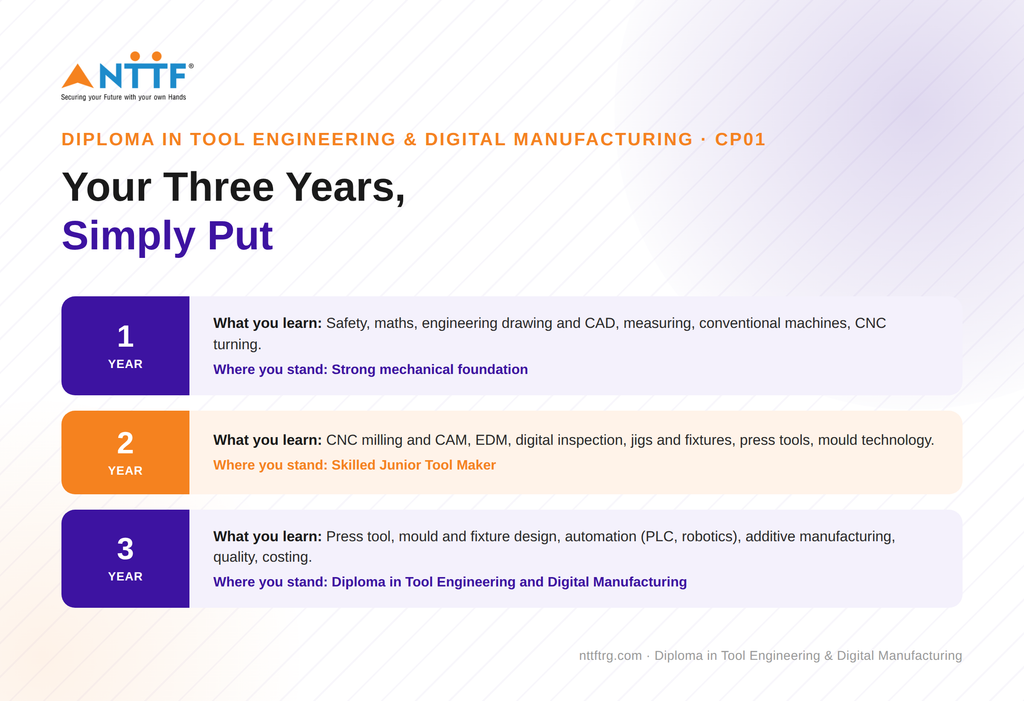
The program also has multiple entry and exit options, so your progress counts even if your plans change along the way.
Who can apply?
| Route | Eligibility | Age limit |
| After Class 10 | Pass in Class 10 with Mathematics, plus the NTTF entrance exam | 24 years |
| Lateral entry after Class 12 / ITI | Pass in Class 12 or ITI with Science and Mathematics, plus the NTTF entrance exam. A short bridge programme applies to some students. | 25 years |
Not sure about the entrance exam? Try NTTF’s free mock test to see where you stand.
The program runs at NTTF campuses including Bengaluru (Peenya and Electronic City), Dharwad, Vellore, Tellicherry, Gannavaram, Jamshedpur, Murbad and Pune. Most centres offer hostels for both boys and girls.
And once you graduate? NTTF reports a placement rate of over 98% and an alumni network of 65,000+. Recruiters include names like Bosch, Tata Steel, Toyota Kirloskar Motor, TVS, Ashok Leyland and HAL. You can see more on the placements page.
Where your career can go
Most diploma holders start as trainees or junior engineers in a tool room, production line or design team. With a few years of experience, the path opens up:
- Tool Designer or CAD/CAM Engineer: designing the tools that make products
- Tool Room In-charge: running a team and keeping every tool in top shape
- Process or Automation Engineer: making production faster, safer and smarter
- Quality Manager: owning the standards every part must meet
- Product Designer: especially in plastic design and packaging
- Purchase, Supplier Development or Sales roles: where knowing how things are made gives you a real edge
Want to specialise further after your diploma? A Post Diploma in Tool Design is a natural next step.
Is this career right for you?
Ask yourself a few quick questions:
- Do you like knowing how things work, not just that they work?
- Would you rather build and test than only read and write?
- Are you okay with a job that mixes machines, computers and people?
- Do you enjoy fixing things when they go wrong?
If you nodded along to most of these, a mechanical diploma could be a great fit.
Frequently asked questions
Can I do a Diploma in Mechanical Engineering after 10th?
Yes. At NTTF, you can join after Class 10 if you passed with Mathematics and clear the entrance exam.
Is a mechanical engineering course still a good choice with automation and AI growing?
Yes, and arguably more than before. Factories are adding robots, 3D printing and smart machines, and they need people who understand both the machine and the part. That is why NTTF’s course includes CNC, CAM, additive manufacturing and IIoT.
What is the difference between a regular diploma and a tool engineering diploma?
A regular diploma is often theory heavy. A tool engineering diploma focuses on making real tools, dies and moulds, with most of your time spent in workshops.
Ready to start your own day in the life?
Shop floor rounds, CAD work, CNC programs and quality checks. This is the real rhythm of a mechanical engineer’s day, and it is exactly what NTTF trains you for. The difference between reading about this career and living it is the training you choose.