You have finished your diploma and you already have real technical training. So what next?
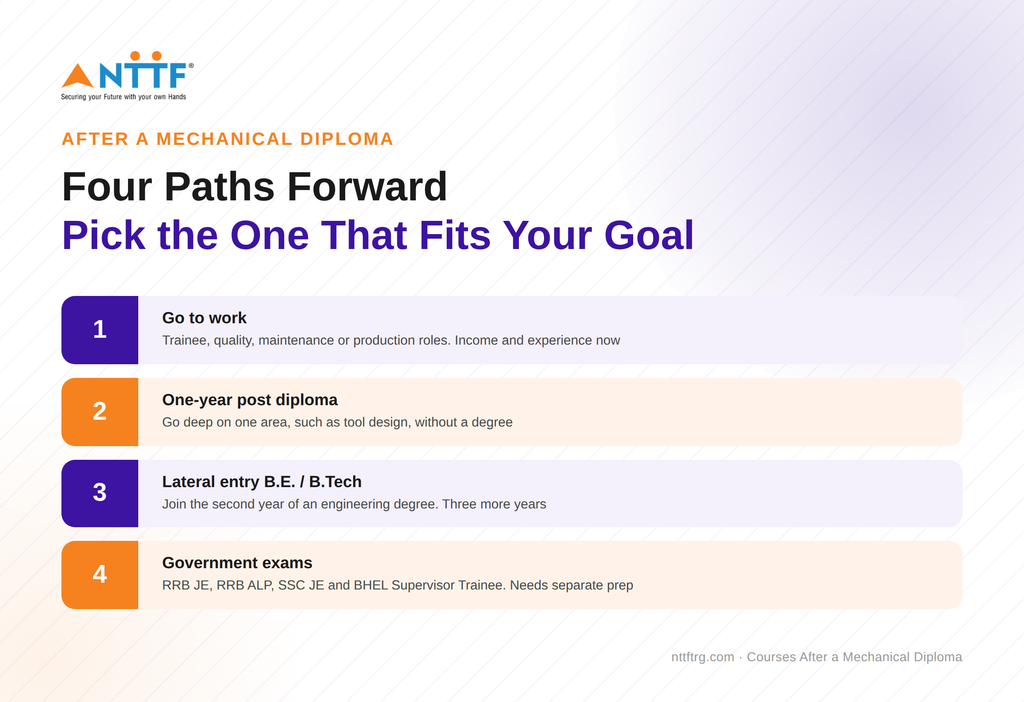
The short answer: you have four real options: go to work, take a one-year post diploma, join a B.E. or B.Tech through lateral entry, or prepare for a government exam. The right one depends on what you want most: a specialist role quickly, a degree, job security, or income now.
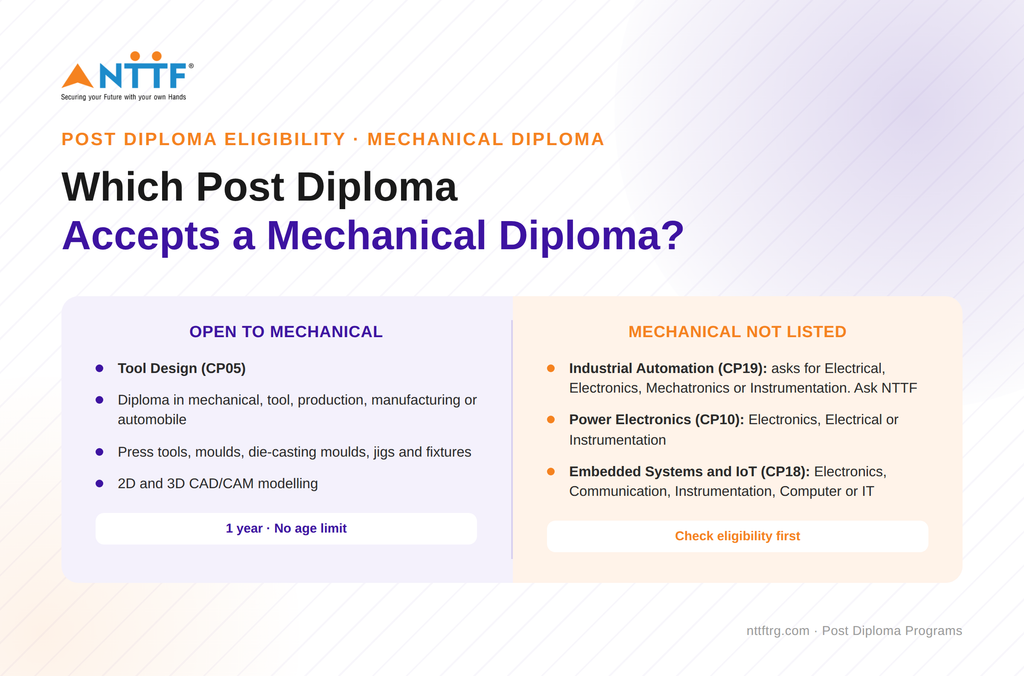
One catch most guides skip: of NTTF’s four post diplomas, only Tool Design clearly accepts a mechanical diploma. The others ask for an electrical, electronics or instrumentation background, so check eligibility before you plan around one.
Four paths after a mechanical diploma
| Path | What it means | Time | Choose it if |
| Job | Trainee, operator, quality, maintenance or production roles | Start now | You need income and want experience first |
| Post diploma | A one-year specialist program that builds on your diploma | 1 year | You want a tooling or design-facing role without a degree |
| Lateral entry B.E./B.Tech | Direct entry into the second year of an engineering degree | 3 years | Your target job or promotion needs a degree |
| Government exam | Diploma-level technical posts in railways, SSC and PSUs | Exam preparation | You value stability and structured career growth |
Post diploma: which one can you actually join?
A post diploma takes a diploma holder and goes deep on one area in one year. All four NTTF post diplomas run for one year (two semesters) with no age limit and heavily hands-on training. They do not all accept the same background.
| Program | What you study | Accepts a mechanical diploma? |
| Tool Design (CP05) | Press tools, moulds, die-casting moulds, jigs and fixtures, 2D and 3D CAD/CAM | Yes. Diploma in mechanical, tool, production, manufacturing or automobile engineering |
| Industrial Automation (CP19) | Pneumatics and hydraulics, PLC, SCADA, industrial robotics | Not listed. Asks for Electrical, Electronics, Mechatronics or Instrumentation, or B.Sc. Electronics |
| Power Electronics (CP10) | Power electronics, electrical machines, microcontrollers, PCB design | No. Electronics, Electrical or Instrumentation, or B.Sc. Electronics |
| Embedded Systems and IoT (CP18) | Embedded C, microcontrollers, Python, PCB design | No. Electronics, Communication, Instrumentation, Computer Engineering or IT |
Tool Design is the natural fit if you enjoyed the workshop, machining or manufacturing subjects in your diploma. It builds directly on them. To see what it teaches in practice, read From Basic Tooling to Advanced Mould Design and Why Tool Design Is One of the Best Careers for Diploma Holders.
If automation interests you more, ask NTTF whether Industrial Automation can take a mechanical diploma, since its page does not list one. NTTF’s Internship Program also has a Pneumatics and Hydraulics stream for polytechnic students, which is a shorter way to get hands-on exposure.
A post diploma is not a degree. If you are not sure it is worth a year before working, Post-Diploma vs Jumping Straight Into a Job lays out the trade-off.
Lateral entry into B.E. or B.Tech
Most states let diploma holders join the second year of a B.E. or B.Tech, so you skip the first year.
| Pros | Cons |
| A full engineering degree at the end | Three more years of study |
| Opens roles that ask for a degree | A broader, more theoretical curriculum |
| A widely recognised qualification | Less hands-on than a post diploma |
The deciding question is whether the job you want needs a degree. Some do. BHEL, for example, hires Engineer Trainees only with a bachelor’s degree, while its Supervisor Trainee post accepts a diploma. If your goal is stronger practical skills rather than a degree, a post diploma gets you there in a third of the time. If the goal is a degree-only role, lateral entry is the route.
NTTF describes a “10 + 3 + 3” route from diploma to B.Tech and mentions a B.Tech in collaboration with Alliance University. Its pages do not say who is eligible or how long it takes, so ask NTTF before you count on it.
Government exams
Mechanical diploma holders can apply for several technical posts. Recent notices:
- RRB Junior Engineer (CEN 04/2026): notified 13 August 2026. A three-year diploma in a mechanical group discipline is accepted. Pay Level 6, with a basic pay of ₹35,400. Applications closed in September.
- RRB Assistant Loco Pilot: accepts a three-year diploma in Mechanical, Electronics or Automobile Engineering after 10th.
- SSC Junior Engineer 2026: notified 2 September 2026 for Civil, Mechanical, Electrical and other posts, at Pay Level 6. A degree or a diploma is accepted depending on the post, so read the official notice. Applications closed on 22 September.
- BHEL Supervisor Trainee: has asked for a full-time diploma in Mechanical engineering with 65% marks. Check BHEL’s site for the current notice.
These cycles have closed, so the next ones are what to prepare for. Age limits and qualifications change with each notice. This route needs separate exam preparation rather than a course, and the posts are broad technical roles, not design or specialist ones.
Straight into the job market
Not everyone needs another course right away. Common starting points are trainee or junior engineer roles in manufacturing, quality control and inspection, machine operation and maintenance, and production planning support.
This builds experience quickly, but design and specialist roles usually take longer to reach without a specialization added later. You can also add a short certificate in CNC programming, CAD/CAM or 3D printing while you work, through NTTF’s certificate programs. That adds a skill, not a new qualification.
So what is the right move?
| If you want | Consider |
| A full engineering degree | Lateral entry B.E./B.Tech |
| Government job security | RRB, SSC or PSU exams |
| A tooling or design-facing specialization | Post Diploma in Tool Design |
| Automation | Ask about Industrial Automation, or start with an internship stream |
| Income and experience now | Job market entry |
There is no single answer. A post diploma is the fastest route to a specialist role, but only if the program accepts your diploma and the work interests you. Matching the specialization to the subjects you enjoyed most in your diploma tends to work better than choosing by job trends.
Where NTTF fits
If you hold a mechanical diploma and want to move into tooling and design, NTTF’s Post Diploma in Tool Design covers press tools, moulds, die-casting moulds and CAD/CAM modelling, with a one-year duration and no age limit. If you came through NTTF’s own Diploma in Tool Engineering & Digital Manufacturing, it is a direct next step. See all post diploma programs for curriculum, eligibility and campus details.