Ever wondered what the real difference is between a diploma and a master’s degree? Or why so many engineering graduates today are choosing tool design as a career path?
A diploma course is more skill-based and hands-on. It is designed to make you job ready quickly with practical knowledge and technical training. A master’s degree, on the other hand, goes deeper into theory, research, and academic learning. While both have their own value, diploma holders often have an edge when it comes to real-time application and entering the job market faster.
But before we dive further into your questions, here is something to think about.
Have you ever looked at the things you use every day— your phone, your automobiles, or even a simple kitchen appliance—and wondered how they are actually made? Behind every great product, there is one common factor: tools. And behind those tools are skilled professionals who design and develop them—Tool Designers.
Now that gives you a clue about what a tool designer does. So, if you are someone with a diploma in mechanical or a related engineering field and are wondering what to do next, here is a career path that is practical, future-focused, and full of opportunities—Tool Design.
Let us break it down and explore why this could be your smartest next step.
What Is Tool Design?
Tool design is the art (and science) of designing the tools that build things. These tools could be dies, moulds, jigs, fixtures, or special-purpose machines used in manufacturing.
As a tool designer, you create components that help industries manufacture products with precision, speed, and efficiency. That means every time a car, phone, or appliance is assembled, your design makes it happen smoothly.
Why Tool Design Is a Smart Move for Diploma Holders
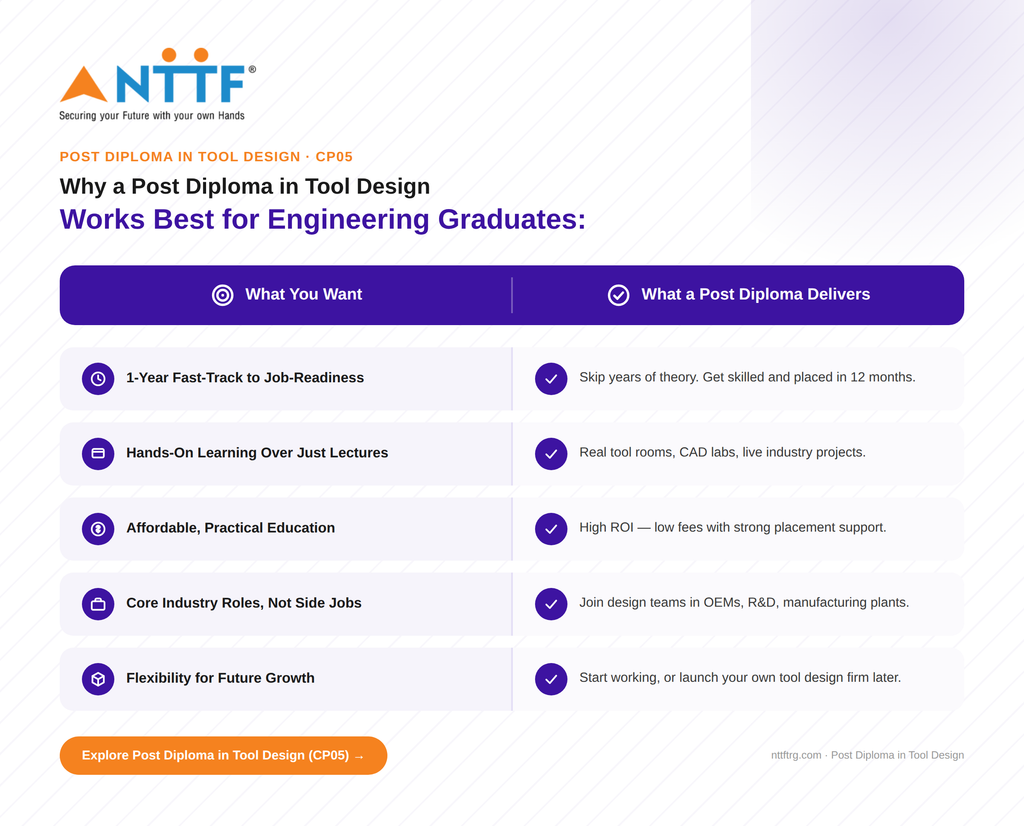
Let us be honest—given today’s competitive job market, every student, fresh graduate, or working professional is worried about one thing: “Do I have the right skills for the right career?” It is normal to feel unsure about your next step after a diploma. You do not want to spend years stuck in theoretical education. What you really want is something hands-on, technical, and valued by the industry, a course that gets you ready for real work. This is exactly where a Post Diploma in Tool Design helps graduates make the right decision.
High Demand in Industries
There is a massive demand in the industry for skilled Tool Designers. Companies are constantly on the lookout for people who can design the tools that make everything from automobiles to appliances.
So, when you choose this path, you instantly stand out—because you bring something practical and rare to the table.
A Core Engineering Role—Not Just Support
Tool Design is not a back-office job. You will be part of the core design team, working directly with production engineers and decision-makers. You will design tools that shape products and impact production lines. It is a role where your ideas and inputs matter—and where you see the actual results of your work on the factory floor.
Where Creativity Meets Engineering
If you enjoy building, sketching, or figuring out how things work, Tool Design is a perfect fit. It is a career that allows you to use both your creative thinking and your technical knowledge.
From working on CAD software to crafting press tools, molds, jigs, and fixtures every day is about solving real-world problems with smart design solutions. You learn how to think, sketch, and design like an engineer and that is a powerful skill set to carry forward.
Become Job-Ready in Just One Year
Most students today want careers that are practical, fast-tracked, and future-safe. Many also dream of becoming entrepreneurs one day. But the starting point is to first become skilled and employable.
That is why at NTTF Postgraduate Diploma in Tool Design is structured to give you all this—in just one year. You get trained in industry tools, work on design projects, and by the end of the course, you are not just qualified you are employable. And our 99% placement record is proof that the industry trusts our training.
What Will You Learn?
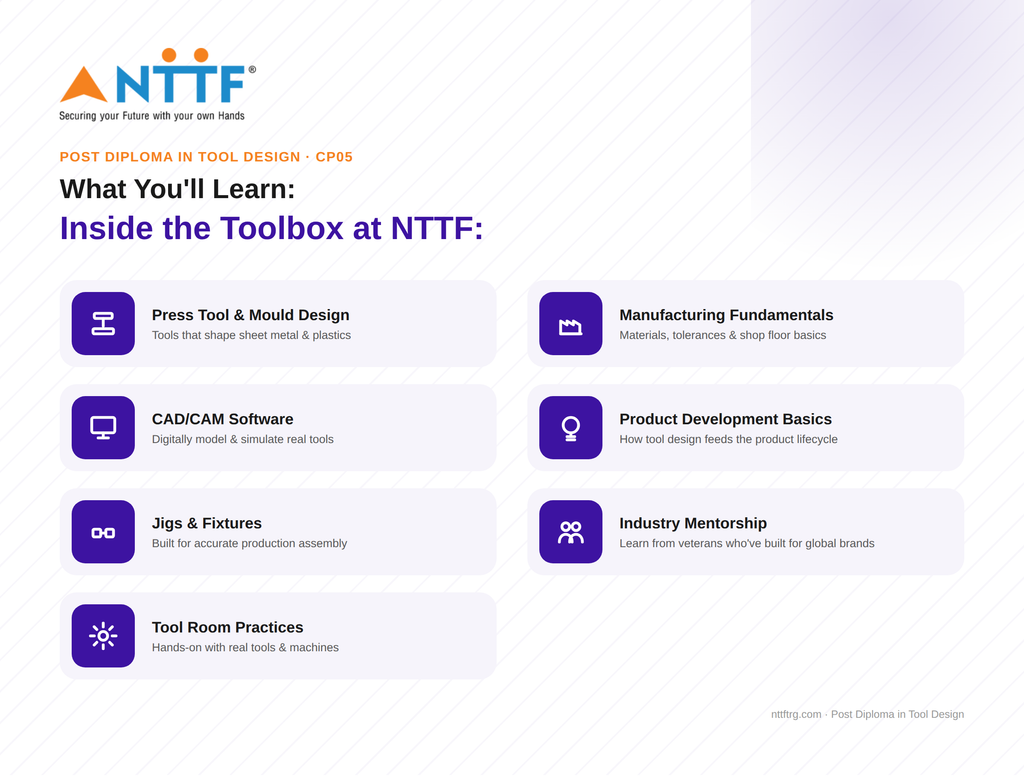
Looking for a Tool Design course in Bangalore or any top industrial city? At NTTF (Nettur Technical Training Foundation), our curriculum is carefully designed to match the needs of the industry and the ambition of the learner.
Here’s what you can expect:
- Design of Press Tools, Molds, Jigs & Fixtures
- CAD/CAM Training on industry-grade software like SolidWorks, AutoCAD, and Creo
- Hands-on experience in modern tool rooms and labs
- Manufacturing principles, and real-world production knowledge
- Direct mentoring by faculty with real industry experience
And most importantly, you will not be stuck in a lecture hall all day. You will be solving real problems, building real designs, and getting ready for real roles.
Career Opportunities After the Course
Tool Design isn’t just a stepping stone. It’s a full-blown career path with many growth options:
- Tool Designer
- CAD/CAM Engineer
- Manufacturing Design Engineer
- Product Development Engineer
- Quality & Process Engineer
And if you are someone with an entrepreneurial spark, you can even start your own tool room or design consultancy later.
So, if you have completed your diploma and are still exploring your options, here’s the deal: Tool Design gives you a strong technical foundation, creative satisfaction, and real job opportunities in core engineering sectors.
It’s one of those careers that stays relevant—because as long as products are made, tools will be needed. Why wait? Explore more details about Post Diploma in Tool Design and take your next step toward a career that builds the future.
Further reading:
Top Career Opportunities After Completing a Post-Diploma in Tool Design
What Are the Top Career-Oriented Diploma Courses for 10th or 12th Pass Students?