Short answer: Yes, if the diploma also teaches programming and embedded systems. Every automated machine runs on sensors, controllers, circuits and firmware. But routine assembly and testing tasks are the first that machines take over, so a diploma in electronics pays off when it goes beyond circuits. NTTF’s Diploma in Electronics & Embedded Systems (CP04) is built that way, and this post shows where it is strong and where another diploma fits better.
What do the numbers say about automation and jobs?
| Fact | Source |
| By 2030, 170 million jobs are expected to be created and 92 million displaced, a net gain of 78 million. 41% of employers plan to cut staff where AI automates tasks, and 77% plan to upskill workers | World Economic Forum, Future of Jobs 2025 |
| India’s electronics production rose from ₹11.32 lakh crore in FY25 to ₹13.11 lakh crore in FY26, up 15.8% | Government statement, 29 Jul 2026, reported by IANS |
| A report estimated a shortage of about 10 million trained people in India’s electronics sector. It is a commercial estimate, so treat it as a direction, not a forecast | TeamLease Degree Apprenticeship, Nov 2024 |
Read together: jobs are removed and created at the same time. The WEF lists specialist roles in AI, robotics and renewable energy among the fastest growing, and cashiers and admin assistants among the fastest declining. The lesson for a diploma student is to pick skills that machines need, not skills that machines replace.
Why does automation still need electronics?
| Area | What electronics provides | What automation adds |
| Robotics | Drives, sensor circuits, control boards | Motion control, logic programming |
| EV technology | Power electronics, battery monitoring | Embedded controllers |
| Smart factory | IoT boards, data acquisition | PLC and SCADA integration |
| IoT devices | Microcontrollers, wireless modules | Cloud connectivity |
| Consumer devices | Embedded firmware, circuits | Smart features |
Electronics is the hardware layer. Automation is built on top of it.

What does a diploma in electronics at NTTF teach?
The Diploma in Electronics & Embedded Systems (CP04) is 3 years, 6 semesters, 70% hands-on and 30% theory.
| Year | Subjects | What it builds |
| 1 | Electrical Engineering, Electronics Engineering, PCB Manufacturing Process, E-DRG/CAD, Mechanical Workshop, Computer Skills, Project | Circuit basics and how boards are made |
| 2 | Digital and Analog Electronics, Circuit Analysis, PCB Design, Programming in C, C++ and Python, Microcontroller, Industrial Electronics, Instrumentation, Analog Communication | Designing circuits and writing code that runs on them |
| 3 | PIC Microcontroller, Advanced Microcontroller (ARM), Embedded System, IIoT, PLC, VLSI Technology, Automotive Electronics, Digital and Data Communication, Industrial Management, Project | Embedded systems and the link to automation |
Each year ends with a project, and Years 2 and 3 projects cover design, planning and manufacturing. NTTF lists exit points too: Electronics Assembly Technician after Year 1 and Electronics Test Technician after Year 2.
The program page names the microcontrollers (PIC and ARM) and the topics, but not the boards, instruments or software in the lab. Ask the centre for that list.
Which jobs does it lead to?
NTTF’s page lists ten roles. This table shows the subjects behind the main ones.
| Role | Subjects behind it |
| Embedded Software Engineer | C, C++, Python, Microcontroller, PIC, ARM, Embedded System |
| PCB Designer | PCB Manufacturing Process, PCB Design |
| Electronics Engineer / R&D Engineer | Analog and Digital Electronics, Circuit Analysis, projects |
| Instrumentation Engineer | Instrumentation, Industrial Electronics |
| Automation Engineer | PLC, IIoT, Industrial Electronics |
| Maintenance / Production Engineer | Electronics Engineering, Industrial Management |
NTTF states a 98%+ placement record for this program, and its Placements page lists 500+ recruiting companies. That page also shows an average package of about ₹3.5 to ₹4 lakh a year across all programs, not CP04 alone. Those are NTTF’s own figures, so ask the centre for CP04’s last batch: companies, roles and pay. For role details, read Top Emerging Tech Roles After a Diploma in Embedded Systems and What Do Electronic Hardware Designers Do?
Electronics, mechatronics or robotics?
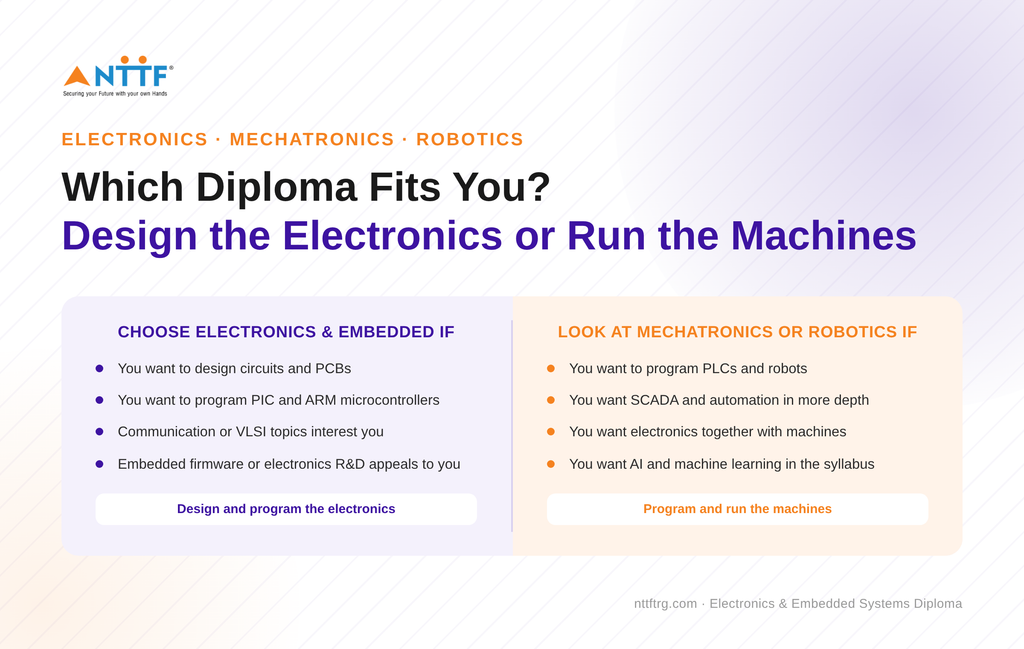
This is where an honest answer matters. CP04 goes deep on circuits, boards and firmware. It teaches PLC as one Year 3 subject and does not list robotics or AI and machine learning. If you want to program robots and PLCs, two NTTF diplomas cover more of that.
| Electronics & Embedded (CP04) | Mechatronics & Smart Factory (CP15) | Automation & Robotics (CP37) | |
| Strongest in | Circuits, PCB design, PIC and ARM microcontrollers, communication, embedded | Electronics with mechanical, pneumatics, drives and PLC | Robots, PLC and SCADA, sensors, embedded and IoT |
| PLC | One Year 3 subject | PLC Basics (Year 2), HMI and SCADA Basics (Year 3) | PLC (Year 2), Advanced PLC and SCADA (Year 3) |
| Robotics | Not listed | Robotics (Year 3) | Robotics and ROS (Year 3) |
| AI and ML | Not listed | Artificial Intelligence, Machine Learning (Year 3) | AI and ML (Year 3) |
| VLSI, communication | VLSI Technology, analog, digital and data communication | Not listed | Not listed |
| Pick it if | You want to design and program the electronics | You want electronics plus machines | You want to program and run robots and automated lines |
Who can join, and what comes next?
| Item | Details |
| After 10th | Pass 10th with Maths and the NTTF entrance exam. Maximum age 24. A free mock test is on the site |
| Lateral entry | Pass 12th or ITI with Science and Maths, plus the entrance exam. Maximum age 25. Some students first complete a bridge programme |
| Duration | 3 years, 6 semesters |
| Fee | Charged per semester. No amount is published. See the brochure |
| Recognition | NTTF lists NCVET Level 4.5, MSDE and NOCN UK |
| Campuses | Peenya and Electronic City (Bangalore), Jamshedpur, Gadag, Pune |
| Contact | Toll-free 1800 103 6883 |
After the diploma you can start work, or add a one-year post diploma. Electronics diploma holders can apply to Embedded Systems and IoT (CP18) and Industrial Automation (CP19), and the Post Diploma programs page lists the rest. To decide between working and studying more, read Post-Diploma vs Jumping Straight Into a Job.
Frequently asked questions
Is a diploma in electronics worth it after 10th?
Yes, if you want to design, program or maintain electronic systems and will learn embedded programming, not only circuits. NTTF’s CP04 is a 3-year diploma open after 10th with Maths.
Will automation replace electronics technicians?
It will remove routine tasks and create new technical roles. The WEF expects 170 million jobs created and 92 million displaced by 2030. Troubleshooting, embedded programming and control skills are the safer ground.
Electronics diploma or mechatronics diploma?
Choose electronics to design and program the electronics. Choose mechatronics or automation and robotics to program PLCs and robots and work on machines.
What can I do after a diploma in electronics?
Start work, enter a 1-year post diploma in Embedded Systems and IoT or Industrial Automation, or look at lateral entry to a B.Tech. See the internship program for industry exposure during study.
So, is it still worth it?
Yes, as long as you treat circuits as the base and add programming on top. The worst choice is a diploma that stops at assembly and testing. The best is one where you leave able to design a board, write the firmware for it and connect it to a control system.
If that is your goal, start with the Diploma in Electronics & Embedded Systems (CP04). If you would rather program robots and PLCs, compare CP15 and CP37, or browse all diploma programs.