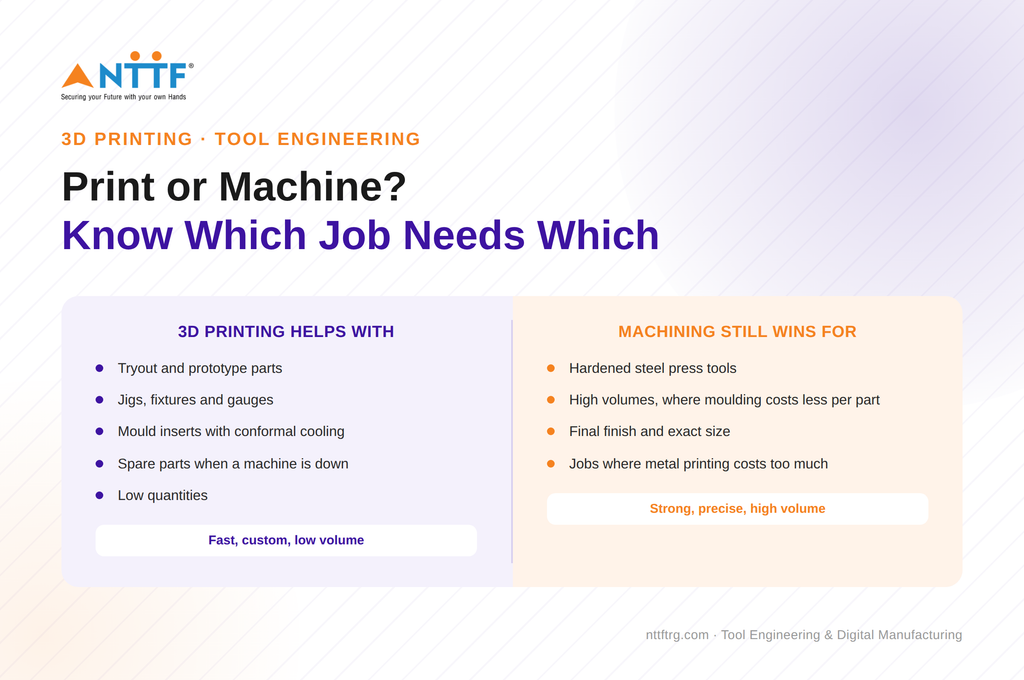
Does 3D printing replace machining in a tool room? No. It changes some jobs a lot: tryout parts, jigs and fixtures, gauges and some metal mould inserts. For hardened steel press tools, CNC machining and EDM still do most of the work. A tool engineer who knows both is more useful than one who knows only one.
Here is where printing helps, where it does not, and what NTTF’s Tool Engineering & Digital Manufacturing diploma teaches about it. For the basics of how the technology works, read Additive Manufacturing: What It Is and Why It Matters.
Where 3D printing helps tool engineers
| Use | Instead of | Why it helps | Watch out for |
| Tryout and prototype parts | Machining a test part | Test a design before cutting steel | Printed plastic may not behave like the final material |
| Jigs, fixtures and gauges | Machined or bought fixtures | Shaped to the part, quick to revise | Strength and wear when used every day |
| Mould inserts with conformal cooling (metal printing) | Straight drilled cooling channels | Channels follow the shape of the part. One case study on a car armrest mould reports a 17% shorter cycle time | Metal printers are costly, and the figure is customer-reported |
| Spare and replacement parts | Waiting on a supplier | Print a part when a machine is down | Check that the printed material is strong enough |
| Part consolidation | Assembling many pieces | GE printed a jet engine fuel nozzle as one piece in place of about 20 welded and brazed parts, and it weighs 25% less | This is an engine part, not a tool. The design has to be made for printing |
The processes you will hear about
| Process | How it works | Typical use in a tool room |
| FDM | Melts and extrudes plastic filament | Jigs, fixtures, tryout parts |
| SLA / DLP | UV light cures liquid resin | Precise prototypes and masters |
| SLS | Laser fuses nylon powder | Functional plastic parts |
| Metal powder bed (DMLS, SLM, EBM) | A laser or electron beam melts metal powder | Mould inserts, aerospace and medical parts |
| Binder jetting | Binder is sprayed onto powder | Sand moulds |
Where it does not help
| Limit | What it means for you |
| Volume | Moulding gets cheaper per part as quantities grow. In one Xometry quoting example, the break-even fell between about 250 and 2,000 parts, depending on the part |
| Steel tooling | Press tools and many moulds are cut from tool steel by CNC machining, grinding and EDM. These are core subjects in NTTF’s diploma |
| Finishing | Printed parts usually need support removal, surface finishing or machining to size |
| Metal printing cost | Metal printers cost far more than plastic ones, so metal printing suits high-value tools first |
What NTTF’s Tool Engineering diploma teaches
The Diploma in Tool Engineering & Digital Manufacturing is 3 years, 6 semesters, and 70% hands-on. Entry after 10th needs Maths and the NTTF entrance exam, with a maximum age of 24. This is how its subjects map to the skills in this post.
| Skill | Subjects on the program page |
| Design | Engineering Drawing/CAD, design using Fusion 360, Design of Press Tool, Mould, and Jig & Fixture |
| Make | CNC Turning, CNC Milling with CAM, EDM, Press Tools, Mould Technology |
| Additive Manufacturing (Year 3), 3D printing technologies and prototyping | |
| Check | Measuring and Inspection, Digital Inspection |
| Connect | Automation (pneumatics, hydraulics, PLC, robotics), IIOT |
Year 3 ends with a project to design, plan, make and prove a press tool or mould.
Be clear about what this is. Additive Manufacturing is one subject in Year 3, not a specialization, and the program page does not name the printers or technologies in the lab. Ask the centre what students print on and how many hours it gets.
If you want more printing depth, NTTF runs a separate Advanced Certification Course in 3D Printing & Additive Manufacturing. It is open to working professionals and to diploma and engineering students. The page does not state a duration or fee, so ask NTTF.
Where tool engineers work
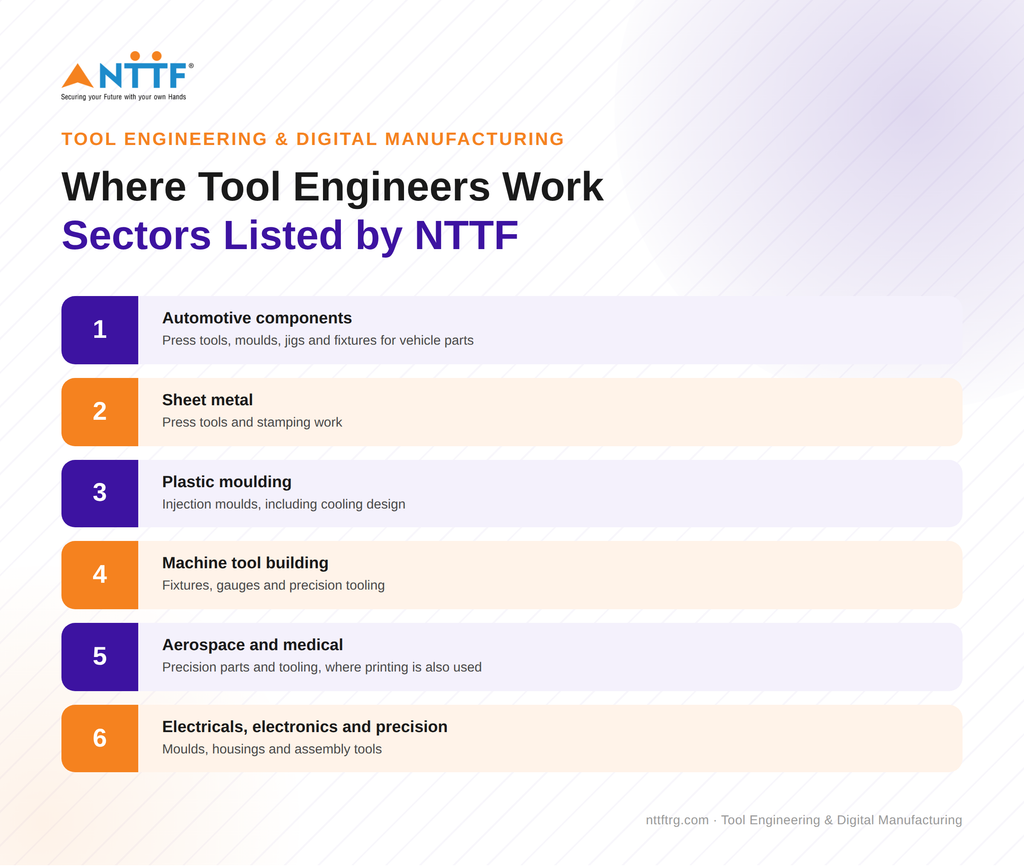
NTTF lists these sectors for its tool engineering graduates: automotive components, sheet metal, plastic moulding, machine tool building, aerospace, medical, electricals and electronics, and precision manufacturing. The page states a 98%+ placement record, which is NTTF’s own figure, so ask the placement cell for the last batch’s companies and roles. For the job itself, read Who Is a Tooling Engineer? and What Are the 3 Major Aspects of Digital Manufacturing?
So, should you learn 3D printing?
Yes, as an added skill, not as a replacement for the basics. If you want to design and make tools, the core is still CAD, CNC, EDM and an understanding of press tools and moulds. Printing then gives you faster tryouts, better fixtures and, in some shops, better mould cooling.
If printing itself is your goal, start with the 3D printing certificate. If tools are your goal, the diploma is the longer and broader route.
Ready to look closer? Read the Tool Engineering & Digital Manufacturing program page, or compare all diploma programs.