
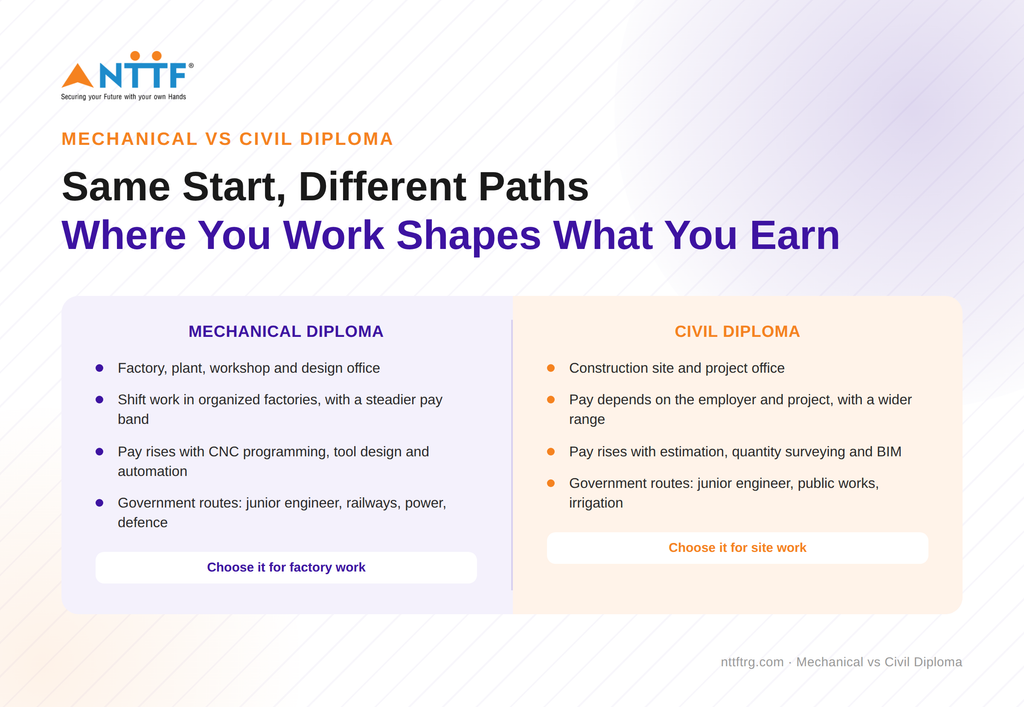
The short answer: neither clearly pays more at the start. The pay data we could find is thin, and it shows similar entry pay for both. What separates them later is not the diploma title. It is where you work and the skills you add: CNC programming, tool design or automation in mechanical, and estimation, quantity surveying or BIM in civil.
Here is the evidence, what it does and does not prove, and how to choose.
Mechanical vs civil diploma at a glance
| Mechanical diploma | Civil diploma | |
| Focus | Machines and manufacturing | Buildings and infrastructure |
| Where you work | Factory, plant, workshop, design office | Construction site, project office |
| Typical conditions | Shift work, noise and heat, strict machine safety | Outdoor work, travel, long hours near deadlines |
| Design software | AutoCAD, SolidWorks, Fusion 360 | AutoCAD, Revit, STAAD.Pro |
| What lifts pay | CNC programming, tool design, automation, maintenance | Estimation, quantity surveying, BIM, project responsibility |
| Government route | Junior engineer and technical posts | Junior engineer and public works posts |
| Entry-role risk | Pay is steadier in organized factories, lower in small workshops | Small contractors can pay very little to freshers |
What the salary data actually shows
| Source | Mechanical diploma | Civil diploma |
| Glassdoor India (50 mechanical and 40 civil self-reported salaries) | ₹14,000 to ₹23,000 a month | ₹17,000 to ₹42,000 a month |
Read this carefully. It is 90 self-reported salaries in total, not a survey, and the pages we checked do not break pay down by experience. Another salary guide puts mechanical diploma freshers at ₹2 to 3.5 lakh a year, which is about ₹17,000 to ₹29,000 a month.
Two things are fair to say. Starting pay is in the same range for both. And civil’s range is wider and goes higher, while mechanical’s is narrower. That matches how the work is paid: a civil site salary depends heavily on the employer and the project, while organized factories tend to pay within a tighter band.
Do not treat any single number as a promise. Pay differs by city, company and how much practical skill you bring.
What raises pay in each branch
Mechanical pay rises when you move beyond basic machine operation: CNC programming and CAM, tool design, industrial automation with PLC basics, and maintenance work where downtime costs a company money.
Civil pay rises when you take on responsibility for the whole job: estimation and costing, quantity surveying, BIM and Revit, planning and billing, and running a complete site. Small contractors can pay freshers very little, so the employer matters as much as the branch.

Where each diploma leads
| Mechanical roles | Civil roles |
| Production or CNC operator: runs and monitors machines | Junior site engineer: supervises daily construction work |
| Maintenance technician: prevents breakdowns | Site supervisor: keeps work to drawings and schedule |
| Quality inspector: checks parts with calipers, micrometers and gauges | Quality control technician: tests concrete and materials |
| CAD technician: draws components and models | Civil CAD or BIM technician: prepares building drawings and models |
| Tool and die technician: makes precision tools for mass production | Quantity surveyor or estimator: calculates quantities and costs |
| Automobile or HVAC technician: services vehicles or building systems | Surveyor: measures land and project boundaries |
For a day-in-the-life view of the mechanical side, read What Does a Mechanical Engineer Do?
Government jobs: where pay is fixed
Both branches can apply for Junior Engineer posts. The Staff Selection Commission published its 2026 JE notice on 2 September 2026 for Civil, Mechanical, Electrical and other posts, with about 1,748 tentative vacancies. Posts sit at Pay Level 6, with a pay matrix of ₹35,400 to ₹1,12,400. The qualification is a degree or a diploma in the relevant discipline, and which one is accepted depends on the post, so read the official notice closely. Applications for this cycle closed on 22 September, so the next one is what to prepare for.
Beyond SSC, civil diploma holders look to public works, irrigation and municipal departments. Mechanical diploma holders look to railways, power, defence units and public-sector companies. Age limits and qualifications change with each notification, so check each one.
Is demand growing?
Yes, for both, based on the latest official numbers.
- Factories: In August 2026, India’s manufacturing output grew 9.0% year on year, and capital goods (machinery and equipment) grew 16.9%, according to the MoSPI release of 28 September.
- Construction: Infrastructure and construction goods grew 6.4% in the same month. The Union Budget also raised central government capital spending to ₹12.2 lakh crore for 2026-27, about 8.9% above last year’s budgeted ₹11.2 lakh crore.
That is one month of data, so do not read too much into the gap between the two. The point is that neither branch is shrinking.
How to choose
Choose diploma in mechanical engineering if you like machines and workshop practice, are fine with factory shifts, and want to move toward CNC, tool design or automation.
Choose civil if you are comfortable working outdoors, like surveying and construction, and want to grow into estimation, BIM or running a site.
The honest tiebreaker is the work, not the first salary. The data does not separate the two at the start, and a skilled mechanical technician can out-earn an average civil diploma holder, just as a good quantity surveyor can out-earn a basic machine operator. Pick the one you can do well for ten years. Whichever you choose, learn the digital tools of that branch, because a diploma syllabus alone will not keep your pay growing.
When you compare institutes, check the workshops or labs, how much of the training is hands-on, and placement support. These matter more than the branch name.
A note on NTTF
NTTF does not run a civil diploma. If civil is your choice, look for a polytechnic that offers it.
If mechanical suits you, NTTF’s Diploma in Tool Engineering & Digital Manufacturing is a mechanical diploma with 70% hands-on and 30% theory training, as NTTF states. It covers CNC turning and milling with CAM, press tools and moulds, quality management, and automation including PLC and robotics. NTTF lists roles such as tool designer, CAD/CAM engineer, automation engineer and quality manager, and you can see its placement record before you decide. Graduates who want to specialize further can add a one-year Post Diploma in Tool Design, and whether that pays off is covered in Post-Diploma vs Jumping Straight Into a Job.
Explore all NTTF diploma programs to compare your options.