Short answer: Data science skills for engineers come in levels. Most engineers do not need to become data scientists, but almost all need data skills: reading sensor and measurement data, pulling records with SQL and writing short Python scripts to spot patterns. If you want data to be your main work, our Diploma in Information Technology & Data Science (CP09) is built for that, though it is a 3-year IT diploma with one AI course, not a machine learning degree. If you are heading into mechatronics, electronics or another core branch, you get a smaller dose of data work inside your own diploma. This post shows which diploma teaches how much.
Do engineers really need data science skills?
You need data literacy. Full data science is for people whose job is analysis. There are three levels, and most engineers sit in the first two.
| Level | What it means | Who needs it |
| Data literacy | Read charts and logs, use a spreadsheet, spot a trend | Every engineer |
| Data handling | Write SQL queries and short Python scripts, clean a dataset | Engineers who work with plant, test or software data |
| Data science | Statistics, building and testing models | People whose main job is analysis. This usually needs more maths than a diploma covers |
Why do employers ask for data skills?
Two sourced facts explain it.
| Fact | Source |
| Analytical thinking is the top core skill: 7 in 10 companies call it essential. AI and big data are the fastest-growing skills, ahead of networks and cybersecurity | World Economic Forum, Future of Jobs Report 2025 (7 Jan 2025), skills outlook |
| 57% of manufacturers said they use predictive maintenance, which means reading sensor data to catch a machine fault early | Augury and IndustryWeek 2026 report, reported by Analytics Insight, 16 Oct 2026 |
Read the second one closely. The same article says the sensors flag a discrepancy, then staff decide whether the alert is real and what to do about it. Data does not replace the engineer. It gives the engineer something better to judge. The WEF survey covers 1,000+ employers across 55 economies, so it shows the global direction, not a promise of jobs in India.
What do engineers actually do with data?
| On the job | Data skill | Where to start |
| Spot a machine fault before it stops production | Read sensor trends over time | Spreadsheet charts, then Python |
| Find out why a batch failed quality checks | Compare measurements across batches | Spreadsheet, SQL |
| Track power or energy use in a plant | Pull and summarise meter readings | SQL, spreadsheet |
| Report output to a manager | Build a clean table and a chart | Spreadsheet, a business intelligence tool |
| Test a software application | Log checks and query records | SQL, Python |
In every row, the engineer still decides what the numbers mean.
Which NTTF diploma teaches how much data?
We list the data-related subjects from each diploma’s program page. CP09 has the most. The other diplomas give you a smaller dose, and each has a clear stopping point.
| Diploma | Data-related subjects | Where it stops |
| CP09 IT & Data Science | Year 1: Python Programming, Data Structures with Python, Database Design and Development, SQL Server Lab. Year 2: Oracle, Artificial Intelligence with lab, Business Intelligence with lab. Year 3: R Programming with lab, Information System Analysis, Business IT Project | No separate statistics or machine learning subject |
| CP15 Mechatronics | Year 2: Programming in Python, Measurement and Instrumentation. Year 3: IIoT, Industry 4.0, Artificial Intelligence, Machine Learning, HMI and SCADA Basics | AI and ML are two of the Year 3 subjects, shared with robotics, CNC and automation. No database or statistics subject. Read our CP15 smart factory careers post for the rest |
| CP04 Electronics & Embedded Systems | Year 2: Programming in C, C++ and Python, Instrumentation. Year 3: IIoT | No database, AI or machine learning subject |
| CP08 IT Infrastructure | Year 1: Database, IoT Lab. Year 2: IoT. Year 3: Cloud Computing, AWS Cloud Lab. See our IT infrastructure careers post | No Python, statistics or AI subject |
| CP19 Industrial Automation (1-year post diploma) | Process Control Instrumentation, SCADA, PLC and Plant Network, DCS Practical Project | Plant data and control, not analysis or programming for data |
| CP01 Tool Engineering and CP23 Electrical & Electronics | CP01: Digital Inspection, IIoT, Quality Management. CP23: Electrical and Electronics Measurement, Computer Programming, IoT | No database, Python or analytics subject |
If your branch is in the last three rows, plan to learn the data skills on the side. The next two sections show how.
Is the IT & Data Science diploma (CP09) the right start?
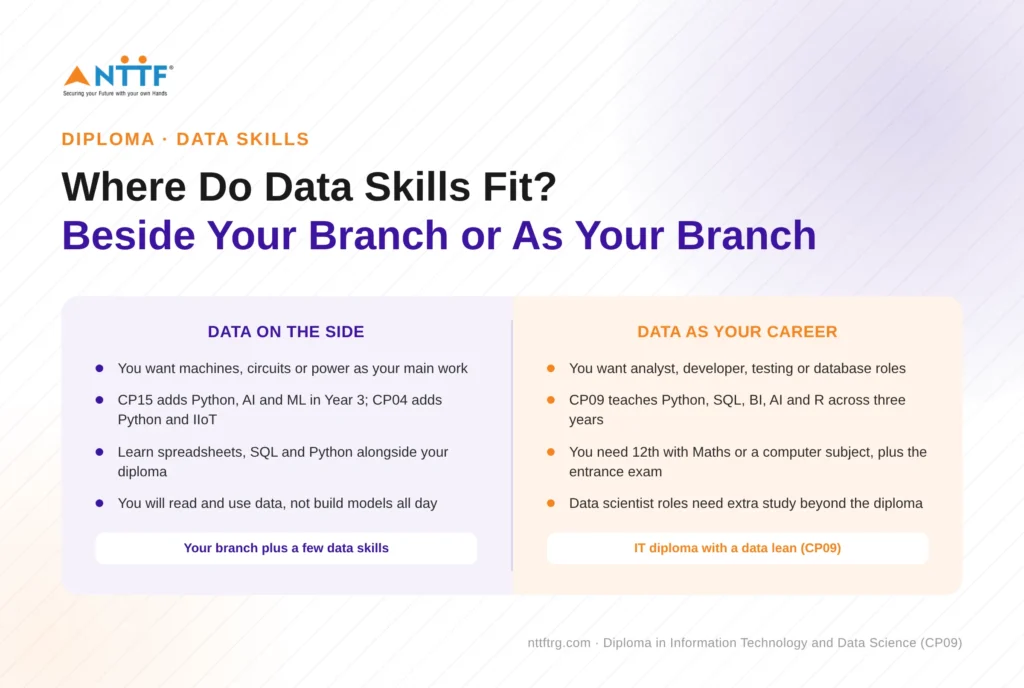
It is the right start if you want analyst, developer, testing or database work. It is a full-time 3-year diploma after Class 12, 70% hands-on and 30% theory, so it is not a short add-on for someone already in another diploma. Our full year-wise syllabus is in Diploma in IT & Data Science: What You Study and Which AI Jobs It Leads To.
| Route | Who can join | Age limit |
| After Class 12 | 12th, PUC or HSC with Maths or any computer-related subject, plus the NTTF entrance exam | 24 |
| Lateral entry | 12th or ITI with Science and Maths, plus the entrance exam. A bridge programme applies to some students: 160 hours after PUC or 12th, 80 hours for non-relevant ITI trades | 25 |
The diploma has multiple entry and exit points: IT Installation Technician after Year 1, Junior Software Developer after Year 2, and the Diploma in Information Technology & Data Science after Year 3, a Level 4.5 NCVET diploma. The roles it prepares you for are RPA Developer, Test Engineer, Data Analyst, Developer, Full-Stack Developer, Cloud Deployment Manager, Database Administrator and Software Engineer. If you searched for a diploma in data science or a diploma in information technology, this is the program, and you can practise for the entrance exam with our free mock test.
Be clear about the limit. CP09 has one Artificial Intelligence course in Year 2 and R Programming in Year 3, but no separate statistics or machine learning subject. Graduates start in analyst, developer, testing and database roles. Data scientist roles usually need stronger maths and machine learning, which you build with further study.
How can I start learning data skills while I study?
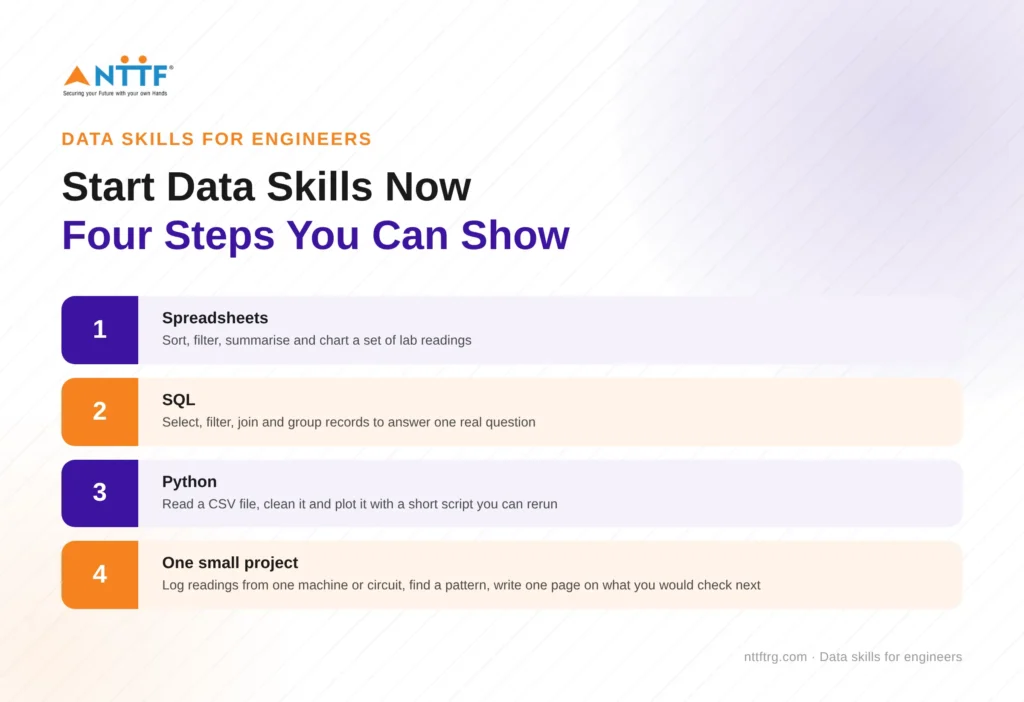
Work through these in order. Each step ends with something you can show an employer.
| Step | What to learn | What you can show |
| 1. Spreadsheets | Sort, filter, summarise and chart | One chart from a set of lab readings |
| 2. SQL | Select, filter, join and group records | One query that answers a real question from a sample dataset |
| 3. Python | Read a CSV file, clean it, plot it | A short script anyone can rerun |
| 4. One small project | Log readings from one machine or circuit and find a pattern | A one-page summary with your chart and what you would check next |
If you are in CP09, CP15 or CP04, Python is already on your timetable, so use it for step 3. Keep step 4 small and honest: one machine, one pattern, one page.
Common questions about data science skills for engineers
Do mechanical engineers need data science?
Not full data science. Data literacy helps: reading measurement data, comparing batches and spotting drift in a process. Our CP01 diploma lists Digital Inspection, Quality Management and IIoT but no database or Python subject, so learn spreadsheets, SQL and basic Python on the side.
Is Python enough to start?
It is enough to start, if you pair it with SQL. Most engineering data sits in files and databases. Python reads and cleans it, and SQL pulls the right records first. Neither replaces knowing your machine.
Can I become a data scientist with a diploma?
A data scientist diploma on its own is a stretch. Our CP09 graduates train for analyst, developer, testing and database roles, because the diploma has no separate statistics or machine learning subject. The national qualification registry lists progression from the CP09 diploma to a post diploma, B.Voc and B.Tech in relevant areas. Ask our admissions team which of those routes is open to you. If the analyst route interests you, read Can I Become a Data Analyst After a Diploma?.
Which is better for data skills, CP09 or CP15?
It depends on what you want to do. Choose CP09 if data, software and databases are the work itself. Choose CP15 if you want to build and run machines, with Python, AI and machine learning as one part of the job.
Ready to pick a diploma? Take our free entrance mock test to see where you stand, compare every program on our Diploma Programs page, then apply online or call us toll-free on 1800 103 6883.