Short answer: A diploma in computer science after 10th is a good start if you like keeping systems running more than writing apps. Cloud services, AI tools and connected factories all sit on networks, servers, storage and security, and companies need people to set them up and look after them. Our Diploma in Computer Technology and IT Infrastructure (CP08), also listed as our diploma in computer science engineering, is a 3-year, 70% hands-on route into that work after 10th with Maths. It starts you in IT support and junior infrastructure roles. Senior network, cloud and security jobs need experience and extra certifications on top.
Why are IT infrastructure jobs growing?
Every cloud app, AI tool and smart factory depends on machines that must stay on. Someone has to connect them, secure them and fix them when they fail. Two recent reports show how big that work is getting.
| Fact | Source |
| India’s installed data centre capacity is about 1.5 GW and is projected to reach nearly 6.5 GW by 2030. The industry will need nearly 1 lakh skilled professionals, including cloud operations, DevOps and data centre automation staff | NLB Services report, reported by IANS, 14 Jul 2026 |
| Demand for cybersecurity specialists rose 15% to 20% between 2025 and 2026 | TeamLease Digital, reported 30 Sep 2026 |
Read these carefully. The TeamLease shortage is 25% to 30% among mid-to-senior professionals, and the NLB report warns of a widening skills gap. Those are experienced roles. A diploma holder starts lower and grows into them. So the numbers show where the field is going. They do not promise a job to every graduate.
Factories add one more reason. Machines on the shop floor now send data over networks, which is why CP08 includes an IoT lab in Year 1 and IoT in Year 2.
Is IT infrastructure a better fit than a software career?
| Question | IT infrastructure | Software development |
| What is the daily work? | Networks, servers, operating systems, security, fixing faults | Writing and testing application code |
| What do you work with? | Real hardware and live systems | Mostly code on a laptop |
| Who enjoys it? | People who like troubleshooting and hands-on work | People who like building features and logic |
| First jobs | IT support, network support, server administration | Junior developer, tester |
Not every student wants to write code all day, and you do not have to. CP08 still teaches C, C++, Java and web programming, so you will not be code-free.
Who can join the diploma in computer science after 10th (CP08)?
| Item | Details |
| Program | Diploma in Computer Technology and IT Infrastructure (CP08) |
| Length | 3 years, 6 semesters, with multiple entry and exit options |
| After Class 10 | Pass Class 10 with Maths and our entrance exam. Maximum age 24. A free mock test is on our site |
| Lateral entry | Pass Class 12 or ITI with Science and Maths, plus our entrance exam. Maximum age 25. A bridge programme applies to some students: 160 hours for PUC or 12th, 80 hours for ITI non-relevant trades |
| Training | 70% hands-on, 30% theory |
| Fee | Charged per semester. Get the current amount from our brochure |
| Recognition | A Level 4.5 NCVET diploma, plus an international diploma from NOCN UK if you enrol for it. Our diplomas are also recognised by MSDE |
| Campuses | Our enquiry form lists Electronic City, Chennai, Gannavaram, Tellicherry, Gadag and Murbad. Confirm your campus before you apply |
| Hostels | Available at most centres, for men and women |
What does CP08 teach?
Here are the CP08 subjects year by year. Each year ends at a recognised exit point.
| Year | Subjects | Exit point |
| 1 | Maths I and II, English, Applied Science, Problem Solving Technique, Basics of Electrical and Electronics, PC Hardware Lab, HTML and CSS Lab, Unix, Computer Networks I, C Programming, Database, IoT Lab | IT Installation Technician |
| 2 | Data Structures, OOPs using C++, Computer Networks II, Microprocessor and Microcontroller, Operating Systems, Software Engineering, Java Programming, WSA and LSA, IoT, Web Programming (JavaScript, Perl, PHP) | IT Support Technician |
| 3 | Cloud Computing, Cyber Security, Software Testing, Organizational Behavior and Project Management, ITIL and DevOps, DevOps Lab, AWS Cloud Lab | Diploma in Computer Engineering and IT Infrastructure |
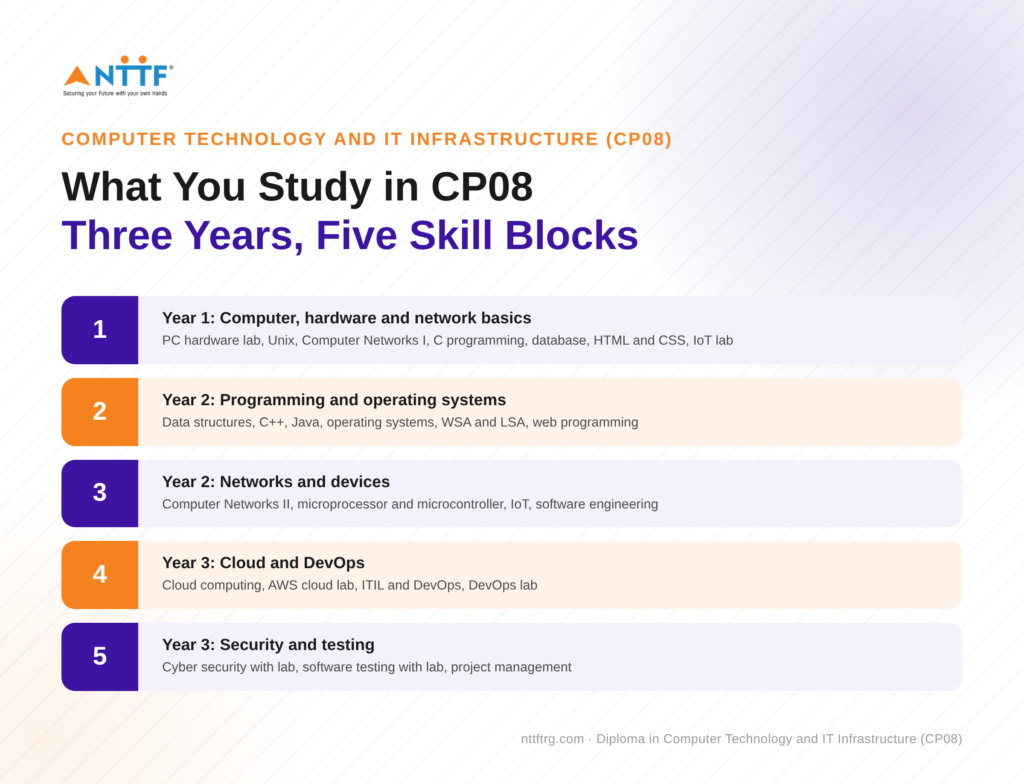
Here is what that means in practice. Networking is two subjects, Computer Networks I and II, so CP08 is a diploma with networking in it, not a dedicated network engineer course. Cloud and AWS arrive in Year 3, and cybersecurity has its own subject and lab. Python is not a separate subject, and there is no AI course. If AI and data are your goal, look at our Diploma in IT and Data Science (CP09).
Which jobs does it lead to?
CP08 graduates work in these roles, and each one builds on specific subjects.
| Role | Subjects behind it |
| Network Engineer | Computer Networks I and II, Unix |
| Systems Engineer, Server Administrator | Operating Systems, Unix, WSA and LSA |
| Cloud or Infrastructure Engineer | Cloud Computing, AWS Cloud Lab, ITIL and DevOps |
| Database Administrator | Database, Data Structures |
| Cybersecurity Analyst | Cyber Security and its lab |
| Test Engineer | Software Testing and its lab |
| Software Developer | C, C++, Java, Web Programming |
We also list technical trainer and operations manager roles. The sectors are IT, cloud computing, cybersecurity, networking and infrastructure, data management, software development and IT operations. For more on the roles, read The Role of Computer Engineering & IT Infrastructure Diplomas in the Tech Industry.
The Year 1 and Year 2 exit points are IT Installation Technician and IT Support Technician, so the realistic first jobs are support and junior infrastructure roles. Titles like network engineer, cloud engineer or cybersecurity analyst are where you grow with experience and extra certifications.
CP08 has a 98%+ placement record. Companies such as Intel, Bosch, Wipro, HAL and Tata Steel have recruited from NTTF, which is not the same as hiring from CP08 every year. Across all our programs, 500+ companies recruit from us and the average package is about ₹3.5 to ₹4 lakh a year (see our Placements page). That is a program-wide figure, not CP08 alone, so ask our admissions team for the latest CP08 batch: companies, roles and pay.
Is CP08 right for you?
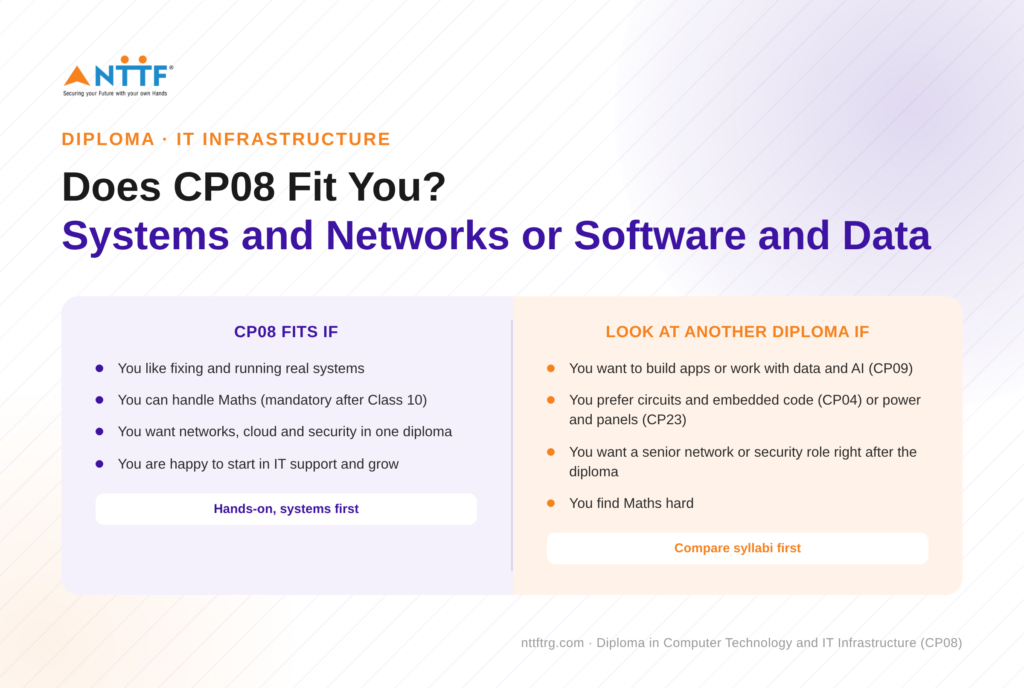
Among our computer diploma courses, CP08 and CP09 are the two most often compared. They lead to different work.
| Compare | CP08 IT Infrastructure | CP09 IT and Data Science |
| Strongest in | Networks, operating systems, cloud, security | Programming, databases, data, one AI course |
| Who can join | After Class 10 with Maths | After Class 12 |
| Cloud | Cloud Computing and AWS Cloud Lab in Year 3 | No cloud subject |
| AI | None | One AI course in Year 2 |
| Typical first jobs | IT support, network support, server administration | Developer, software tester, junior data analyst |
If a degree is your plan, read Is a Diploma in Computer Technology Better Than a BCA?. For CP09 in detail, see Diploma in IT & Data Science: What You Study and Which AI Jobs It Leads To.
Common questions about CP08
Is a diploma in computer science after 10th worth it?
Yes, if you want hands-on technical work and a 3-year route to a job. It starts you in support and junior infrastructure roles, not senior engineer titles. If you want to write software or work in AI and data, compare it with CP09 first.
Is CP08 a network engineer course?
Not only. It is a diploma where networking sits next to operating systems, cloud and security. Networking is two subjects with labs. If you want to become a network engineer, CP08 gives you the base, and you add experience and certifications after.
Do I need to be good at coding?
You need Maths after Class 10, and you will study C, C++, Java and web programming. You do not need to love coding. Most of the course is about systems, networks and security.
Does CP08 include internships?
Internships are optional, and students can do one in their vacations. Our Internship Program runs 4, 8, 12 and 24 weeks.
IT infrastructure is the work behind every cloud app, AI tool and connected machine, and it will keep needing people. If you want hands-on work after 10th, see our CP08 page, take the free mock test, and apply or call 1800 103 6883.