Short answer: A diploma in manufacturing technology suits you if you like machines, making things and seeing a drawing become a real part. NTTF has no program with that exact name. The closest match is its Diploma in Tool Engineering and Digital Manufacturing (CP01): a 3-year, 6-semester mechanical diploma with a toolroom focus. It covers press tools, moulds, jigs and fixtures, CNC, and in Year 3 additive manufacturing, IIoT and automation. It is 70% hands-on and 30% theory. It is a narrower, more practical route than a general mechanical diploma, and this post shows when that is the right trade.
Is there demand for manufacturing diploma jobs in 2026?
| Fact | Source |
| India’s manufacturing PMI was 54.7 in October 2026 (September: 55.1). Above 50 means growth. New export orders rose at their fastest pace in six months | S&P Global/HSBC, reported by KNN |
| Employment rose for a second month, but only slightly. Capital goods producers cut staff while other manufacturing categories added workers | Same report |
Demand for factory output is strong. Hiring is cautious, and the one group that cut staff, capital goods, is close to tool rooms and machine building. So skills decide who gets hired. A diploma that gets you running CNC machines and designing tools is more useful than one that only lists subjects.
What does the CP01 diploma teach?
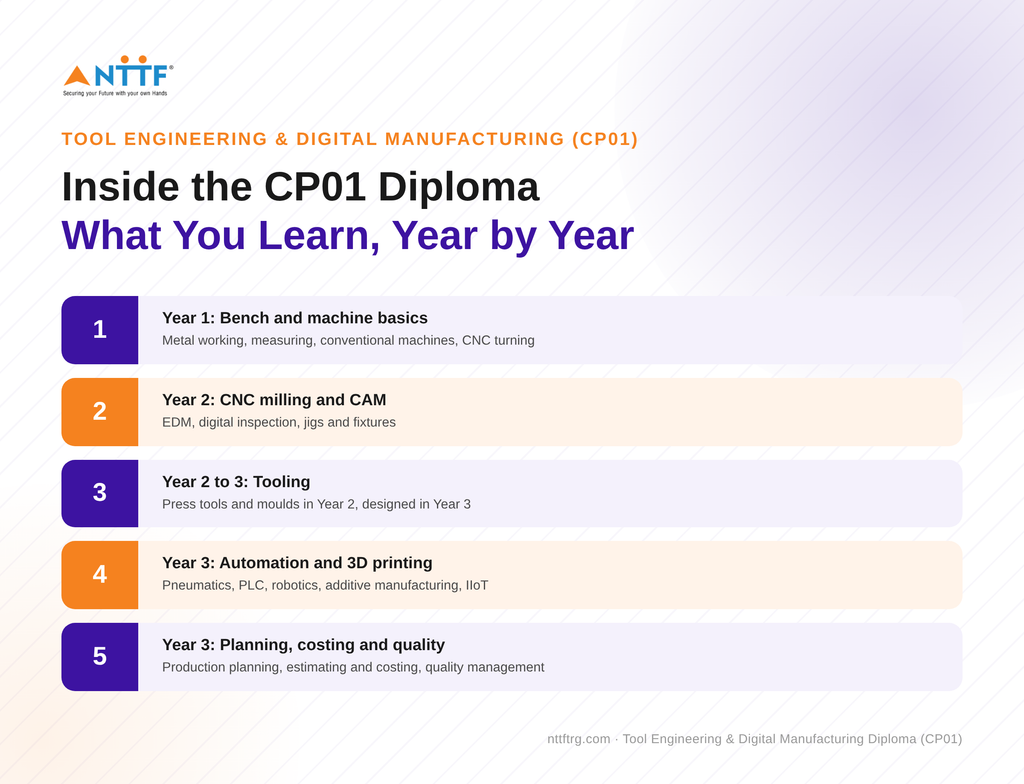
The Diploma in Tool Engineering and Digital Manufacturing (CP01) runs 3 years and 6 semesters. NTTF lists its subjects year by year.
| Year | Subjects | What it builds |
| 1 | Induction Programme, Safety, English, Mathematics, Engineering Science, Precision Manual Metal Working, Measuring and Inspection, Material Technology and Heat Treatment, Conventional Machines, Computer Skills, Engineering Drawing and CAD, CNC Turning, Project | Bench skills, measuring, conventional machines, CNC turning |
| 2 | Electrical Engineering, Electronics Engineering, Conventional Machines, Engineering Drawing and CAD for tool design, CNC Milling and CAM, EDM, Digital Inspection, Strength of Materials, Jigs and Fixtures, Press Tools, Mould Technology, Project, NOCN | CNC milling and CAM, EDM, and the basics of jigs, press tools and moulds |
| 3 | Design of Press Tools, Design of Moulds, Design of Jigs and Fixtures, Automation (pneumatics and hydraulics, PLC, robotics), Additive Manufacturing, IIoT, Project, Industrial Management, Production Planning and Control, Estimating and Costing, Quality Management, NOCN | Tool design, automation, 3D printing, planning and costing |
The page names Fusion 360 and says students work on real projects and take part in competitions. It does not name the 3D printers, CNC machines or EDM machines, so ask the centre what you will use. It also lists no digital twin or smart factory subject. IIoT and Automation are the closest.
Exit points. NTTF’s page says “multiple entry-exit options” but does not name the certificates. India’s National Qualifications Register lists two NTTF qualifications that line up with the years: an Assistant Tool Maker (NSQF Level 4.0, 1,200 hours including 90 hours of on-the-job training) and a Senior Technician in Digital Manufacturing and Tool Engineering (Level 4.5, 1,380 hours). Those files are inconsistent in places, so ask the centre exactly which certificate you receive and how re-entry works after an exit.
Is it better than a general mechanical diploma?
It depends on what you want. CP01 is a mechanical diploma with a toolroom focus. Its Year 1 is the mechanical foundation, so you are not giving up the basics.
| NTTF CP01 | A general mechanical diploma | |
| Focus | Tooling: press tools, moulds, jigs and fixtures, designed in Year 3 | Usually broader across mechanical engineering. Check the syllabus |
| Digital skills | CAD, CAM, CNC, EDM, digital inspection, additive manufacturing, IIoT | Varies by college |
| Hands-on | 70% hands-on, 30% theory | Ask the college for lab hours |
| Pick it if | You want toolroom, CNC and design work | You want a wider base or are unsure which area to choose |
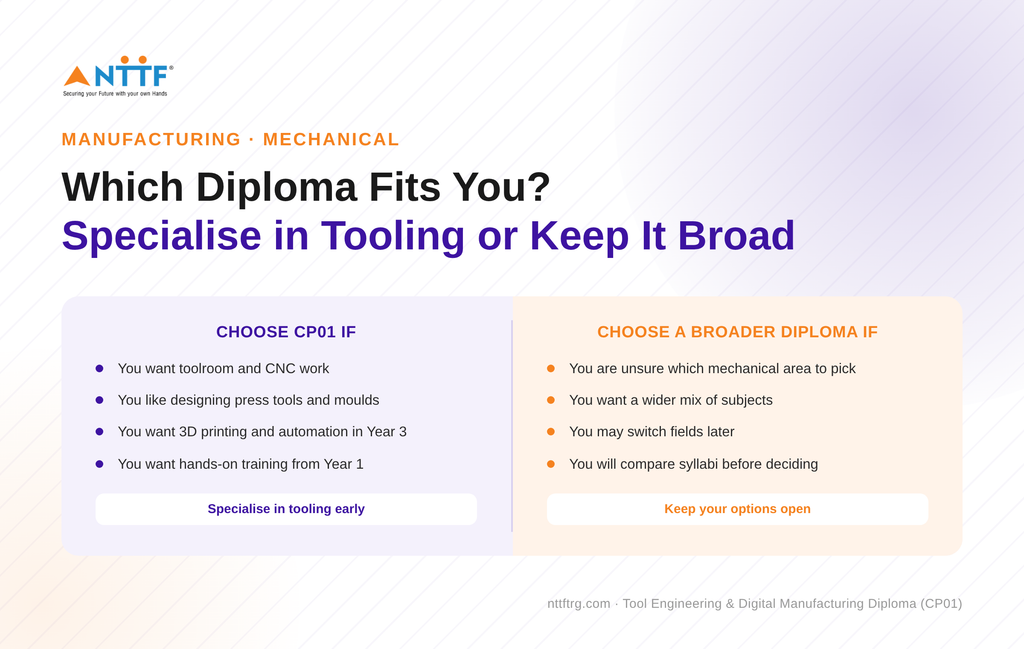
If you already know you want tooling, CNC or plastic design, CP01 gets you there faster. If you are still deciding, compare the syllabus of a broader diploma first. For where a mechanical diploma can lead afterwards, read Post-Diploma vs Jumping Straight Into a Job.
Which jobs does it lead to?
NTTF’s page lists nine roles. This table shows the subjects behind them.
| Role | Subjects behind it |
| Tool designer | Design of Press Tools, Moulds, Jigs and Fixtures (Year 3) |
| Tool room in-charge | Press Tools, Mould Technology, Production Planning and Control, plus experience |
| Production (tool room) | Conventional Machines, CNC Turning and Milling, Jigs and Fixtures |
| Tool maintenance | Press Tools, Mould Technology, EDM |
| CAD/CAM engineer | Engineering Drawing and CAD, CNC Milling and CAM |
| Automation engineer | Automation (P&H, PLC, Robotics), IIoT |
| Product designer (plastic design) | Mould Technology, Design of Moulds, CAD |
| Application engineer | CNC and CAM, Digital Inspection, Additive Manufacturing |
| Process engineer | Production Planning and Control, Quality Management, Estimating and Costing |
The page lists these sectors: automotive components, sheet metal, plastic moulding, machine tool building, FMCG, electricals and electronics, aerospace, medical and precision manufacturing. The Year 3 qualification file adds that after about three years of experience, paths include process engineer, product design engineer, digital manufacturing engineer and additive manufacturing engineer.
NTTF states a 98%+ placement record for CP01. The page shows 44 recruiter logos, including Tata Steel, Ford, Bosch, Toyota Kirloskar, Maruti Suzuki, HAL and Fanuc. Logos show who has recruited from NTTF, not who hires CP01 every year. The Placements page lists 500+ recruiting companies and an average package of about ₹3.5 to ₹4 lakh a year across all programs, not CP01 alone. NTTF publishes no CP01 pay. One outside figure: a 2022 National Skills Network article puts tool design engineer pay at ₹2.4 to ₹6.5 lakh a year (average ₹3.4 lakh) without naming its source, so treat it as a rough guide. Ask the centre for the last CP01 batch: companies, roles and pay. For a role-by-role view, read Who is a Tooling Engineer? and How CAD CAM Engineers Unlock High-Growth Career Opportunities.
Who can join the diploma?
| Item | Details |
| After 10th | Pass 10th with Maths and the NTTF entrance exam. Maximum age 24. A free mock test is on the site |
| Lateral entry | Pass 12th or ITI with Science and Maths, plus the entrance exam. Maximum age 25. Some students first complete a bridge programme: 160 hours for 12th or PUC, 80 hours for an ITI in a non-relevant trade |
| Duration | 3 years, 6 semesters, with multiple entry-exit options |
| Fee | Charged per semester. No amount is published. See the brochure |
| Recognition | NTTF lists a Level 4.5 NCVET diploma and an international diploma from NOCN UK for enrolled students |
| Campuses | Peenya and Electronic City (Bengaluru), Dharwad, Vellore, Tellicherry, Gannavaram, Jamshedpur, Murbad and Pune |
| Contact | Toll-free 1800 103 6883 |
What can you do after the diploma?
| Option | What to know |
| Start work | The roles above, in toolrooms, CNC shops, design offices and production |
| 1-year Post Diploma in Tool Design (CP05) | The natural next step if you want to go deeper into tool and mould design |
| Lateral entry into B.E. or B.Tech | Many universities admit diploma holders into the second year. Rules differ by university and state, so check each one |
Check each post diploma’s eligibility before planning on it. The Post Diploma programs page lists them all, and not every one accepts a mechanical diploma. To use your time during the diploma well, see the internship program.
Frequently asked questions
Is a diploma in manufacturing technology worth it after 10th?
Yes, if you enjoy machines and making things and are happy starting in a toolroom, CNC or inspection role. NTTF’s CP01 is open after 10th with Maths. If you want a broad mechanical base before choosing a specialty, compare other mechanical diplomas too.
Is a diploma in manufacturing technology the same as a mechanical diploma?
Not exactly. NTTF’s CP01 is a mechanical diploma with a toolroom and digital manufacturing focus. Year 1 is the mechanical foundation, and from Year 2 it specialises in tooling, CNC and design.
Does it include CNC and 3D printing?
Yes. CNC Turning is in Year 1, CNC Milling and CAM in Year 2, and Additive Manufacturing in Year 3. The page does not name the machines or printers, so ask the centre. For the 3D printing detail, read 3D Printing in Tool Engineering.
Can I leave after one year and come back later?
NTTF lists multiple entry-exit options, but its page does not explain the rules or name the certificates. Ask the centre which certificate you get after Year 1 and Year 2 and how you can re-enter.
A diploma in manufacturing technology is a good fit if you want to work on machines and tooling soon after school, and CP01 is NTTF’s version of it. It is a poorer fit if you want a broad mechanical base first. If you like toolroom, CNC and design work, start with the Diploma in Tool Engineering and Digital Manufacturing (CP01). To compare other options, see all diploma programs.