Short answer: Yes, a diploma in electrical engineering is worth it if you want a hands-on career in power, machines, automation or renewable energy and you are happy to start as a technician or junior engineer. It is a 3-year route into work, not a shortcut to a design engineer title. NTTF’s version is the Diploma in Electrical and Electronics Systems (CP23). This post shows what it teaches, where it leads, and when the electronics diploma fits you better.
What is the future scope of a diploma in electrical engineering?
| Fact | Source |
| India’s peak power demand hit an all-time high of 270.8 GW on 21 May 2026 | Ministry of Power, reported by Down To Earth |
| Installed power capacity was about 552 GW in July 2026. Non-fossil capacity passed 300 GW (300.50 GW on 31 July), over 54% of the total | Government factsheet, reported by IANS |
More demand and more solar and wind capacity mean more panels, substations, drives and maintenance work. These numbers show the field is growing. They do not promise a job to every diploma holder. Jobs go to people who can wire, test and fix real equipment, so the next sections look at what the diploma actually teaches.
What does NTTF’s electrical diploma (CP23) teach?
The Diploma in Electrical and Electronics Systems (CP23) is 3 years, 6 semesters, 70% hands-on and 30% theory. Students also search for it as “electrical diploma” or “diploma in electricals”. It is the same course.
| Year | Subjects | What it builds |
| 1 | Electrical Technology I, Electronics, Electrical Circuit Analysis, Analog Electronics, Electrical Material Science, Electrical Wiring Practical, Engineering Drawing, CAD, Workshop Practical, Basics of Computer, Applied Science, Mathematics I and II, English I and II | Wiring, circuits and basic electronics |
| 2 | Electrical and Electronics Measurement, Digital Electronics, Electrical Machines I and II, Power Engineering I, Control System, Microcontroller and Application, Computer Programming, Renewable Energy 1 (Solar Technology), Renewable Energy 2 (Wind Energy), Electrical Layout Design (Electrical CAD) | Machines, control, solar and wind, and electrical drawings |
| 3 | PLC, Power Electronics I and II, Power Engineering II, Embedded Systems, IoT, Switchgear and Protection, Maintenance and Installation of Electrical Machines, Industrial Drives, Estimation, Costing and Utilization of Energy, Industrial Management, Main Project | Power electronics, drives, protection, PLC and a main project |
NTTF lists exit points too: Industrial Electrical Technician after Year 1 and Industrial or Equipment Electrician after Year 2.
Two things the page does not list: an EV subject and robotics. Power Electronics and Industrial Drives in Year 3 are the base for solar inverter and EV work, but EV is a direction you build toward, not something the syllabus teaches. The page also names no lab equipment or software beyond CAD and Electrical CAD, so ask the centre what you will work on.
Which jobs does it lead to?
NTTF’s page lists nine roles. This table shows the subjects behind them.
| Role | Subjects behind it |
| Industrial Electrician | Electrical Wiring Practical, Electrical Machines, Maintenance and Installation of Electrical Machines |
| Electrical Technician | Electrical Technology, Electrical Circuit Analysis, Measurement, Wiring Practical |
| Maintenance Engineer | Maintenance and Installation of Electrical Machines, Industrial Drives, Electrical Machines I and II |
| Power Distribution Engineer | Power Engineering I and II, Switchgear and Protection |
| Substation Technician | Switchgear and Protection, Power Engineering |
| Electrical Design Engineer | Electrical Layout Design (Electrical CAD), CAD, Estimation, Costing and Utilization of Energy |
| Automation Technician | PLC, Industrial Drives, IoT, Embedded Systems |
| R&D Engineer | Power Electronics, Microcontroller and Application, Embedded Systems, Main Project |
| Technical Consultant | Built with experience in any area above |
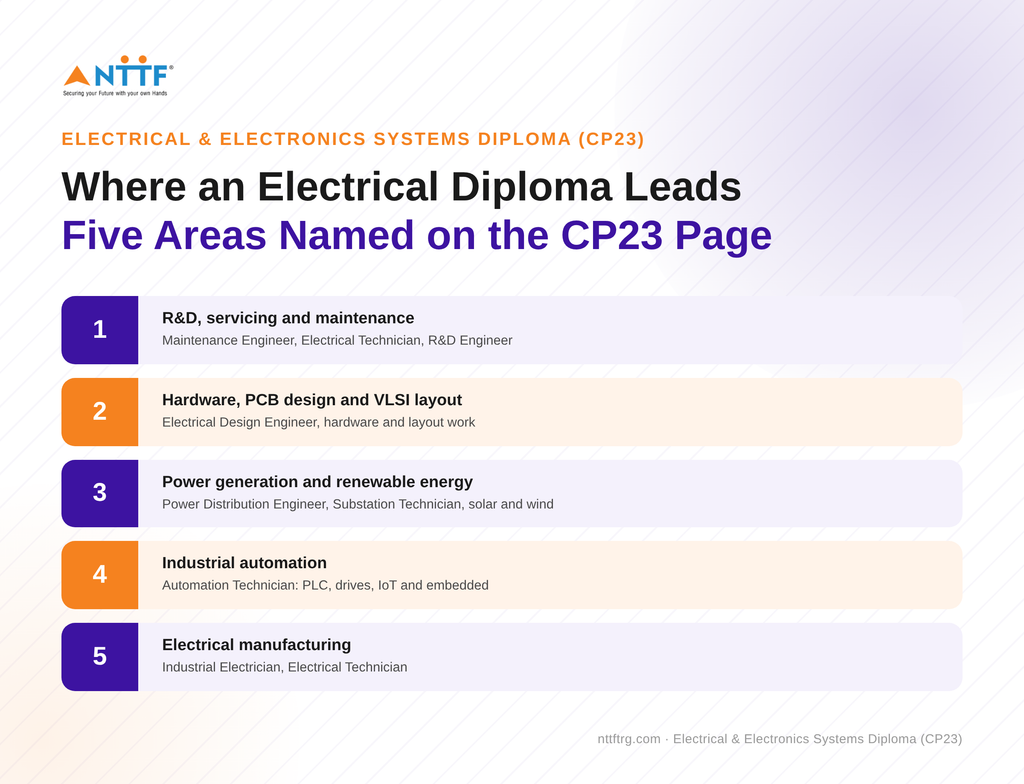
NTTF states a 98%+ placement record for CP23 and shows 44 recruiter logos on the page, including Tata Power, BHEL, Schneider, GE Power and Bosch. Logos show who has recruited from NTTF, not who hires this program every year. The Placements page lists 500+ recruiting companies and an average package of about ₹3.5 to ₹4 lakh a year across all programs, not CP23 alone. Ask the centre for the last CP23 batch: companies, roles and pay. For a general overview of the course, read What is a Diploma in Electrical and Electronics Systems?
What can you do after the diploma?
| Option | What to know |
| Start work | The roles above. NTTF’s own exit points come after Year 1 and Year 2 |
| 1-year post diploma: Industrial Automation (CP19) | The page lists a diploma in Electrical or Electronics. PLC, SCADA, robotics. No age limit |
| 1-year post diploma: Power Electronics (CP10) | The page lists a diploma in Electrical or Electronics Engineering. Power electronics, machines, PLC, PCB design. No age limit |
| Lateral entry into B.E. or B.Tech | Many universities admit diploma holders into the second year. Rules differ by university and state, so check each one |
CP23’s name joins electrical and electronics, while both post diploma pages name “Electrical” or “Electronics” separately, so confirm with admissions that you qualify. One route to avoid assuming: Embedded Systems and IoT (CP18) lists electronics, communication, instrumentation, computer and IT diplomas, not electrical. The Post Diploma programs page lists them all. To decide between working and studying more, read Post-Diploma vs Jumping Straight Into a Job.
Electrical or electronics diploma?
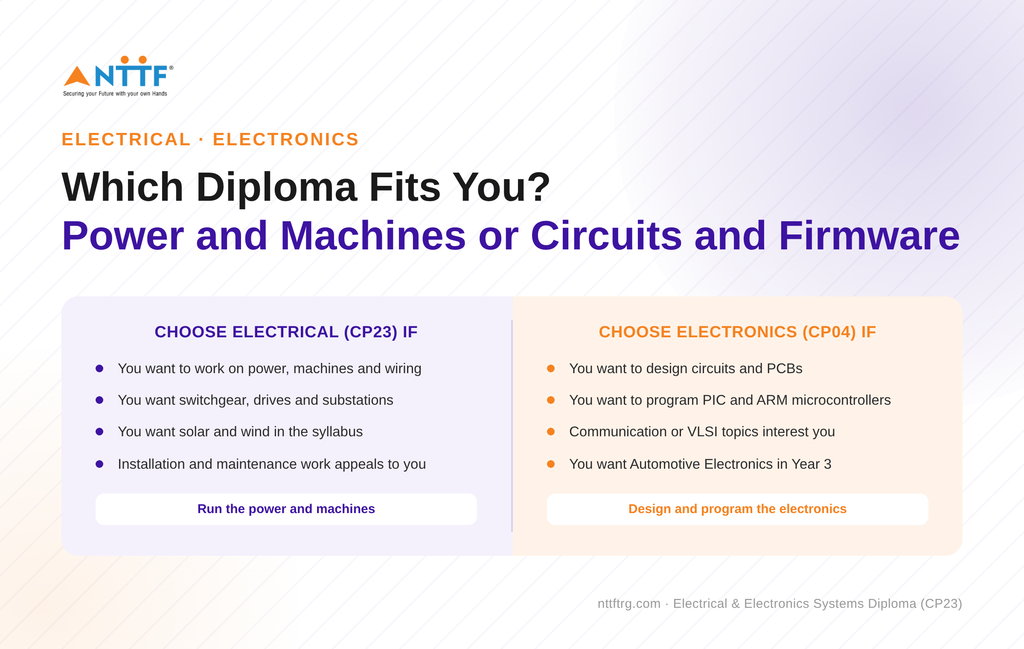
This is where an honest answer matters. CP23 leans to machines, power and installation. The electronics diploma leans to circuits, boards and firmware.
| Compare | Electrical & Electronics Systems (CP23) | Electronics & Embedded (CP04) |
| Strongest in | Electrical machines, power engineering, switchgear, drives, wiring | Circuits, PCB design, PIC and ARM microcontrollers, communication |
| Renewable energy | Solar and wind, Year 2 | Not listed |
| Power electronics | Power Electronics I and II, Year 3 | Industrial Electronics, Year 2 |
| PLC | Year 3 | Year 3 |
| Embedded and IoT | Embedded Systems and IoT, Year 3 | Embedded System and IIoT, plus PIC and ARM, Year 3 |
| EV link | No EV subject | Automotive Electronics, Year 3 |
| Pick it if | You want to work on power, machines, installation and maintenance | You want to design and program the electronics |
For the electronics side in detail, read Is a Diploma in Electronics Still Worth It in the Age of Automation?
Who can join the electrical diploma?
| Item | Details |
| After 10th | Pass 10th with Maths and the NTTF entrance exam. Maximum age 24. A free mock test is on the site |
| Lateral entry | Pass 12th or ITI with Science and Maths, plus the entrance exam. Maximum age 25. Some students first complete a bridge programme: 160 hours for 12th or PUC, 80 hours for an ITI in a non-relevant trade |
| Duration | 3 years, 6 semesters |
| Fee | Charged per semester. No amount is published. See the brochure |
| Recognition | NTTF lists a Level 4.5 NCVET diploma and an international diploma from NOCN UK for enrolled students. The FAQ also names MSDE |
| Campuses | Electronic City (Bengaluru), Jamshedpur (Burma Mines) and Gadag, per the enquiry form. Most centres have hostels |
| Contact | Toll-free 1800 103 6883 |
Frequently asked questions
Is a diploma in electrical engineering worth it after 10th?
Yes, if you want a practical career in power, machines or automation and are fine starting as a technician or junior engineer. NTTF’s CP23 is a 3-year diploma open after 10th with Maths. If you would rather design circuits and write firmware, compare it with the electronics diploma first.
Is a diploma in electrical engineering the same as an electrical and electronics diploma?
Students search both names. NTTF’s course is the Diploma in Electrical and Electronics Systems (CP23). It covers electrical machines and power systems along with electronics, microcontrollers, PLC and IoT.
Does the electrical diploma cover solar or EV?
Solar and wind, yes: they are two Year 2 subjects. EV, no: no EV subject is listed. Power Electronics I and II and Industrial Drives are the base for EV work, so ask the centre what EV exposure exists. The electronics diploma (CP04) lists Automotive Electronics.
What can I do after a diploma in electrical engineering?
Start work, take a 1-year post diploma in Industrial Automation (CP19) or Power Electronics (CP10), or look at lateral entry to B.E. or B.Tech. See the internship program for industry exposure during study.
A diploma in electrical engineering is a strong start for a practical career in power, machines and automation, and it fits students who like working with real equipment. It suits students who mainly want to design circuits or write firmware less well. If you like the power and machines side, start with the Diploma in Electrical and Electronics Systems (CP23). If you lean to circuits and firmware, look at CP04, or browse all diploma programs.