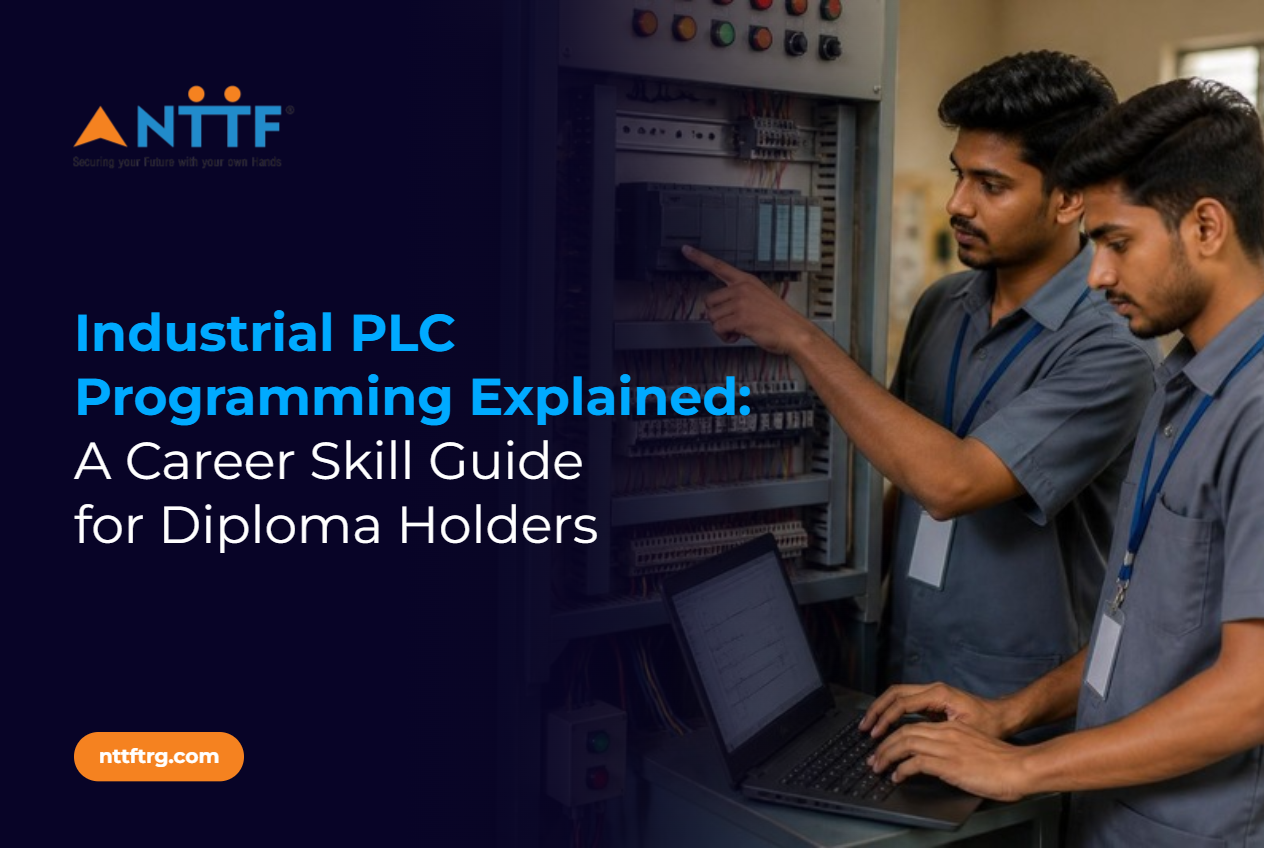
Walk onto any shop floor in Bengaluru’s Peenya industrial area, a Chennai automotive plant, or a Pune manufacturing unit, and the machine that is quietly running everything is not a computer with a screen and mouse. It is a grey metal box bolted inside a control panel, wired to sensors and motors, running logic that someone with a diploma wrote. That box is a PLC, and learning to program it is one of the most direct routes from a technical diploma to a paying job on the automation side of Indian manufacturing.
Here is what industrial PLC programming actually involves, what a diploma holder needs to be able to do with it, and where a structured program fits into that picture: an industrial automation PLC programming guide built from the outcome backward, covering what you actually need to know rather than padding out a generic checklist.
What a PLC Actually Does, in Concrete Terms
A Programmable Logic Controller reads inputs (a proximity sensor, a push button, a limit switch), runs a program against those inputs, and drives outputs (a motor contactor, a solenoid valve, an indicator lamp). It does this on a continuous scan cycle, often several times per second, for years without a reboot.
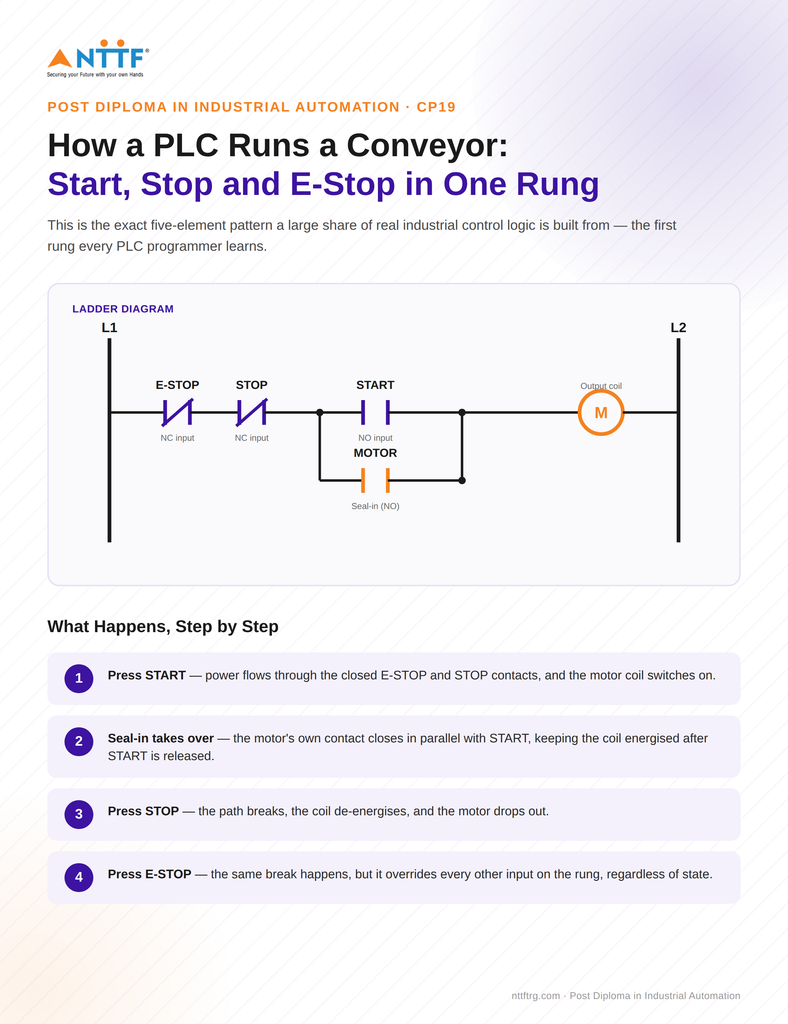
Here is a real example of what that looks like in practice: a conveyor with a motor start-stop and an emergency-stop interlock.
| Element | Role in the Logic |
| Start pushbutton (input) | Energises the motor coil, if the stop and E-stop conditions are not active |
| Stop pushbutton (input) | Breaks the circuit, de-energising the motor coil |
| Emergency stop (input) | Overrides everything else and force-stops the motor regardless of other inputs |
| Motor contactor (output) | Physically switches power to the conveyor motor |
| Seal-in contact | Lets the motor stay running after the start button is released |
That five-line logic block, written in ladder diagram form, is one of the first things every PLC programmer learns, because a large share of real industrial control logic is built from variations of exactly this pattern layered together.
Where a Diploma Holder Actually Starts
If you already hold a diploma in Electrical, Electronics, Mechatronics, or Instrumentation, you do not need to learn PLC programming from the concept of “what is a switch” or “what is a relay.” You have already covered that ground. What you actually need is the translation step: taking the relay logic you already understand and expressing it as rungs, timers, and function blocks on a specific PLC platform. That translation, not the underlying electrical theory, is where the real learning curve sits, and it is why PLC programming for beginners looks different for a diploma holder than it does for someone starting from zero electrical knowledge.
Why This Skill Specifically Matters for Diploma Holders Right Now
India’s PLC and automation job postings are not concentrated in one city or one sector. They show up wherever a plant has moved from manual or relay-based control to programmable control, which today includes automotive component manufacturing, FMCG packaging lines, pharma production, textile machinery, and power distribution.
- The brands doing the hiring use a small, learnable set of platforms. Siemens (S7-1200/1500), Allen-Bradley, Delta, and Mitsubishi PLCs cover most of the installed base in Indian factories. Learning ladder logic on one of these transfers with minor syntax differences to the others.
- Diploma holders are hired into technician and programmer-support roles that degree holders often skip. A B.Tech graduate is frequently steered toward design or management tracks; a diploma holder with PLC skills is the one actually commissioning and maintaining the panel on the floor.
- The pay-off is faster than a second degree. A diploma holder who adds a focused automation specialisation is job-ready in roughly a year, not the three to four years a fresh degree would take.
Ladder Logic, SCADA, and the Other Pieces You Actually Need
Ladder logic is the primary language, and it is visual by design: it mirrors the relay control diagrams that older electricians already know how to read, which is exactly why diploma holders with an electrical or electronics background pick it up quickly.
SCADA is the layer above the PLC. Where the PLC runs the real-time control logic, a SCADA screen is what lets an operator in the control room watch tank levels, motor status, and alarms without physically walking the plant floor. Employers rarely hire for PLC skills alone; SCADA and PLC training are usually bundled because a plant floor role touches both.
PC-based data acquisition is the third piece: systems that log sensor data over time for quality checks, maintenance scheduling, and compliance reporting. It is less visible than ladder logic but shows up constantly in process industries like pharma and food processing, where a plant has to prove, on paper, that a temperature or pressure stayed within range for the entire batch, not just at the moment someone happened to check.
Industrial robotics and DCS (Distributed Control Systems) sit one level further out. A PLC handles discrete, fast logic (start, stop, count, interlock); a DCS handles continuous process control across a large plant, coordinating dozens of loops at once. Most diploma-level automation training introduces both, because a technician who understands only PLCs will struggle the first time they are asked to trace a fault that originates in the DCS layer instead.
Where a Structured Program Beats Learning It Alone
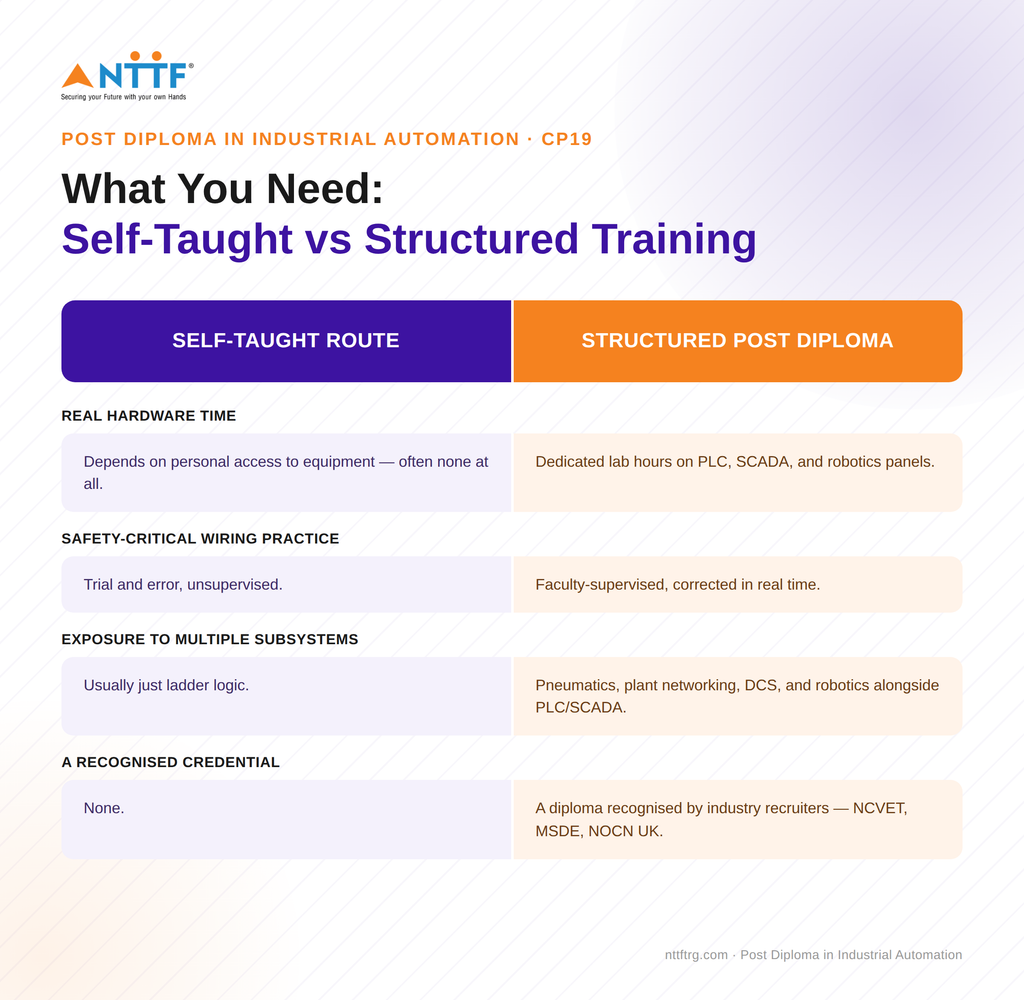
Free ladder-logic tutorials online can teach the syntax. What they cannot give you is time on an actual PLC panel, wired to real sensors and a real motor, with someone correcting your wiring before it becomes a safety issue. This is the gap a proper PLC programming course for diploma holders is built to close: not more theory, but supervised time with the same hardware you will meet on a real plant floor.
Where NTTF Fits Into This
NTTF’s Post Diploma in Industrial Automation (CP19) is built specifically around this gap. It is a one-year, two-semester program for diploma holders in Electrical, Electronics, Mechatronics, or Instrumentation (a B.Sc. in Electronics also qualifies), with no upper age limit on eligibility.
Program Facts
| Detail | Information |
| Program Name | Post Diploma in Industrial Automation (CP19) |
| Duration | 1 year, 2 semesters |
| Eligibility | Diploma in Electrical / Electronics / Mechatronics / Instrumentation, or B.Sc. Electronics |
| Age Limit | None |
| Hands-On Training | 75% of the program |
| Placement Record | 98%+ |
| Alumni Network | 65,000+ |
| Recognition | NCVET, MSDE, and NOCN UK |
What the two semesters actually cover:
- Pneumatics and Hydraulics
- Electrical Technology
- PLC and Plant Network
- Process Control Instrumentation
- SCADA
- Industrial Equipment Maintenance
- Automated Production Systems
- Industrial Robotics
- A DCS practical project on automation, where you build and run a working automated system rather than submitting a written report
The 75% hands-on split means the majority of the program is spent wiring panels, running SCADA screens, and troubleshooting faults that were deliberately introduced by an instructor, not reading slides about them. That is also why the program’s international recognition (NCVET, MSDE, NOCN UK) matters practically, not just as a line on a certificate: it signals to employers outside India, not only domestic recruiters, that the training meets a defined technical standard.
What the Job Actually Looks Like Afterward
These roles look different once you are actually in them:
- PLC Programmer: Writes and edits ladder logic or structured text for new machine functions, and modifies existing programs when a process changes.
- Automation Technician: Diagnoses why a machine stopped, checking sensors, wiring, and PLC inputs/outputs in sequence until the fault is found.
- SCADA Engineer: Builds and maintains the operator screens, alarms, and trend graphs that plant staff use to monitor the process.
- Industrial Robotics Technician: Programs and calibrates robotic arms, often working alongside the PLC that sequences the robot’s tasks with the rest of the line.
- Process Control Engineer: Tunes control loops (temperature, pressure, flow) so a process runs within its target range without manual intervention.
Companies that have hired automation-trained NTTF graduates for these functions include Bosch, Ford, Tata Steel, Toyota Kirloskar, and Schneider, spanning automotive, heavy engineering, and electrical equipment manufacturing.
What a Year of Structured Training Actually Buys You
The difference between self-taught ladder logic and a structured post diploma is not theory versus practice; both routes eventually get you writing working logic. The difference is what happens the first time something goes wrong. A self-taught learner debugging a faulty interlock on their own has to guess. A trainee doing the same thing on a supervised panel has an instructor who has seen that exact fault before, watching them fix it correctly, on hardware built to the same standard they will find on a real plant floor.
That supervised repetition, across a full year and multiple subsystems (pneumatics, plant networking, DCS, and robotics alongside PLC and SCADA), is what turns “I can write ladder logic” into “I can be handed a panel I have never seen before and figure out why it stopped.” That second capability is the one employer are hiring for, and it is also the one a recognised diploma signals to a recruiter before the interview even starts.
Explore NTTF’s Post Diploma in Industrial Automation (CP19) for the full curriculum, eligibility details, and campus information.
Further reading: Robotics, PLC, and SCADA: Mastering Industrial Automation After Diploma