
For most diploma holders, the immediate priority is simple: get on a job. That’s the natural first step, and it’s exactly what most students set out to do right after their diploma. But somewhere along the way, especially once you start exploring options, a nagging question comes up: should I do post diploma or job?
It’s one of the most common crossroads for diploma holders in technical fields, and there’s no one-size-fits-all answer. This blog breaks down the real post diploma vs job after diploma debate with a side-by-side comparison, so you can weigh post diploma salary vs diploma salary and decide what fits your goals.
Post Diploma vs Job After Diploma: Quick Comparison
| Parameter | Job Right After Diploma | Post Diploma Program |
| Time to first paycheck | Immediate | Extended advanced training by 1-year |
| Entry-level role type | Technician / junior operator / trainee | Design associate, automation engineer, systems specialist |
| Skill depth | Broad, foundational | Specialized, domain-specific |
| Placement support | Depends on employer | Structured, industry-tied |
| Career progression speed | Often plateaus without upskilling | Faster access to senior-track roles |
| Certification value | Diploma only | Diploma + specialized, globally recognized certification |
| Best suited for | Immediate financial need, clear job offers in hand | Long-term specialization, higher-responsibility roles |
Understanding the Two Paths
Job after diploma means stepping directly into the workforce as an entry-level technician, junior engineer, or trainee, applying what you learned in your diploma to real production floors, workshops, or service teams. You start earning immediately, begin building work experience, and get exposed to real industry problems from day one.
Post Diploma programs are advanced, specialized courses built specifically for diploma holders who want to go deeper into a high-demand technical domain: Tool Design, Industrial Automation, Power Electronics, or Embedded Systems and IoT. Unlike a general diploma, which builds a broad technical foundation, a Post Diploma program sharpens that foundation into specialized, industry-ready expertise. At institutions like NTTF, these are typically one-year, hands-on programs with strong practical training and dedicated placement support built into the course structure.
So the real post diploma vs job after diploma comparison isn’t “study vs. work.” It’s immediate income and experience vs. deeper specialization and stronger long-term positioning.
Job After Diploma: Pros and Cons
Pros:
- You start earning sooner, with no opportunity cost of an extra year without income
- You gain real-world experience early, on the shop floor, handling live projects
- You build your professional network from day one, shaping your career after diploma
- You avoid additional education costs and convert your diploma into income immediately
Cons:
- Without deeper specialization, you compete for a narrower band of entry-level roles
- Career progression can plateau earlier, especially in fields like precision manufacturing, automation, and tool engineering
- Advanced technical skill (the kind that separates a technician from a specialist) has to be built on the job, often more slowly
Post Diploma Program: Pros and Cons
Pros:
- Specialized, high-demand skillsets in automation systems, precision tooling, mould design, embedded systems, or power electronics
- Access to senior-track roles with more technical ownership from the start, one of the most underrated post diploma benefits
- Stronger placement positioning through structured industry tie-ups
- Compounding career value that feeds into supervisory, R&D, and leadership tracks later
- A stronger, internationally recognized profile that resonates with employers in India and abroad
Cons:
- One additional year before you start earning
- Requires clarity on which specialization you want to commit to
Post Diploma Salary vs Diploma Salary: What Actually Changes
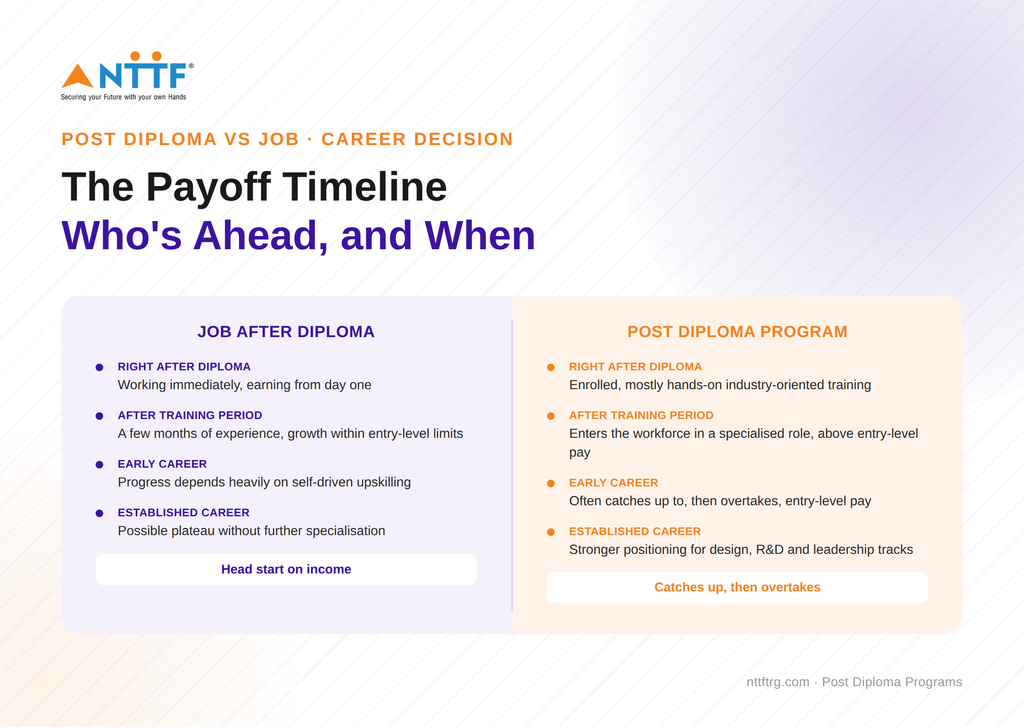
In other words: the job-first path has a head start on income and experience. The Post Diploma path trades that early start for a training period, then re-enters the workforce one level higher on the skill ladder, which is what tends to close and eventually reverse the gap as careers progress.
In the short term, a diploma holder who takes a job immediately has a head start: a year’s worth of income and experience while the Post Diploma student is still training. That’s real and shouldn’t be ignored.
But specialized skills tend to command better compensation because they solve a narrower, harder-to-fill hiring need. A general diploma holder competes in a wide talent pool; a Post Diploma holder with expertise in, say, industrial automation or embedded systems competes in a much smaller, more specialized pool, and specialized talent is typically priced higher.
Outcomes vary by industry, company, and individual performance. There’s no universal number that applies to everyone. This isn’t financial advice; it’s a framework for thinking about the trade-off.
Career After Diploma: Job or Further Study, How to Decide
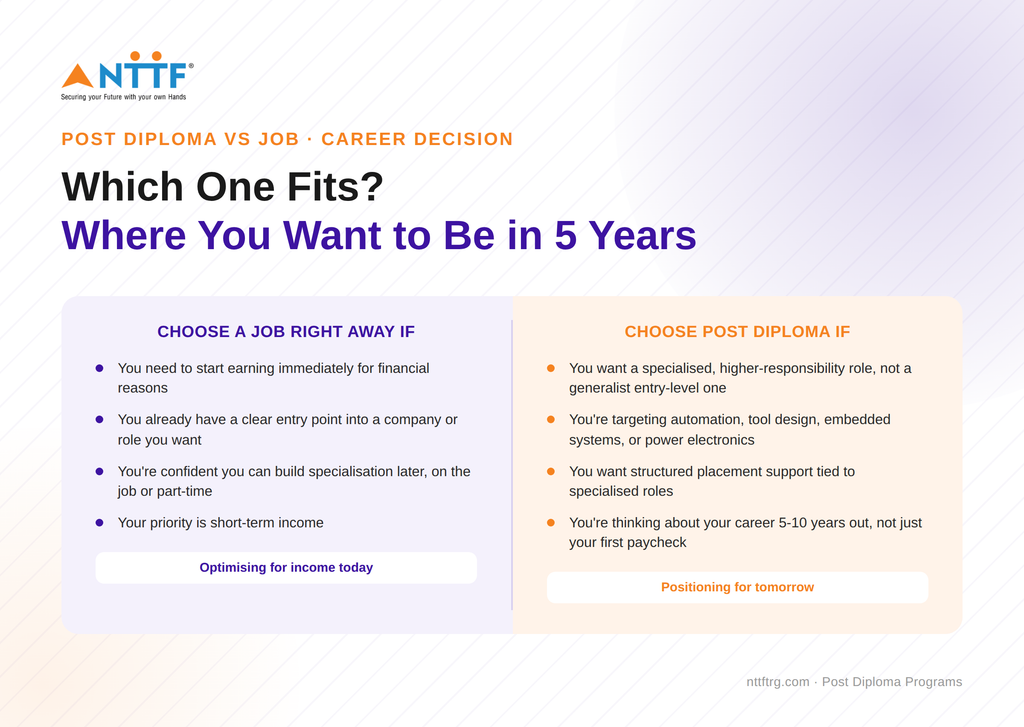
Whichever way you lean on should I do post diploma or job, this isn’t a judgment on the value of a diploma or of starting work early. Both are legitimate, valid paths that have launched strong careers. The question is simply which one aligns better with where you want to be in five years.
Eligibility to Keep in Mind
If you’re considering a Post Diploma route, eligibility typically requires a diploma in a relevant technical field. The specific requirements vary by program, so it’s worth checking the exact criteria for the specialization you’re interested in before applying.
The Bottom Line
There’s no universally “correct” answer to post diploma vs job after diploma. It depends on your financial situation, your career ambitions, and the industry you’re aiming for. What’s clear is this: if your goal is deep technical specialization, faster access to senior-track roles, and stronger long-term earning potential in fields like automation, tool design, or embedded systems, a Post Diploma program is built precisely for that transition, turning a solid technical foundation into recognized, in-demand expertise.
The choice isn’t about picking the “safe” option or the “ambitious” one. It’s about being honest with yourself on what you’re optimizing for: income today or positioning for tomorrow.
Ready to Specialize?
If deeper expertise, senior-track roles, and stronger long-term earning potential sound like the direction you want your career to take, NTTF’s Post Diploma Programs are built exactly for that next step. With 100% placement assistance, 70% hands-on training, 500+ industry tie-ups, and globally recognized certification, you don’t just gain a qualification. You gain a career accelerator.
Explore programs like Post Diploma in Tool Design, Post Diploma in Industrial Automation, Post Diploma in Embedded Systems and IoT, and Post Diploma in Power Electronics, and see which one matches where you want to be in five years.
Further reading: From Basic Tooling to Advanced Mould Design: What Post Diploma in Tool Design Teaches You · PLC & SCADA Training Course: What You’ll Learn, Skills Gained & Job Roles in 2027