Have you ever watched an excavator lift a mountain of soil in one smooth motion, or seen a factory robot arm pick, twist, and place parts without a single wasted second? Behind almost every one of those powerful, precise movements is a quiet pair of technologies working together: hydraulics and pneumatics.
This guide walks you through what hydraulics and pneumatics actually are, how they work, where they show up in daily life, what a good industrial automation course actually teaches, and what a career built around them can look like from industrial PLC programming roles to the wider post diploma careers in hydraulics now opening up across manufacturing.
What Exactly Are Hydraulics and Pneumatics?
Let’s keep this simple. Both hydraulics and pneumatics are ways of transmitting power using fluid, instead of gears, belts, or motors alone.
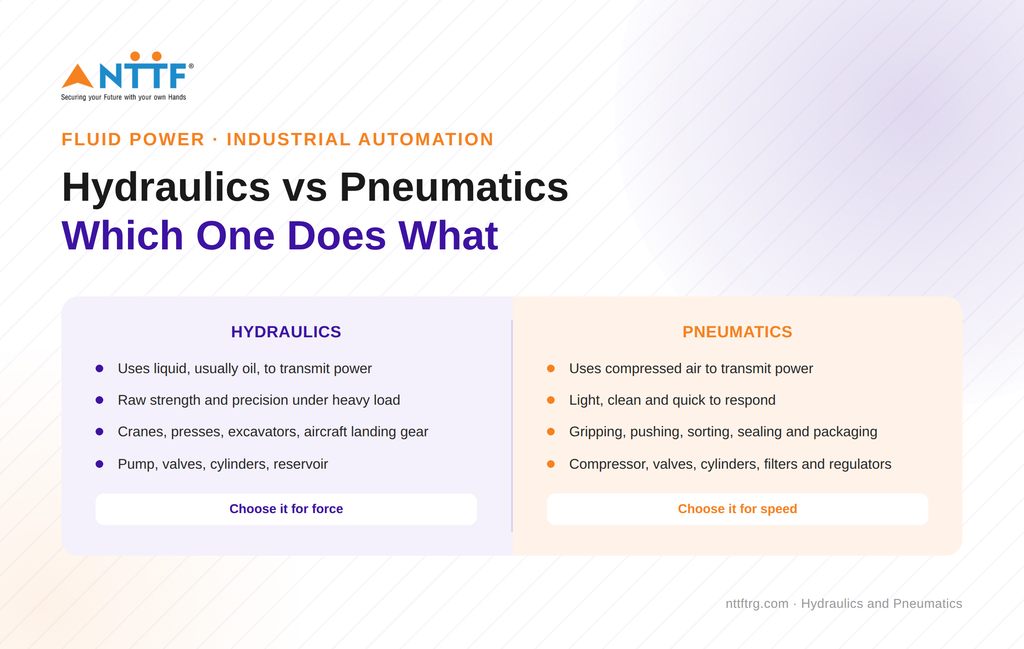
Hydraulics uses liquid usually oil pushed through pipes and cylinders to create strong, controlled force. Think of it as water pressure but engineered to lift a ten-tonne machine or press metal sheets into car parts. Because liquid barely compresses, hydraulic systems are known for their raw strength and precision. That’s why you’ll find them in cranes, presses, aircraft landing gear, and heavy earthmoving equipment.
Pneumatics, on the other hand, uses compressed air instead of liquid. Air is lighter, cleaner, and quicker to respond, which makes pneumatic systems ideal for fast, repetitive tasks think of the quick “hiss and click” you hear when a packaging machine seals a box, or when a robotic gripper picks up a component on an assembly line.
How Do These Systems Actually Work?
It helps to break each one down into its basic building blocks.
A hydraulic system typically has four main parts:
- A pump, which pushes oil through the system
- Valves, which control the direction and amount of flow
- Cylinders or actuators, which convert fluid pressure into physical movement
- A reservoir, which stores and cools the oil for reuse
The underlying idea comes from a simple scientific principle called Pascal’s Law pressure applied at one point in a confined liquid is transmitted equally throughout it. That’s how a small amount of force on a pump can generate enormous lifting power at the other end of a cylinder.
A pneumatic system works on a similar layout, but with air instead of oil:
- A compressor pressurises air and stores it in a tank
- Valves direct the compressed air where it’s needed
- Cylinders or actuators use that air pressure to create movement
- Filters and regulators keep the air clean and at a steady pressure
Because air compresses more easily than liquid, pneumatic systems tend to be faster and lighter, but slightly less precise under heavy load, which is exactly why engineers choose one system over the other depending on the job.
Hydraulics vs Pneumatics: Which One Does What?
A common question people have is why factories use both instead of just picking one. The honest answer is that each system is good at different things.
Hydraulics wins when a job needs serious force lifting heavy loads, pressing metal, or powering machinery that can’t afford to lose strength under pressure. Pneumatics wins when a job needs speed and simplicity, quick, repetitive motions like gripping, pushing, or sorting, where absolute strength matters less than reaction time.
Most modern factories don’t choose one over the other. They use both, often on the very same machine, matching each task to the system best suited for it.
The Brain Behind the Muscle: Where PLCs Come In
A hydraulic press or a pneumatic gripper doesn’t just move on its own. It needs instructions — when to extend, how far, how fast, and when to stop. That’s the job of a PLC, or Programmable Logic Controller.
Think of a PLC as the mission control for a machine. Engineers use industrial PLC programming to tell hydraulic and pneumatic components exactly what to do, in what sequence, and under what conditions, turning individual mechanical parts into a coordinated, automated system. Learning industrial PLC programming alongside fluid power fundamentals is what makes this skill set employable one without the other only tells half the story.
This is why hydraulics and pneumatics rarely get taught in isolation anymore. A technician who understands both the mechanical side and the programming side become far more valuable on any shop floor, because they can troubleshoot a problem from the pump all the way to the code that controls it. It’s this pairing, fluid power plus programmable control that sits at the core of a modern industrial automation course, and it’s exactly why choosing the right industrial automation course matters as much as the subject itself.
Where You’ll See These Systems at Work
It helps to picture where hydraulics and pneumatics show up in daily industrial life:
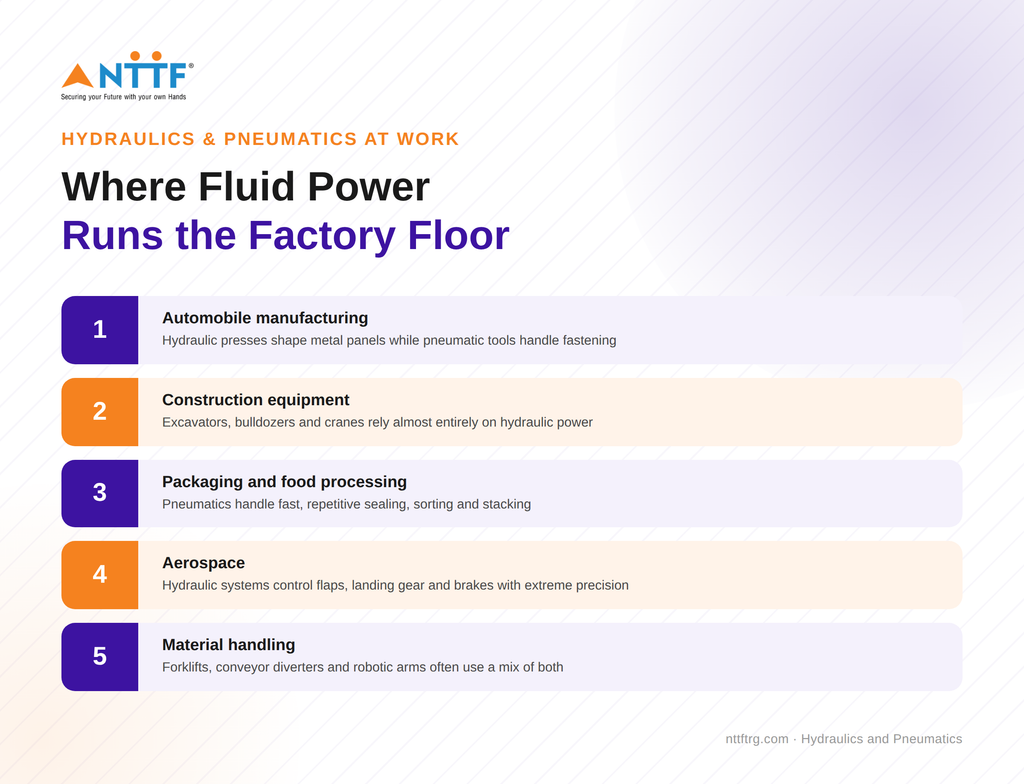
- Automobile manufacturing — hydraulic presses shape metal panels, while pneumatic tools tighten bolts with exact torque
- Construction equipment — excavators, bulldozers, and cranes rely almost entirely on hydraulic power for lifting and digging
- Packaging and food processing — pneumatic systems handle the fast, repetitive push-pull movements of sealing, sorting, and stacking
- Aerospace — hydraulic systems control flaps, landing gear, and brakes with extreme precision
- Material handling — forklifts, conveyor diverters, and robotic arms often use a mix of both
Once you start noticing this, you’ll realise hydraulics and pneumatics are everywhere quietly running the machines that build, move, and package almost everything around you.
Why an Industrial Automation Course Matters More Than Ever
Manufacturing today is shifting fast toward automation, and that shift isn’t replacing hydraulics and pneumatics, it’s making them smarter. Factories are combining old-school fluid power reliability with new-school programmable control, and someone needs to understand both worlds. This is exactly the gap a well-designed industrial automation course is meant to fill.
As industries invest more in automated production lines, demand keeps climbing for technicians and engineers who can bridge mechanical systems and digital control logic. It’s a genuinely future-facing combination practical enough to apply on day one, and advanced enough to keep growing with you. Enrolling in the right industrial automation course early on can shape the entire trajectory of a technical career.
Post Diploma Careers in Hydraulics: What the Field Actually Offers
Post diploma careers in hydraulics and automation are wide-ranging, and they only continue to grow as more factories move toward smart, connected manufacturing. Depending on your interests, some of the roles you could step into include:
- Electro-Mechanical Technician — maintaining and repairing hydraulic and pneumatic systems on production lines
- Automation Engineer — designing and programming control systems for automated manufacturing setups
- PLC Programmer — putting industrial PLC programming skills to work writing and debugging the logic that runs machines on the factory floor
- Robotics Engineer / Mechatronics System Designer — building the next generation of robotic and automated production systems
- Industrial Machinery Mechanic — keeping heavy equipment running smoothly across plants
- R&D or Build Engineer — working on the design and development side of automation solutions
These roles show up across a genuinely wide spread of industries: automotive, aerospace, defence, medical devices, consumer products, and materials processing. Because most machinery worldwide still depends on hydraulic or pneumatic power in some form, this isn’t a niche skill. It’s a foundational one that keeps you employable across sectors, and its exactly why post diploma careers in hydraulics are increasingly seen as a smart, stable choice for technically minded professionals.
Learning It the Right Way
Theory alone won’t make you job-ready in this field, hydraulics and pneumatics are hands-on subjects, best learned by wiring a circuit, bleeding a hydraulic line, or debugging a PLC program that isn’t behaving the way you expected.
NTTF’s Post Diploma in Industrial Automation is one place this training comes together, with Industrial Pneumatics & Hydraulics and PLC Basics taught alongside robotics, and automation, backed by heavily practical, workshop-based training. It’s one example of how this field is taught properly — but the bigger takeaway is this: whichever course you choose, look for one that puts you in front of real components, not just diagrams in a textbook.
Final Thoughts
Hydraulics and pneumatics aren’t old, outdated technologies waiting to be replaced. They’re the powerful, reliable core of modern machinery now getting smarter through automation and programmable control. Learning how to work across both the mechanical and digital sides of these systems doesn’t just teach you a subject. It opens doors to some genuinely rewarding, in-demand careers across manufacturing, construction, aerospace, and beyond.
If you’ve ever been curious about what really makes heavy machinery move and you want the skills to control that movement yourself this is a field worth exploring.
Further reading: Industrial PLC Programming Explained · PLC & SCADA Training Course